


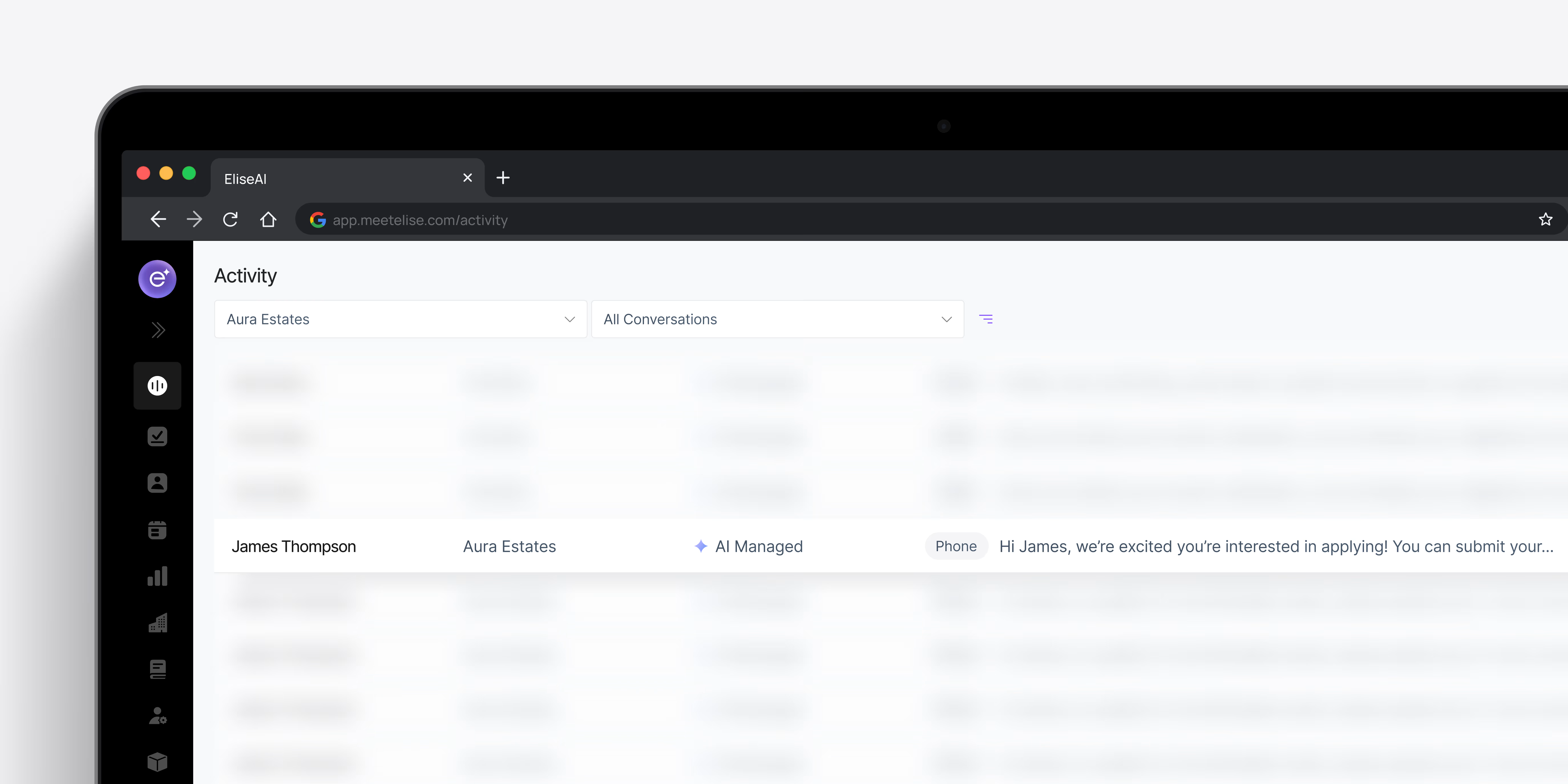
Looking to improve NOI in 2025 and beyond? Choose a multifamily CRM that speeds response, boosts lead-to-lease conversion, improves marketing ROI, and reduces onsite workload to increase occupancy, rents, and operational efficiency... like EliseCRM.
.svg)

Why Choosing the Right Multifamily CRM Matters
CRM selection directly affects leasing velocity and revenue: slow responses cost leads and wasted marketing spend. Research shows responding after 90 minutes can lose roughly half of potential leads, and waiting 48 hours can forfeit leases to faster competitors (see source). For example, luxury properties spending $600,000 on marketing can risk ~$300,000 in lost revenue when response times are poor.
The right multifamily CRM should deliver four measurable outcomes: faster response times, higher lead-to-lease conversion, improved marketing ROI through attribution and follow-up, and reduced manual workload for onsite teams—each translating to higher occupancy, stronger effective rents, and leaner operations.
Speed-to-lead—time from initial inquiry to first response—is the strongest single predictor of conversion; faster responses capture intent and protect marketing investments. Modern multifamily CRMs must handle mobile-first prospects, tour scheduling complexity, application workflows, and lean onsite staffing. AI-first platforms such as EliseAI demonstrate how automation can scale personalized engagement while preserving human handoffs.


Key Features to Look for in a Multifamily CRM
Prioritize systems tailored to rental workflows: automated responses, AI engagement, lead nurturing, PMS integrations, analytics, and scalability. These features directly improve conversion-related KPIs.
Fast Response Time and Automation
Response speed is critical: delayed replies cause substantial lead loss. Automation should provide immediate acknowledgments, intelligent SMS/phone routing, mobile-first staff notifications, and SLA dashboards to monitor compliance.
A typical effective flow: Inquiry received → automated reply within minutes → AI qualification or routing rules → assignment → follow-up sequence. Automated drip sequences (timed, triggered messages) keep prospects engaged without manual work.
AI-Powered Lead Engagement and Follow-Up
AI reduces manual effort, shortens latency, and scales personalized, multi-channel engagement. AI capabilities to evaluate include natural language processing for intent detection, multi-channel conversation management (SMS, chat, email, phone), escalation rules to human agents, and learning algorithms that improve over time.
Properties using advanced AI report 2–4 minute average responses and meaningful lifts in conversion—examples include reported 44.8% increases in lead-to-lease and AI handling of most initial inquiries—demonstrating how AI tackles high-volume routine interactions while reserving humans for complex closings (see case sources). An AI virtual leasing assistant can answer availability, schedule tours, and qualify leads to free onsite teams for high-intent prospects.
Lead Nurturing and Pipeline Management
Most prospects convert after multiple touchpoints; pipeline management ensures systematic progression through stages: new lead → engaged → tour scheduled → toured → application → approved. Each stage should trigger targeted actions and automation.
Lead scoring ranks prospects by engagement and fit using behaviors (website visits, responses, tours) and demographic signals (timeline, party size, budget). High scores get priority routing and more intensive outreach; lower scores enter longer-term nurture sequences.
Integration with Property Management and Marketing Tools
A multifamily CRM must integrate with PMS, marketing automation, website forms, listing portals, accounting systems, and resident portals to avoid silos and duplicate work. Essential attributes: real-time availability sync, accurate field mapping, and API access.
Performance Metrics and Reporting Capabilities
Reporting should surface conversion and efficiency metrics to optimize operations and demonstrate ROI. Core KPIs:
- Prospect-to-Tour Conversion Rate
- Tour-to-Application Rate
- Lead-to-Lease Conversion Rate
- Average Response Time (SLA compliance)
Dashboards should show SLA adherence, channel comparisons, and marketing spend-to-conversion ratios. Recommended cadences: daily SLA checks, weekly conversion tracking, monthly channel analysis, and quarterly strategic reviews.
Scalability and Customization Options
As portfolios grow, CRMs must support multi-property deployments, configurable workflows, and role-based access. Look for centralized reporting, API access, custom fields, and workflow customization for property-specific needs (e.g., affordable housing vs. luxury vs. student housing). Vendor experience with large deployments, documented onboarding, and ongoing support are essential for enterprise rollouts. See EliseAI’s prospect management for an example of adaptable automation.
Steps to Select the Best Multifamily CRM for Your Needs
A structured selection reduces risk and aligns the vendor to measurable business outcomes. Typical timelines: 30–90 days for selection and 90–180 days for implementation and optimization. Involve stakeholders early and focus decisions on outcomes rather than feature lists.
Assess Your Property Management and Leasing Requirements
Start with a baseline assessment: lead volume by source, average response times, channel mix (phone, SMS, web chat, email), mobile lead percentage, funnel conversion rates, and marketing attribution accuracy. Use a gap analysis to map current state to desired outcomes and prioritize initiatives.
Research and Compare CRM Solutions with Industry Focus
Prioritize vendors with proven multifamily expertise, measurable outcomes, and references from similar property types. Compare AI depth, integrations, case studies, scalability, pricing models, and implementation support.
Request and Evaluate Product Demonstrations
Use demos to validate real-world capability with standardized scripts: import sample leads, simulate missed lead scenarios, test mobile responsiveness and notifications, verify reporting exports, and show integrations with your tools. Score demos on usability, automation intelligence, reporting, integration reliability, AI quality, and mobile optimization. Obtain sandbox access or trials for hands-on testing.
Verify Integration and Workflow Compatibility
Test critical integrations: availability sync, lead routing, application status updates, resident record creation, financial reporting, and marketing attribution. Create an integration acceptance checklist covering field mapping, sync latency, error handling, data security, and API documentation. Engage IT and compliance early to avoid privacy or technical issues.
Consider Long-Term Scalability and Support
Evaluate vendor support for growth: multi-tenant deployments, user provisioning, SLAs for uptime and support, onboarding resources, training, and roadmap transparency. Request references for similar-scale customers and compare cost-of-growth models (per-unit vs. fixed tiers) to estimate break-even for automation benefits.
Make an Informed Decision with Stakeholder Input
Use a weighted decision matrix reflecting business priorities (example weights: AI 30%, integrations 20%, UX 20%, TCO 15%, support 15%). Pilot at 1–3 properties before full rollout and track KPIs (response time, tours, application completion, staff time saved) plus qualitative usability feedback. Define go/no-go criteria and schedule ROI reviews at 30, 60, and 90 days.
Best Practices for Implementing a Multifamily CRM
Implementation succeeds when technical configuration and user adoption align. Prioritize early wins, measure adoption alongside conversion improvements, and iterate based on data and frontline feedback.
Onboarding and Training Leasing Teams
Train teams with phased, role-based programs and micro-learning modules: system basics, mobile workflows, escalation rules, and dashboard interpretation. Include account setup, mobile testing, workflow walkthroughs, and reporting orientation. Measure adoption via daily active users, AI vs. human message share, time-to-first-response, and brief user satisfaction surveys. Provide office hours and champions for ongoing support.
Establishing Automated Workflows and Lead Scoring
Convert business rules into automation starting simple and adding complexity over time. Foundational workflow: capture → AI triage → schedule or nurture → application assistance → approval handoff → move-in coordination.
Design lead scoring combining behavior (visits, opens, tours) with demographics (timeline, party size, budget) and document logic for transparency.
Continuous Monitoring and Optimization of Lead Management
Maintain a monitoring cadence: daily SLA checks, weekly conversion analyses, monthly channel reviews, and quarterly strategy sessions. Use A/B testing for messages, cadences, and channels (e.g., SMS vs. email for segments). Provide dashboards for central teams and onsite staff, and align incentives by linking automation gains to reduced workload and improved results. Capture qualitative feedback to surface conversion drivers not visible in metrics.
Leveraging AI Insights for Operational Efficiency
Use AI to surface common objections, optimal tour times, channel preferences, and seasonal trends. Apply insights to staffing, messaging, tour availability, and personalized follow-ups. Reported outcomes from mobile-first AI workflows include faster application completion and shorter approval-to-lease times, showing AI can deliver measurable operational gains (see source).
Measuring Success: Evaluating CRM Performance and ROI
Track leading and lagging indicators, establish baselines before implementation, and translate improvements into dollar impact. ROI components include incremental leases from higher conversion, reduced marketing waste, labor savings from automation, and total cost of ownership.
Primary KPIs:
- Average Response Time: move from hours to minutes
- Lead-to-Lease Conversion Rate: measure across sources
- Prospect-to-Tour Conversion Rate
- Tour-to-Application Rate
Convert improvements into annual value (example): raising lead-to-lease from 15% to 25% on 1,000 annual leads at $1,500 average monthly rent yields ~$180,000 additional annual revenue.
Factor in cost of inaction: slow response and poor lead management can consume a large share of marketing budgets, making CRM investment both defensive and growth-oriented.
Frequently Asked Questions
What features should a multifamily CRM have for effective lead management?
Centralized lead tracking, automated follow-up and drip campaigns, intelligent lead scoring and pipeline management, mobile-optimized staff and prospect workflows, analytics dashboards for key funnel metrics, and seamless PMS/marketing integrations.
How can AI improve lead response times and conversion rates?
AI qualifies leads instantly, answers common questions, schedules tours, and runs consistent follow-up sequences—cutting response from hours to minutes and preserving prospect intent to improve conversions.
Can a multifamily CRM integrate with existing property management systems?
Yes—modern CRMs provide real-time sync, field mapping, and APIs for custom integrations, eliminating duplicate entry and keeping data consistent across systems.
How do I measure the return on investment for a new CRM?
Set baselines, track KPI improvements (response time, conversion rates, attribution), convert performance gains to dollar impact, and include labor savings and reduced marketing waste in ROI calculations.
What is needed to ensure easy adoption by onsite teams?
Role-based micro-training, mobile-first workflows, champion programs, visible dashboards showing early wins, and ongoing support to demonstrate how automation reduces workload rather than replaces staff.