


OpenAI Launches Healthcare Products—And Names EliseAI as a Trusted Partner
OpenAI made waves this week with the launch of OpenAI for Healthcare, a suite of products designed to help healthcare organizations deliver more consistent care while supporting HIPAA compliance. OpenAI specifically named EliseAI—the only patient-facing VoiceAI solution featured—for automating patient scheduling and communications at scale.
This recognition validates what leading practices already know: conversational AI isn't experimental anymore. It's essential infrastructure for managing patient access, reducing call abandonment, and freeing clinical staff from administrative burden. When the company defining the future of AI spotlights EliseAI, it confirms our position as the proven standard for healthcare VoiceAI.
For practices evaluating AI solutions, OpenAI's announcement raises a critical question: what separates a purpose-built platform from generic tools adapted for healthcare?
.svg)

The Healthcare AI Moment—And What It Demands
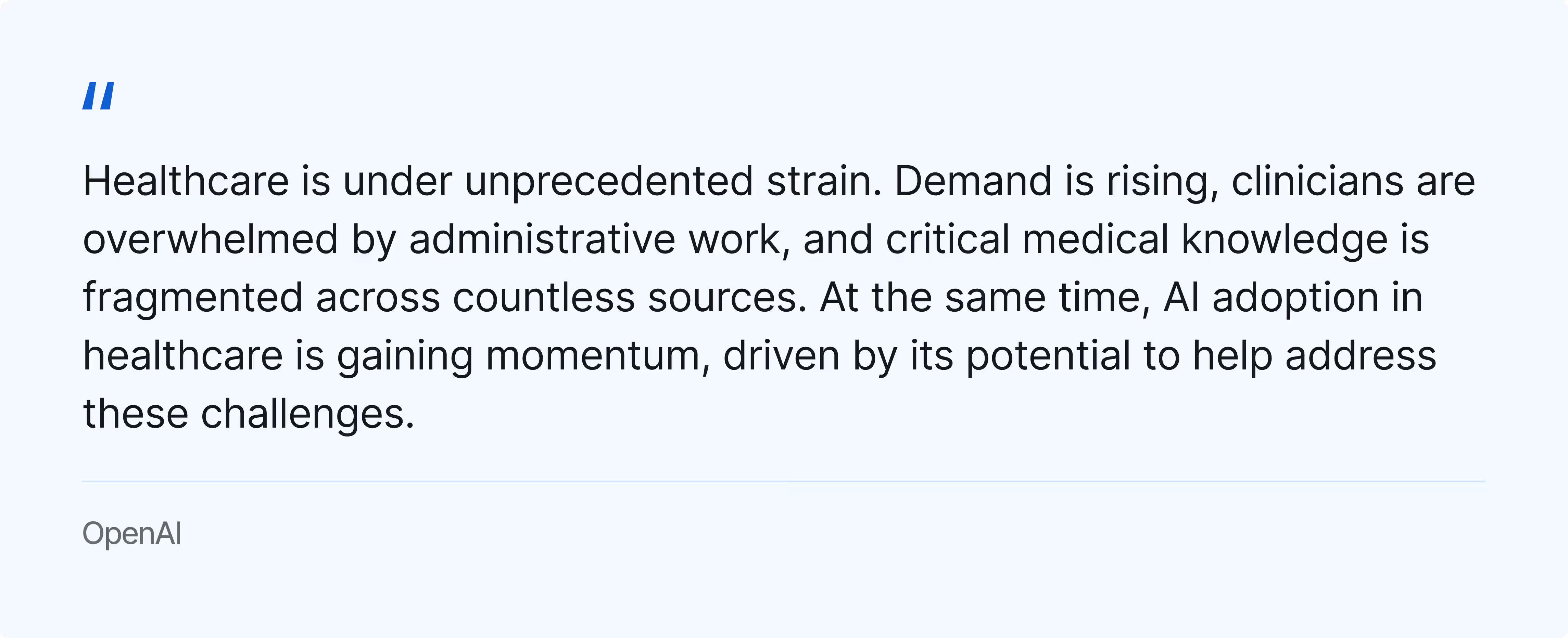
As OpenAI noted in their announcement, "demand is rising, clinicians are overwhelmed by administrative work, and critical medical knowledge is fragmented." This operational strain isn't new to medical practices. Front desk teams field hundreds of patient calls daily while managing scheduling, insurance verification, appointment changes, and general inquiries. Clinical staff spend hours on routine administrative tasks instead of patient care.
The difference today is that conversational AI technology has matured enough to handle the complexity and nuance healthcare operations require. But not all AI platforms are built for this reality.
.avif)


Why Medical Practices Need Purpose-Built VoiceAI
Generic chatbots and broad AI platforms face a fundamental challenge in healthcare: they weren't designed around the specific workflows, compliance requirements, and operational constraints of medical practices. Healthcare isn't a use case you can bolt onto consumer technology—it requires deep understanding of specialty-specific processes, EHR integrations, and patient communication patterns.
EliseAI's VoiceAI platform was purpose-built for healthcare operations from the ground up. We've processed over 100 million patient conversations across dermatology, women's health, orthopedics, and ophthalmology practices nationwide. That scale creates something generic platforms can't replicate: proven, specialty-specific workflows that understand the difference between urgent orthopedic care coordination and routine dermatology follow-ups.
This specialization also means practices can implement call automation quickly—often going live within 30 days—because the workflows are already built for their specialty rather than configured from scratch.
The Operational Impact Medical Practices Actually Need
Healthcare AI adoption ultimately comes down to one question: does it solve the operational problems preventing your practice from scaling efficiently? EliseAI's VoiceAI delivers outcomes that matter:
Patient access without additional headcount. Practices using EliseAI handle appointment scheduling, cancellations, rescheduling, and routine inquiries automatically—with direct EHR integration through platforms like athenahealth, ModMed, Nextech, and AdvancedMD. Patients reach your practice instantly, 24/7, while your staff focuses on in-office care.
Staff time returned to clinical work. Women's Health Connecticut reduced inbound call volume by 52% after implementing VoiceAI. Kansas City Skin & Cancer Center saves 14+ staff hours daily on routine communications. These aren't marginal efficiency gains—they're structural improvements that let clinical teams do the work they were hired for. Measuring this impact accurately requires tracking the right metrics from day one.
Revenue capture from missed opportunities. Traditional call centers can't answer calls outside business hours or during peak volume periods. VoiceAI captures these after-hours appointment requests, urgent rescheduling needs, and patient inquiries that would otherwise go unanswered—converting missed calls into scheduled appointments and preserved revenue.
Proven Solutions vs. Promising Technology
The healthcare AI landscape now includes consumer-facing tools like ChatGPT Health alongside enterprise platforms like OpenAI for Healthcare. These represent important advances in medical AI capabilities. But medical practice operations require something different: systems proven to handle the specific, repetitive, high-volume communications that consume front desk capacity every day.
EliseAI's track record speaks to this distinction. We've automated patient communications at scale across dermatology, women's health, orthopedics, and ophthalmology practices, maintaining HIPAA compliance, integrating with complex EHR systems, and delivering consistent outcomes across diverse practice sizes and patient populations. Each specialty brings unique operational demands—from benign pathology result calls in dermatology to urgent orthopedic injury coordination—and purpose-built VoiceAI handles these distinctions reliably.
For practice managers and operations leaders evaluating healthcare AI, implementation speed matters. Purpose-built platforms get practices operational in weeks rather than months because the infrastructure, workflows, and compliance frameworks already exist.
What Operational Excellence Actually Enables
When routine patient communications run autonomously, practices unlock growth potential that headcount constraints previously limited. Adding providers, opening new locations, or expanding service lines no longer requires proportional front desk staffing increases. VoiceAI creates operational capacity that scales with patient volume automatically.
This matters for multi-location groups, MSOs, and PE-backed practices pursuing growth strategies across dermatology, women's health, orthopedics, and ophthalmology. Operational efficiency isn't just about cost reduction—it's about removing the administrative barriers that limit clinical capacity and patient access.
The Proven Platform Advantage
OpenAI's healthcare launch reinforces what forward-thinking practices already understand: AI integration is no longer a question of if, but which solutions deliver proven outcomes for healthcare operations. The distinction between experimental technology and proven platforms matters more than ever.
EliseAI's 100+ million patient conversations and specialty-specific expertise represent the kind of proven track record the industry needs as healthcare AI adoption accelerates. Purpose-built solutions that understand the operational realities of medical practices will continue to drive meaningful outcomes—while generic platforms work to catch up.