


Ready to Streamline Your Operations?
Book a demo to see how EliseAI automates communication, reduces workload, and delivers real results.
Increase in Overall Work Order Completion
Faster Median Speed to Complete Work Orders
Weekly Work Order Assignment Time Savings
PRG Real Estate is a Philadelphia-based vertically integrated investment and property management firm, with over 11,000 units under management across the Southeast and Midwest. PRG operates across diverse property types—from luxury mid-rise buildings to traditional garden-style Class B and C communities—and has built a reputation for both improving asset value and delivering exceptional resident experiences. This commitment to quality extends throughout the organization, and no place more so than maintenance. The men and women of the maintenance team embody this standard, priding themselves on fast work order completion times and exceptional service standards that keep renewal rates high and residents happy.
Despite strong operational performance, PRG’s maintenance operations faced a significant technology gap. The company hadn't made a substantial investment in work order technology in over a decade, leaving maintenance teams relying on printed work orders and cumbersome manual processes that impacted their ability to deliver service at scale. As a devoted technologist with his finger on the pulse of the multifamily industry’s shift towards software-enabled operations, Brad Fitzpatrick, Chief Technology Officer at PRG, first identified the tech gap while doing due diligence into PRG’s existing maintenance operations.
For PRG's maintenance teams, the daily reality of work order management looked a lot like it had for the past decade. Maintenance supervisors like Aaron Spaulding started each day by printing out work orders, physically distributing them to technicians, and spending 30-45 minutes manually scheduling and assigning tasks across their teams. Getting in touch with residents required techs to navigate a maze of phone calls, first dialing the leasing office, waiting for someone to answer, having that person relay information to the resident, then hoping for a callback. Often, this meant technicians had to return to the office mid-day just to look up phone numbers and make calls from the office line in order to get permission to enter units, coordinate repairs, and discuss fixes with residents.
This pen-and-paper approach created significant inefficiencies that rippled across PRG’s operations. Time spent managing communications took technicians away from actually completing repairs and maintaining properties. The leasing office constantly fielded maintenance-related calls and information requests, pulling them away from touring and leasing activities. Residents experienced delays in communication and updates about their work orders, with limited visibility into when technicians would arrive or when jobs were complete.
With maintenance technician turnover rates regularly averaging 45-50% across the multifamily sector, it’s easy to see the part technology and workflow issues play in driving that level of attrition. Brad quickly realized that not having modern tools to make technicians' jobs easier incurred an increased risk of losing valuable talent to competitors offering better working conditions, and made it his mission to find a better way for PRG’s technicians to work.
Brad and the PRG Real Estate team were already familiar with EliseAI from their usage of various products including LeasingAI, ResidentAI, VoiceAI, and Delinquency, which made the decision to test EliseAI’s Maintenance App a no brainer. The results of the rollout went better than PRG could have hoped.
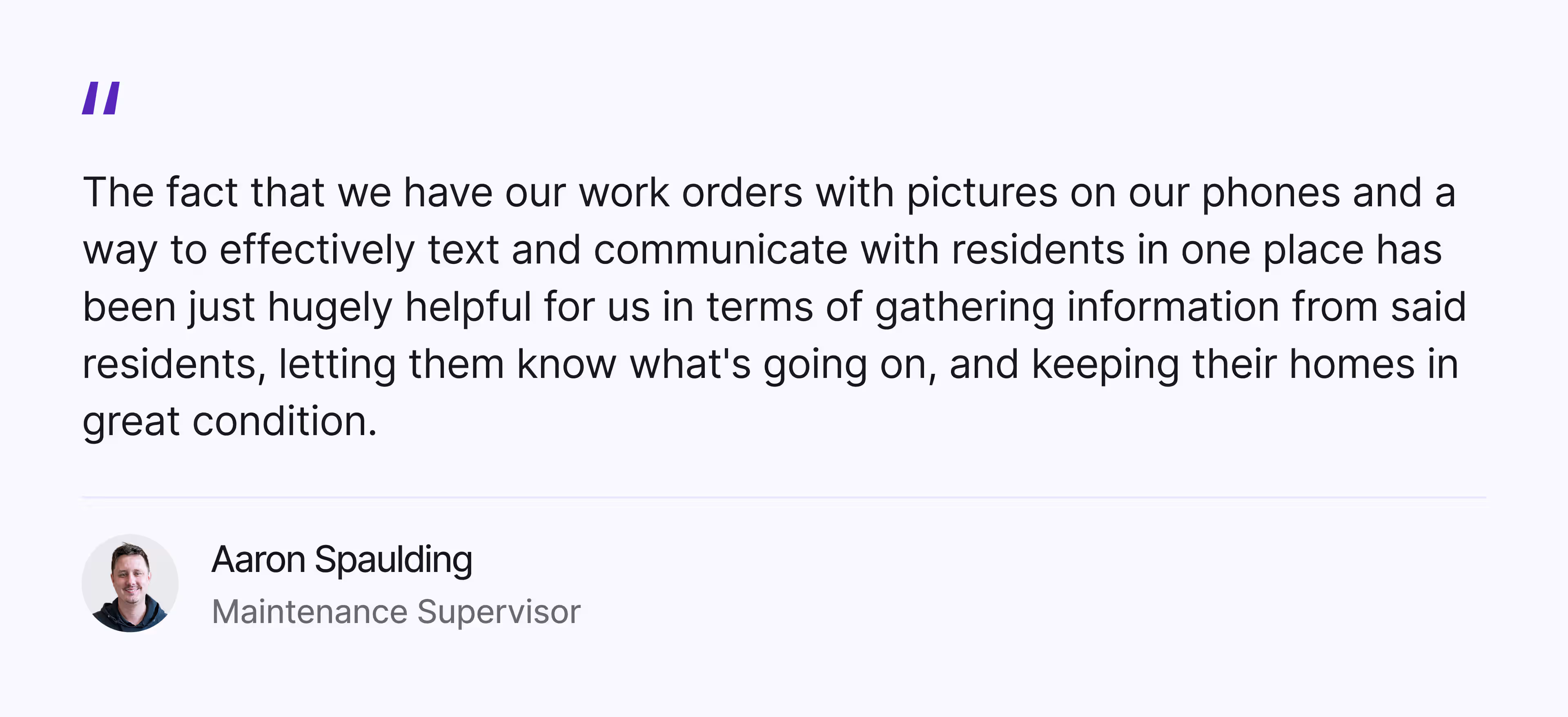
PRG approached their Maintenance App deployment with the same methodical strategy that had driven success with other EliseAI products. Starting with a pilot program in spring 2025, they selected Aaron Spaulding—a maintenance supervisor who had raised his hand to be an early adopter—to test the platform at his property. This deliberate choice gave PRG Real Estate an initial advocate who could provide honest feedback and help refine the implementation process.
After validating success with their eager adopters, PRG expanded to properties with more skeptical maintenance supervisors. Brad and PRG’s leadership specifically chose team members they knew would be critical of new technology to test the platform's true usability. The result? Even the slow-to-adopt technicians quickly became converts, telling leadership that the app genuinely made their jobs easier. Today, eight properties use the Maintenance App, with plans in motion to subsequently deploy across the entire PRG portfolio.
The features that resonated most with PRG's maintenance teams centered on resident communication and scheduling. The Maintenance App enables technicians to communicate directly with residents via text from their phones, with work orders displaying photos and all relevant information in one place plus built-in translation capabilities for Spanish speaking techs. The platform automatically notifies residents when technicians start and complete work orders, eliminating the need for manual updates and phone tag with the leasing office.
The Maintenance App has also dramatically improved the day-to-day work of maintenance supervisors like Aaron. Supervisors using the Maintenance App can now simply click and drag cards in the platform to assign work orders instead of printing and physically distributing paper assignments. Having work orders pre-assigned each morning saves roughly 45 minutes of administrative work daily per community, allowing maintenance supervisors to focus on site walks and other strategic initiatives.
PRG is also working along EliseAI to further develop the Maintenance App's inspection capabilities for move-in and move-out processes. These detailed inspection reports will help their newly established centralized team to process move-outs and deposit accounting in a timely manner. It will also provide their collections team with the information required to investigate charge disputes. Further, the platform's ability to create work orders in real-time during inspections eliminates the previous process of conducting paper inspections, returning to the office, and manually entering work orders; effectively cutting the effort in half and expediting coordination with vendors.

The measurable impact of the Maintenance App at PRG has been significant. The initial property they rolled out the tool on saw a 25% increase in overall work order completion in Q3 2025 compared to Q3 2024, a substantial increase that reflects either improved operational efficiency, better resident engagement due to simplified work order creation, or both. Critically, this increase in volume came without any impact on performance. PRG's maintenance teams maintained their rapid average completion times and high completion rates, proving that the new platform enhanced rather than hindered their ability to work effectively.
Beyond the numbers, the qualitative improvements have been equally important. Maintenance technicians report spending less time on administrative tasks and more time on property beautification, preventive maintenance, and inventory management. The ability to handle resident communications efficiently means technicians can focus on the physical work rather than playing phone tag or tracking down contact information. Aaron specifically noted that residents now submit work orders in clusters—reporting two or three issues at once rather than calling about problems one at a time—because the platform makes it so easy for them to communicate, simplifying the work order assignment process.
The technology has also proven its value through what it hasn't done: create problems. Throughout the pilot and expansion phases, PRG's maintenance supervisors never reported being unable to complete work orders because of the app, never experienced significant delays due to the platform, and never found their work orders "messed up" by the technology. For Brad and team, this consistency was the key litmus test that proved the Maintenance App was ready for broader deployment.
Looking ahead, PRG plans to continue expanding the Maintenance App across their entire portfolio while exploring additional functionality. The company is particularly interested in tracking how the impact of the Maintenance App improves technician retention, which could prove even more valuable than operational efficiency gains in an industry facing severe skilled labor shortages. By investing in technology that empowers their maintenance teams to do what they do best, PRG Real Estate continues to position itself to attract and retain the maintenance talent needed to ensure their assets continue to deliver high-quality resident experiences.

Brad Fitzpatrick is the Chief Technology Officer at PRG Real Estate, where he drives the company’s technology vision, strategy, and operations. Since joining PRG in 2015, he has leveraged his expertise in network and server infrastructure, disaster recovery, and IT consulting to lead transformative enterprise-wide initiatives. His leadership has modernized PRG’s technology landscape through projects such as unifying communications on a single VoIP platform, migrating identity services to the cloud, implementing advanced network management, enhancing cybersecurity, and adopting AI-enabled solutions across multiple business functions.

Aaron Spaulding is a dedicated maintenance professional with over 6 years of facility management expertise. After serving in the United States Marine Corps Aaron joined PRG Real Estate in 2019, where he combines a fastidious and detail oriented mindset, team leadership skills, and strong resident relationship management skills to deliver incredible living experiences at PRG’s assets.

Book a demo to see how EliseAI automates communication, reduces workload, and delivers real results.