
Built to Automate & Scale Your Operations
Answer a couple of questions and we'll connect you with the right team member.
Answer a couple of questions and we'll connect you with the right team member.


Higher Collection Rates for Operators Using One AI for Maintenance + Collections
Higher Average Occupancy Rates for Operators w/One AI Across the Renter Lifecycle
Decrease in Average Lead-to-Lease Timeline for Operators Who Use AI for Maintenance
30 years ago, proptech vendors digitized property operations. The databases and accounting softwares like PMSes that emerged became the foundation of multifamily tech stacks. Now, with the advent of strong AI, tech stack orientation is shifting. So what is the future of multifamily tech? How should operators adapt? And what will the “foundation” of tech stacks look like in the age of AI?
In this whitepaper, we examine industry trends and look carefully at the current state of multifamily technology to answer these questions. Our finding: operators who reorient their tech stacks around “one AI,” or an interconnected AI system that spans the entire prospect-through-resident lifecycle, achieve outsized results as their “one AI” shares context, learns over time, and executes at scale, automating greater quantities of work and freeing onsite teams for value-add activities.
EliseAI tested this thesis by comparing asset performance for operators on a “one AI” architecture (who use AI products that touch every aspect of the prospect-through-resident lifecycle) versus those using individual products (focused on only certain sections of that lifecycle). Our data shows that those operators who have embraced this “one AI” architecture by deploying AI throughout the renter lifecycle realize significant NOI outperformance relative to their peers, including:
The crucial takeaway is this: as AI moves from point solution to foundational operating infrastructure, the operators who put “one AI” at the center of their operating model in order to seamlessly access, learn from, and autonomously act on internal data are well positioned to outperform their peers. This change requires adapting their operating models to fit the strengths of “one AI” rather than attempting to layer AI into existing databases and systems of record. As AI tools create compounding gains powered by self-learning, context-awareness, and workflow execution, forward-thinking operators who adapt their businesses to the “one AI” model will be best equipped to enact long term structural changes to multifamily operating models like the ones digitization ushered in, conferring unique benefits on the experience of residents, teams, and businesses.

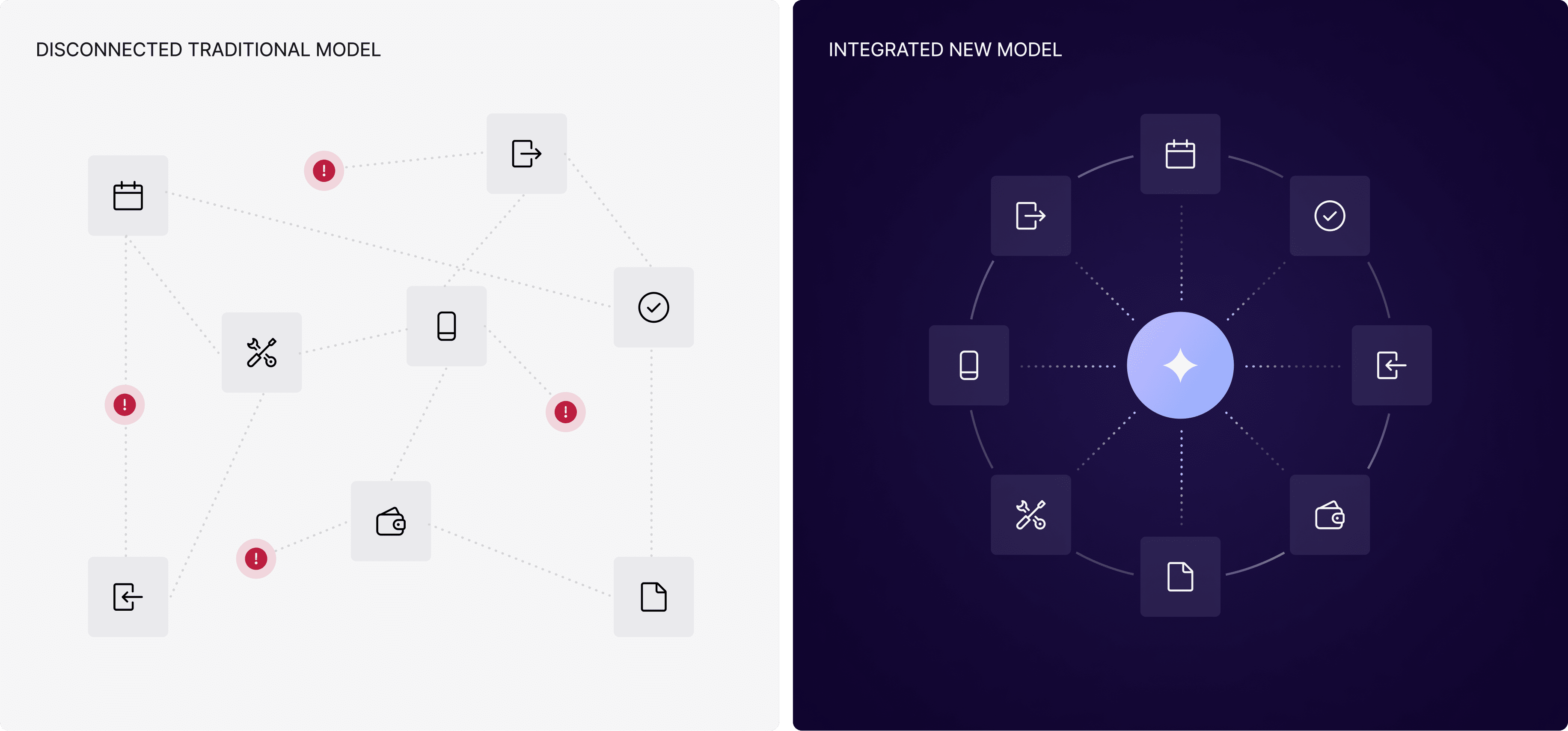
Forty years ago, guest cards were written by hand, rent rolls were kept in filing cabinets, and residents mailed paper checks on the first of the month. PropTech has made all of those processes a thing of the past, reorienting the multifamily operating model around digital ledgers and accounting software. But while the digitization wave started by PropTech providers helped operators build repeatable processes, it also created a lot of noise and new administrative work for operators. Today, the modern onsite team member is buried in disparate platforms, logins, and handoff queues, with many digital solutions creating more work than they can handle. This is where AI comes in, as an execution-focused layer that automates most of the administrative busywork our teams find themselves drowning in. That has spurred many operators to embrace an AI-first operating model, reinventing the orientation of their tech stacks.
Yet, as operators go about making this a reality, many organizations are faced with a simple question: why not just use out-of-the-box AI tools that were produced by the same vendors who produced your PMS? To explain why this strategy is problematic, we look to a housing-related analogy. Office-to-residential conversions seemed like a slam dunk way to both capitalize on a downturn in office demand and a shortage of affordable housing, but many of these office assets were not structurally prepared to become residences. Those that were required significant infrastructural changes to meet the needs of renters vs. workers, oftentimes costing more to retrofit than the cost of a new construction would have been. This “retrofitting tax” is no different than what an operator should expect to encounter when trying to use AI that’s built right into their PMS architecture, because these systems were designed to be managed by people, not AI.
PMS solutions have relied on humans to serve as the connective glue between systems, taking handoffs, doing manual work, and pushing the information back into the PMS, instead of being built to have AI deployed directly into them. An integrated AI system needs to be able to interface with many of these different systems of record, interpret information, and make decisions, all under the parameters and guidelines established by the operator. That’s where the need for “one AI” architecture begins to come into focus.
In One AI architecture, a central, integrated AI connects all systems of record and integrations seamlessly, and becomes the hub that connects systems, teams, and residents with real time data and execution-focused workflows. With One AI that touches every component of the prospect-through-resident lifecycle, eliminating operational blindspots, integrating context from interactions, and improving automation rates over time, operators have the visibility and freedom they need to run their businesses exactly how they want. This is the philosophy behind the development of EliseAI as a One AI platform, learning, executing, and giving operators complete control over their operations with a single brain and shared intelligence.
At the core of the “One AI” thesis is the concept of self-learning. Across industries, AI allows systems to self-improve over time. In production, knowledge is always limited at the start. The question is whether the AI is able to understand when it doesn’t know the right answer, hand off, and then learn from the human response. This allows it to help close its own gaps instead of pushing that work onto operators.
An integrated AI system should accumulate knowledge from every interaction throughout the resident lifecycle, from first inquiry to move out, and ensure that context follows the resident from day one to renewal to departure without ever losing the crucial operational context that makes a difference in the level of service delivered to residents. AI point solutions have crucial gaps that prevent end-to-end context building, missing entire parts of the resident lifecycle (like renewals or work order management), which paint an incomplete picture of the resident journey.
Unlike AI point solutions that log tickets for humans and create more work, agentic AI products actually complete workflows end-to-end. The ability to seamlessly act on data from a variety of sources, leveraging context developed from self-learning, enables integrated AI solutions to achieve higher automation rates than multifamily AI solutions that focus on one specific part of the renter lifecycle without key context.
Being able to execute as opposed to simply creating more work for onsite teams makes an impact on so many levels: residents’ journeys are more straightforward, as they are able to resolve issues instantly. Teams can focus on the resident experience, rather than managing the handoffs from disconnected AI solutions. Operators can reliably manage their communities at peak performance levels, maximizing NOI and mitigating personnel-related inconsistency that drags on asset performance. At the root of this all is execution—execution that requires context, self-learning, and customization that fits the unique needs of each individual operating model.
Integrated AI platforms give operators the ability to set configurable goals and exceptions, allowing them to tailor the AI agents’ behavior to meet the unique needs of their businesses. Whether it’s customizable leasing objectives, modifiable qualification thresholds, or customizable team-based routing and escalation, these tools allow multifamily teams to better enact the strategies they need to meet their business goals. Operators using One AI architecture can run their businesses exactly how they want, creating consistent and seamless customer experiences that meet the expectations of the modern consumer. At the end of the day, the barometer for what a “good” consumer experience won’t be measured against the leasing process at the community down the street—it will be measured against the frictionless consumer experiences created by brands like Amazon, Netflix, and Uber. Control and one AI are the fastest path to replicating those experiences.
It’s also important to note how these three foundational pillars reinforce the functioning of each other. Consistent learning informs better execution through the development of context. Execution generates data points and edge cases that feed learning capabilities. Unprecedented control allows operators to dictate both how their AI learns, and how it executes. Together, these three foundational building blocks allow operators to fundamentally reshape the way their teams work, rather than slightly improve traditional ways of working.
Nowhere is that more clear than in the synergistic performance gains operators who have embraced the “One AI” approach are already realizing today.
Our analysis of a sample of EliseAI customers using varying amounts of EliseAI solutions crystalizes the divide between the operators who are truly embracing a “one AI”-centered management model, and those who aren’t. On average, across the millions of units live on EliseAI products, operators who leverage 3 or more EliseAI products realize 2.5 percentage point higher occupancy rates. But the synergistic gains don’t end there.
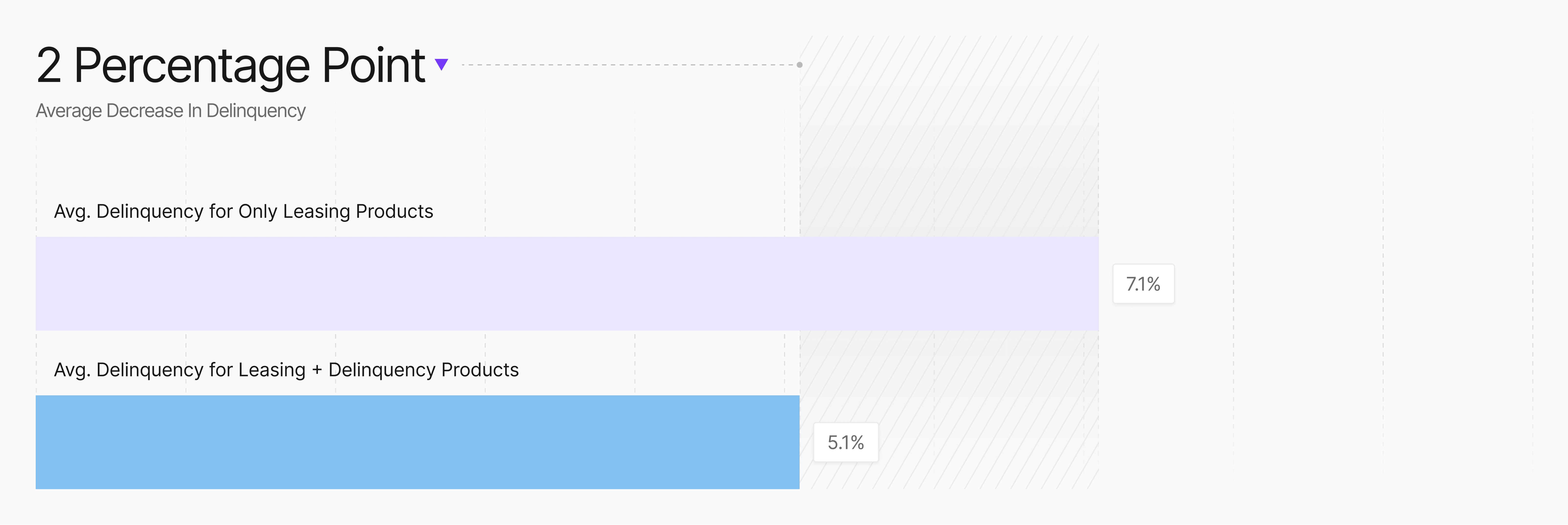
When comparative collection rates are analyzed, the compounding gains of the Delinquency and LeasingAI products versus the Delinquency product alone strongly supports the need for One AI infrastructure. As these products interact to provide additional learning and execution opportunities, we can see that this amplifies their impact, improving both resident quality and financial outcomes.
What creates this impact? For one, LeasingAI intelligently prequalifies applicants, ensuring higher-quality residents and reducing delinquency risk across portfolios. DelinquencyAI provides a real-time feedback loop to leadership on leasing performance, empowering data-driven decisions around screening rigor, eviction processes, and operational efficiency. And residents whose first contact at your community was a leasing concierge are far more likely to respond to the resident concierge, given the expectation you set from the beginning that working with the AI is the quickest and easiest way to get help at your assets.
This results in a 2 percentage point decrease in average delinquency rates for customers who deploy both products, driven by the synergy between proactive screening and informed portfolio management.
Just as having LeasingAI turned on improves the performance of the Delinquency tool, having the maintenance suite (MaintenanceAI + the Maintenance App) can help LeasingAI truncate lead-to-lease timelines. Maintenance Products and LeasingAI create a seamless connection between different operational functions, unlocking faster unit turns.
With the Maintenance App providing real-time visibility into unit availability through continuous maintenance status tracking, operators can expedite unit turn to increase leasing velocity and minimize vacancy loss.
MaintenanceAI automates work order creation and management to free up onsite staff, allowing teams to focus on high-value leasing activities. Together, these synergistic effects result in an average 1.44-day improvement in leasing velocity, or 11.4% of the overall average leasing cycle, reducing vacancy loss by ensuring units are filled faster.
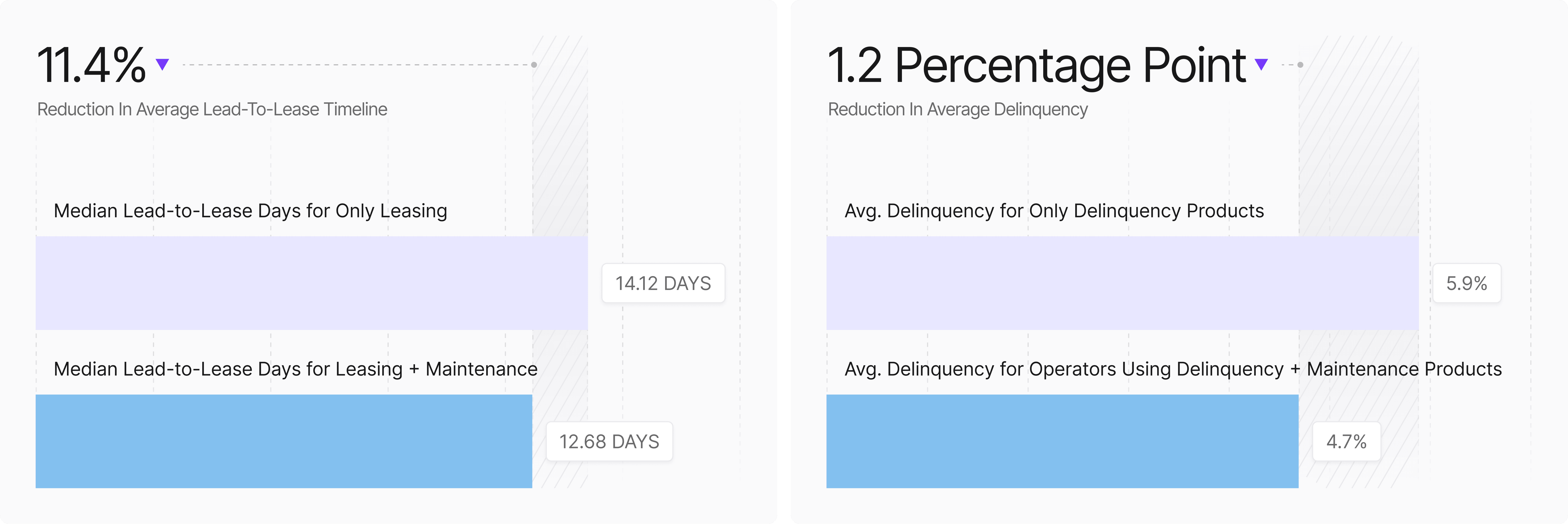
The same synergistic effects apply for the MaintenanceAI product and the Delinquency tool. When an integrated AI can leverage maintenance and delinquency together, onsite teams have the support they need to resolve issues faster and recover more revenue.
DelinquencyAI proactively follows up on outstanding maintenance-related charges and coordinates based on work order status, ensuring nothing falls through the cracks. MaintenanceAI closes the loop by addressing maintenance concerns surfaced in DelinquencyAI conversations, resolving the root causes that may lead residents to withhold rent. Together, they pull collection rates up, ensuring the resident feels heard and supported both during the maintenance and delinquency processes.
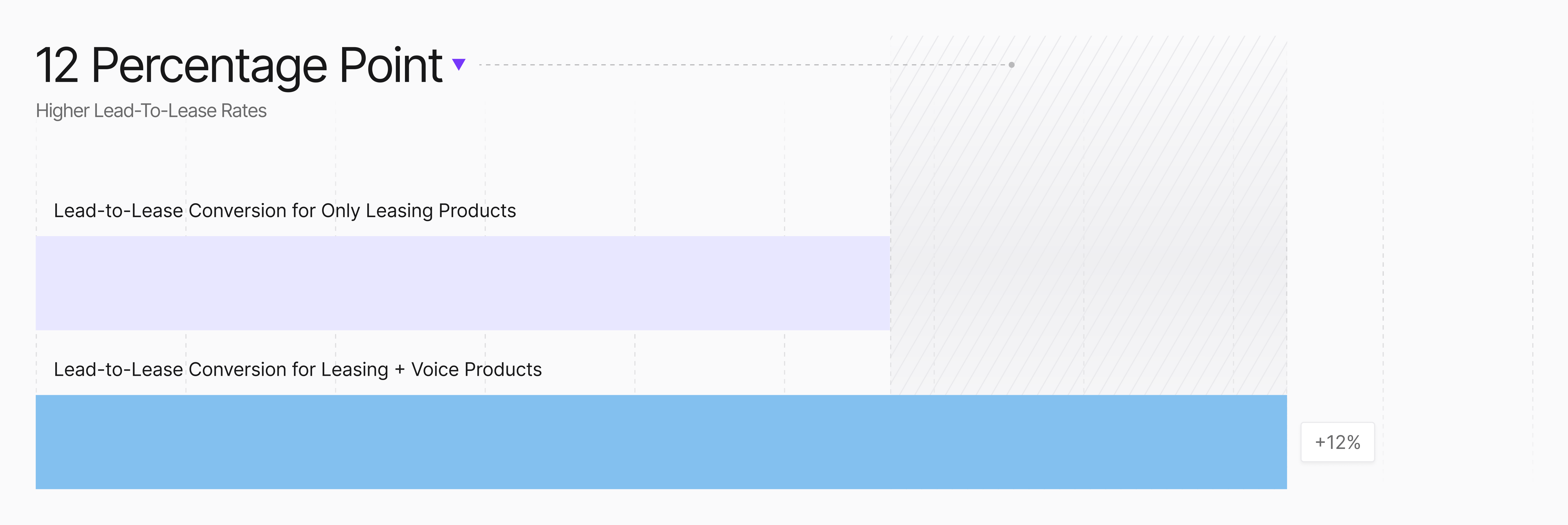
With EliseAI’s Mystery Shopping Report demonstrating nearly 30% of calls to leasing offices on average go unanswered, the rationale for rolling out VoiceAI is clear. When you add in the fact that inbound call leads have a higher likelihood to be qualified leads than those received via webchat or email, that rationale is even stronger. With 100% of those high intent call leads captured by VoiceAI, we see the synergistic impact on leasing velocity, with operators who use VoiceAI alongside LeasingAI achieving 12% higher lead-to-lease rates for the operators who use LeasingAI alone.
Operators who leverage the comprehensive set of EliseAI tools outperform other operators in a crucial area: renewal rates. Those who use all EliseAI products, including LeasingAI, Delinquency, RenewalsAI, and Maintenance, created seamless, AI-powered rental experiences that span the entire prospect-through-resident lifecycle. From initial tour scheduling conversations with a LeasingAI-powered concierge, through their first RenewalsAI-powered renewal cycle, to the first time they’re able to seamlessly open a work order by texting the Maintenance product, these operators create integrated, consumer grade experiences for their residents with no holes, handoffs, or delays. These renters get what they need, when they want it, on their own time as a result of interfacing with one execution-focused, self-learning, and controllable AI.
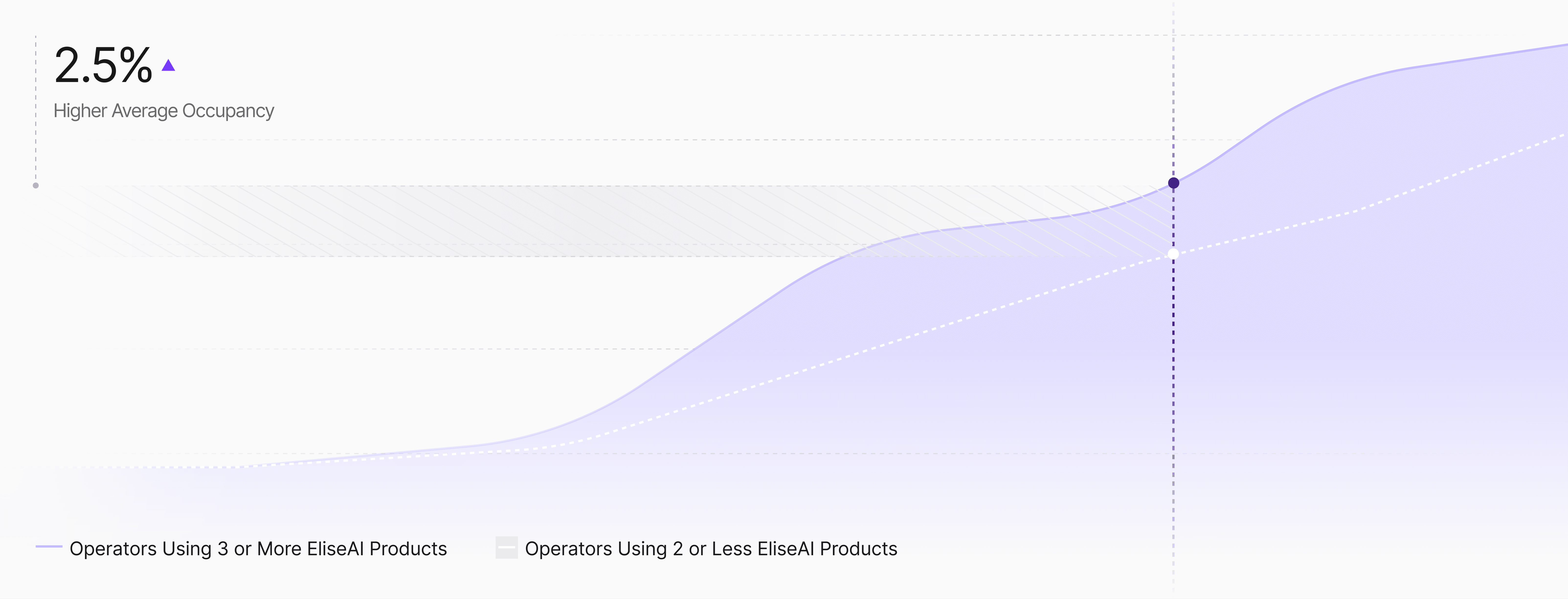
This all culminates in the 2.5% higher average occupancy rates operators using 3 or more EliseAI products see versus their peers who use 2 or fewer. With over half of EliseAI customers using three or more products the sample size for this segment is substantial, and the strongest proof point for the value of the One AI approach.
All data for this comparative analysis was derived by comparing accounts on multiple connected EliseAI products to accounts on individual EliseAI products, adjusting for factors including operator type, housing type, and other characteristics to ensure apples-to-apples similarity.
In order to harness the gains associated with greater integration of AI into multifamily operating models, operators must rethink both the way data is stored and the way their systems speak to each other. At the root of that is the need to have One AI.
With 9 years developing purpose-built AI tools across the entire prospect-through-resident lifecycle, EliseAI has a significant head start in establishing a robust One AI architecture for the multifamily industry.
EliseAI’s products have been trained on over 300M resident and prospect interactions, giving our tools a massive breadth of awareness and context with many complicated edge cases already learned and developed into the product. The mix of customization, control, and self-learning means EliseAI’s products outperform all other solutions on the market, letting the compounding gains from a 9 year head start inform the future of our product development.
The EliseAI team isn’t coasting off that head start, however. EliseAI produces new solutions and tools with the aforementioned AI-native velocity, with 450+ product and feature releases and updates per year. EliseAI has successfully brought a variety of new AI-powered products to market (AI-Guided Tours, The Maintenance App, Lease Audits, and more) quickly to meet the demands the multifamily industry and of modern renter expectations.
The lessons from this data and system of action approach offer operators a few key practical takeaways as they go to incorporate One AI infrastructure into their operations. Here’s how you can get started comparing vendors as you build a One AI action plan.
Step One: Identify gaps in your current AI coverage. Find any aspects of your prospect-through-resident lifecycle, whether it’s maintenance, collections, or move-ins, that aren’t currently automated by AI tools.
Step Two: Analyze whether or not the existing AI products you use are resulting in compounding gains. Are your handoff rates going down over time? If your AI tools aren’t creating cross-workflow impact and automating more work than they’re creating, you will not be able to recognize ROI from those solutions.
Step Three: Evaluate AI vendors to close these gaps based on their system architecture and pace of innovation. Ensure you’re asking questions about how these AI products touch every aspect of the prospect-through-resident lifecycle.
It’s important to note that the window to build on an AI-native operating model is measured in years, not decades. The early movers who integrated One AI into the center of their operations are already realizing long-term, compounding advantages that continue to extend with the rapid pace of AI development.
Having One AI that learns across workflows, executes end-to-end, and gives operators control is a key component of embracing a new operating model that removes tedious work from the plates of your teams and gives them time back to make an impact on residents’ lives. EliseAI data makes it clear that the operators who've adopted this integrated AI approach are pulling ahead, proving that there’s no better time than now to embrace an operating model built around One AI.
Forty years ago, guest cards were written by hand, rent rolls were kept in filing cabinets, and residents mailed paper checks on the first of the month. PropTech has made all of those processes a thing of the past, reorienting the multifamily operating model around digital ledgers and accounting software. But while the digitization wave started by PropTech providers helped operators build repeatable processes, it also created a lot of noise and new administrative work for operators. Today, the modern onsite team member is buried in disparate platforms, logins, and handoff queues, with many digital solutions creating more work than they can handle. This is where AI comes in, as an execution-focused layer that automates most of the administrative busywork our teams find themselves drowning in. That has spurred many operators to embrace an AI-first operating model, reinventing the orientation of their tech stacks.
Yet, as operators go about making this a reality, many organizations are faced with a simple question: why not just use out-of-the-box AI tools that were produced by the same vendors who produced your PMS? To explain why this strategy is problematic, we look to a housing-related analogy. Office-to-residential conversions seemed like a slam dunk way to both capitalize on a downturn in office demand and a shortage of affordable housing, but many of these office assets were not structurally prepared to become residences. Those that were required significant infrastructural changes to meet the needs of renters vs. workers, oftentimes costing more to retrofit than the cost of a new construction would have been. This “retrofitting tax” is no different than what an operator should expect to encounter when trying to use AI that’s built right into their PMS architecture, because these systems were designed to be managed by people, not AI.
PMS solutions have relied on humans to serve as the connective glue between systems, taking handoffs, doing manual work, and pushing the information back into the PMS, instead of being built to have AI deployed directly into them. An integrated AI system needs to be able to interface with many of these different systems of record, interpret information, and make decisions, all under the parameters and guidelines established by the operator. That’s where the need for “one AI” architecture begins to come into focus.
In One AI architecture, a central, integrated AI connects all systems of record and integrations seamlessly, and becomes the hub that connects systems, teams, and residents with real time data and execution-focused workflows. With One AI that touches every component of the prospect-through-resident lifecycle, eliminating operational blindspots, integrating context from interactions, and improving automation rates over time, operators have the visibility and freedom they need to run their businesses exactly how they want. This is the philosophy behind the development of EliseAI as a One AI platform, learning, executing, and giving operators complete control over their operations with a single brain and shared intelligence.
At the core of the “One AI” thesis is the concept of self-learning. Across industries, AI allows systems to self-improve over time. In production, knowledge is always limited at the start. The question is whether the AI is able to understand when it doesn’t know the right answer, hand off, and then learn from the human response. This allows it to help close its own gaps instead of pushing that work onto operators.
An integrated AI system should accumulate knowledge from every interaction throughout the resident lifecycle, from first inquiry to move out, and ensure that context follows the resident from day one to renewal to departure without ever losing the crucial operational context that makes a difference in the level of service delivered to residents. AI point solutions have crucial gaps that prevent end-to-end context building, missing entire parts of the resident lifecycle (like renewals or work order management), which paint an incomplete picture of the resident journey.
Unlike AI point solutions that log tickets for humans and create more work, agentic AI products actually complete workflows end-to-end. The ability to seamlessly act on data from a variety of sources, leveraging context developed from self-learning, enables integrated AI solutions to achieve higher automation rates than multifamily AI solutions that focus on one specific part of the renter lifecycle without key context.
Being able to execute as opposed to simply creating more work for onsite teams makes an impact on so many levels: residents’ journeys are more straightforward, as they are able to resolve issues instantly. Teams can focus on the resident experience, rather than managing the handoffs from disconnected AI solutions. Operators can reliably manage their communities at peak performance levels, maximizing NOI and mitigating personnel-related inconsistency that drags on asset performance. At the root of this all is execution—execution that requires context, self-learning, and customization that fits the unique needs of each individual operating model.
Integrated AI platforms give operators the ability to set configurable goals and exceptions, allowing them to tailor the AI agents’ behavior to meet the unique needs of their businesses. Whether it’s customizable leasing objectives, modifiable qualification thresholds, or customizable team-based routing and escalation, these tools allow multifamily teams to better enact the strategies they need to meet their business goals. Operators using One AI architecture can run their businesses exactly how they want, creating consistent and seamless customer experiences that meet the expectations of the modern consumer. At the end of the day, the barometer for what a “good” consumer experience won’t be measured against the leasing process at the community down the street—it will be measured against the frictionless consumer experiences created by brands like Amazon, Netflix, and Uber. Control and one AI are the fastest path to replicating those experiences.
It’s also important to note how these three foundational pillars reinforce the functioning of each other. Consistent learning informs better execution through the development of context. Execution generates data points and edge cases that feed learning capabilities. Unprecedented control allows operators to dictate both how their AI learns, and how it executes. Together, these three foundational building blocks allow operators to fundamentally reshape the way their teams work, rather than slightly improve traditional ways of working.
Nowhere is that more clear than in the synergistic performance gains operators who have embraced the “One AI” approach are already realizing today.
Our analysis of a sample of EliseAI customers using varying amounts of EliseAI solutions crystalizes the divide between the operators who are truly embracing a “one AI”-centered management model, and those who aren’t. On average, across the millions of units live on EliseAI products, operators who leverage 3 or more EliseAI products realize 2.5 percentage point higher occupancy rates. But the synergistic gains don’t end there.
When comparative collection rates are analyzed, the compounding gains of the Delinquency and LeasingAI products versus the Delinquency product alone strongly supports the need for One AI infrastructure. As these products interact to provide additional learning and execution opportunities, we can see that this amplifies their impact, improving both resident quality and financial outcomes.
What creates this impact? For one, LeasingAI intelligently prequalifies applicants, ensuring higher-quality residents and reducing delinquency risk across portfolios. DelinquencyAI provides a real-time feedback loop to leadership on leasing performance, empowering data-driven decisions around screening rigor, eviction processes, and operational efficiency. And residents whose first contact at your community was a leasing concierge are far more likely to respond to the resident concierge, given the expectation you set from the beginning that working with the AI is the quickest and easiest way to get help at your assets.
This results in a 2 percentage point decrease in average delinquency rates for customers who deploy both products, driven by the synergy between proactive screening and informed portfolio management.
Just as having LeasingAI turned on improves the performance of the Delinquency tool, having the maintenance suite (MaintenanceAI + the Maintenance App) can help LeasingAI truncate lead-to-lease timelines. Maintenance Products and LeasingAI create a seamless connection between different operational functions, unlocking faster unit turns.
With the Maintenance App providing real-time visibility into unit availability through continuous maintenance status tracking, operators can expedite unit turn to increase leasing velocity and minimize vacancy loss.
MaintenanceAI automates work order creation and management to free up onsite staff, allowing teams to focus on high-value leasing activities. Together, these synergistic effects result in an average 1.44-day improvement in leasing velocity, or 11.4% of the overall average leasing cycle, reducing vacancy loss by ensuring units are filled faster.
The same synergistic effects apply for the MaintenanceAI product and the Delinquency tool. When an integrated AI can leverage maintenance and delinquency together, onsite teams have the support they need to resolve issues faster and recover more revenue.
DelinquencyAI proactively follows up on outstanding maintenance-related charges and coordinates based on work order status, ensuring nothing falls through the cracks. MaintenanceAI closes the loop by addressing maintenance concerns surfaced in DelinquencyAI conversations, resolving the root causes that may lead residents to withhold rent. Together, they pull collection rates up, ensuring the resident feels heard and supported both during the maintenance and delinquency processes.
With EliseAI’s Mystery Shopping Report demonstrating nearly 30% of calls to leasing offices on average go unanswered, the rationale for rolling out VoiceAI is clear. When you add in the fact that inbound call leads have a higher likelihood to be qualified leads than those received via webchat or email, that rationale is even stronger. With 100% of those high intent call leads captured by VoiceAI, we see the synergistic impact on leasing velocity, with operators who use VoiceAI alongside LeasingAI achieving 12% higher lead-to-lease rates for the operators who use LeasingAI alone.
Operators who leverage the comprehensive set of EliseAI tools outperform other operators in a crucial area: renewal rates. Those who use all EliseAI products, including LeasingAI, Delinquency, RenewalsAI, and Maintenance, created seamless, AI-powered rental experiences that span the entire prospect-through-resident lifecycle. From initial tour scheduling conversations with a LeasingAI-powered concierge, through their first RenewalsAI-powered renewal cycle, to the first time they’re able to seamlessly open a work order by texting the Maintenance product, these operators create integrated, consumer grade experiences for their residents with no holes, handoffs, or delays. These renters get what they need, when they want it, on their own time as a result of interfacing with one execution-focused, self-learning, and controllable AI.
This all culminates in the 2.5% higher average occupancy rates operators using 3 or more EliseAI products see versus their peers who use 2 or fewer. With over half of EliseAI customers using three or more products the sample size for this segment is substantial, and the strongest proof point for the value of the One AI approach.
All data for this comparative analysis was derived by comparing accounts on multiple connected EliseAI products to accounts on individual EliseAI products, adjusting for factors including operator type, housing type, and other characteristics to ensure apples-to-apples similarity.
In order to harness the gains associated with greater integration of AI into multifamily operating models, operators must rethink both the way data is stored and the way their systems speak to each other. At the root of that is the need to have One AI.
With 9 years developing purpose-built AI tools across the entire prospect-through-resident lifecycle, EliseAI has a significant head start in establishing a robust One AI architecture for the multifamily industry.
EliseAI’s products have been trained on over 300M resident and prospect interactions, giving our tools a massive breadth of awareness and context with many complicated edge cases already learned and developed into the product. The mix of customization, control, and self-learning means EliseAI’s products outperform all other solutions on the market, letting the compounding gains from a 9 year head start inform the future of our product development.
The EliseAI team isn’t coasting off that head start, however. EliseAI produces new solutions and tools with the aforementioned AI-native velocity, with 450+ product and feature releases and updates per year. EliseAI has successfully brought a variety of new AI-powered products to market (AI-Guided Tours, The Maintenance App, Lease Audits, and more) quickly to meet the demands the multifamily industry and of modern renter expectations.
The lessons from this data and system of action approach offer operators a few key practical takeaways as they go to incorporate One AI infrastructure into their operations. Here’s how you can get started comparing vendors as you build a One AI action plan.
Step One: Identify gaps in your current AI coverage. Find any aspects of your prospect-through-resident lifecycle, whether it’s maintenance, collections, or move-ins, that aren’t currently automated by AI tools.
Step Two: Analyze whether or not the existing AI products you use are resulting in compounding gains. Are your handoff rates going down over time? If your AI tools aren’t creating cross-workflow impact and automating more work than they’re creating, you will not be able to recognize ROI from those solutions.
Step Three: Evaluate AI vendors to close these gaps based on their system architecture and pace of innovation. Ensure you’re asking questions about how these AI products touch every aspect of the prospect-through-resident lifecycle.
It’s important to note that the window to build on an AI-native operating model is measured in years, not decades. The early movers who integrated One AI into the center of their operations are already realizing long-term, compounding advantages that continue to extend with the rapid pace of AI development.
Having One AI that learns across workflows, executes end-to-end, and gives operators control is a key component of embracing a new operating model that removes tedious work from the plates of your teams and gives them time back to make an impact on residents’ lives. EliseAI data makes it clear that the operators who've adopted this integrated AI approach are pulling ahead, proving that there’s no better time than now to embrace an operating model built around One AI.


