


AI is no longer experimental in women's health. It's how many practices now handle appointment scheduling, after-hours access, and multilingual patient support. Patients have real questions about what that means for them, and this post is our attempt to answer them.
EliseAI and MetroPartners OBGYN co-authored a guide to do that in full. It covers what AI does when you call your doctor's office, what it can and can't do, and why practices are adopting it now. You can download the full guide here, but the story behind it is worth sharing on its own.
.svg)

The Problem Was Never the Care
MetroPartners OBGYN has 18 physicians on staff handling everything from routine annuals to high-risk OB care. The clinical care was never the issue. Getting patients connected to that care was.
Before partnering with EliseAI, the practice was missing hundreds of calls a week. The phone system dropped calls after 15 minutes on hold, and patients were regularly hitting that limit. OB/GYN appointment wait times nationally have climbed to 41.8 days on average, up 33% since 2022 (Medical Economics, 2026), and a December 2025 MGMA poll found that phone access is one of the top priorities for practice leaders heading into 2026 (MGMA, 2025).
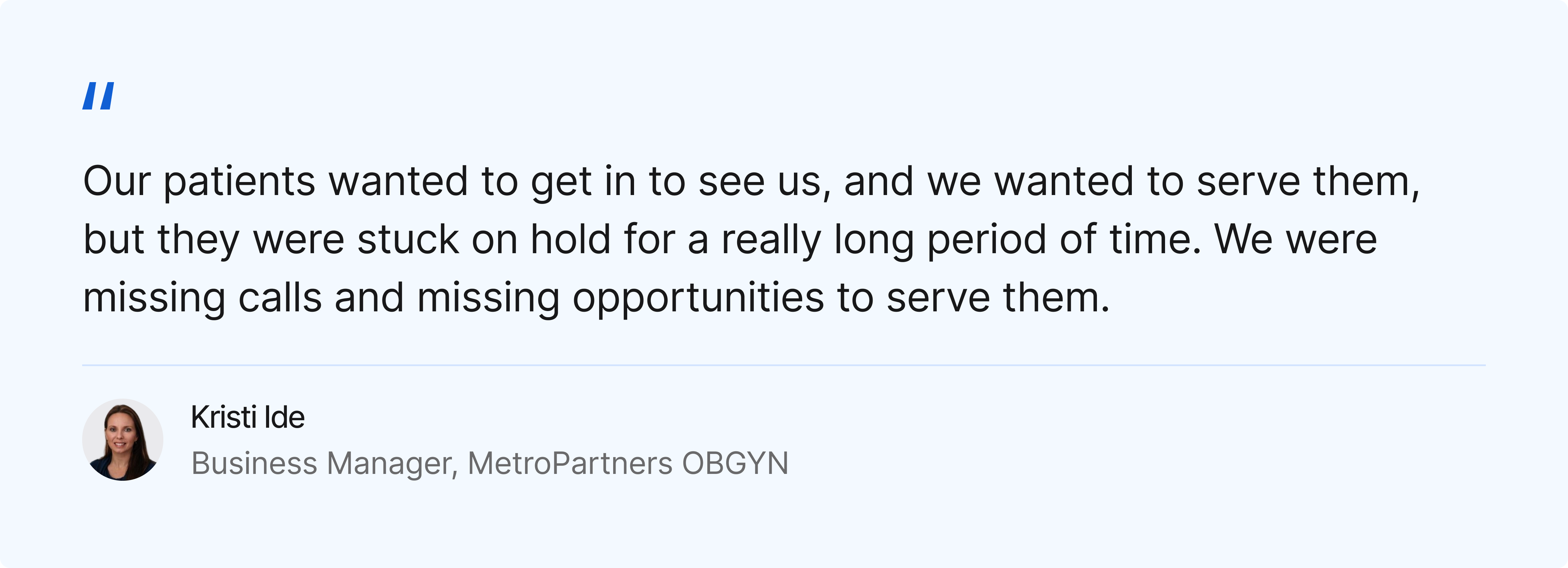
"Our patients wanted to get in to see us, and we wanted to serve them, but they were stuck on hold for a really long period of time," said Kristi Ide, Business Manager. "We were missing calls and missing opportunities to serve them."
The practice had also lost three scheduling team members, and replacing them wasn't simple. Scheduling and front desk roles are among the hardest positions to fill in healthcare right now. Every unfilled seat means longer hold times, more voicemails, and more patients who can't get through. For a women's health practice where timely access to care matters — a new pregnancy, an urgent concern, a routine annual that's already overdue — that gap has a direct impact on patients.


What Actually Happens When You Call
When you call MetroPartners OBGYN, Elise picks up immediately. She asks what you need. If you're scheduling, she books your appointment in real time using the same rules the front desk follows, because she's connected directly to the practice's EHR. MetroPartners runs on Athenahealth, and Elise integrates with Athena directly to handle provider schedules, appointment types, and templates in real time — removing a significant amount of lookup and data entry that previously fell on the scheduling team. If you're a new patient, she can get you set up in the system. If you have a medical question, she creates a case with your information and routes it to the right clinical team member. And if you want to talk to a person, or if you're calling about an emergency, Elise transfers you immediately. There's no loop and no dead end.
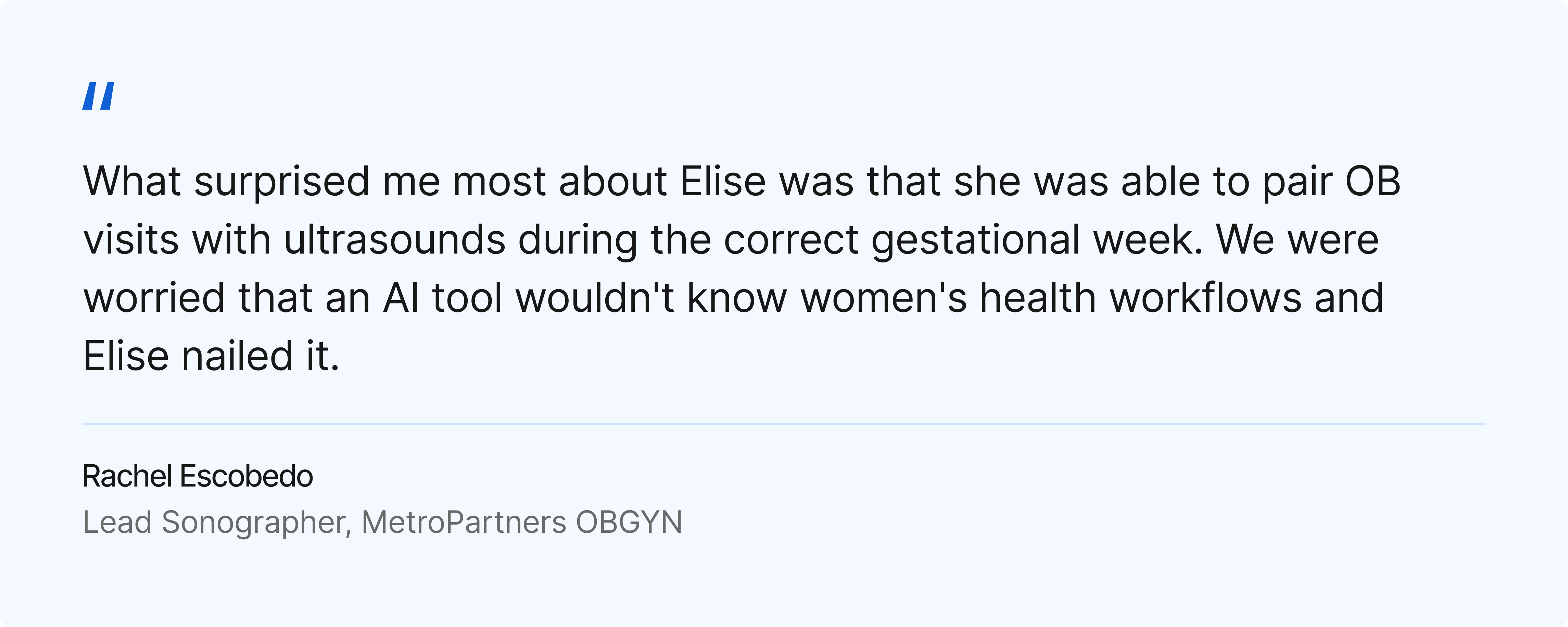
What surprised the team was how well Elise handled the specifics of OB/GYN scheduling. "What surprised me most about Elise was that she was able to pair OB visits with ultrasounds during the correct gestational week," said Rachel Escobedo, Lead Sonographer. "We were worried that an AI tool wouldn't know women's health workflows and Elise nailed it." (MetroPartners isn't the only OB/GYN practice seeing this.)
What Elise doesn't do: diagnose anything, make clinical decisions, or replace your provider. Your care team is still there. They're just spending their time differently. "We want to take those menial tasks off the plate so our staff can actually care for people and be present for our patients," said Kristi Ide, Business Manager.
Language Access Is a Clinical Issue
This part doesn't get talked about enough. A research framework published in ACOG's journal Obstetrics & Gynecology found that language barriers in OB/GYN are connected to lower quality of care, lower cancer screening rates, and higher rates of unscheduled cesarean births (Obstetrics & Gynecology, 2023). A 2025 study found that only 13% of hospitals meet all federal language-access benchmarks (ScienceDirect, 2025).
For MetroPartners OBGYN, multilingual support was one of the main reasons they chose EliseAI. "When someone called through Elise, no matter what language they spoke, our patients could speak in their native tongue," said Kristi Ide, Business Manager. "That was really important to us." EliseAI supports over 50 languages, so a patient who speaks Spanish can schedule an OB appointment at 9 PM without waiting for a bilingual staff member.
The Results
Since going live, EliseAI has handled 1,863 calls at MetroPartners OBGYN. That's 1,863 calls answered on the first ring instead of going to hold or voicemail.
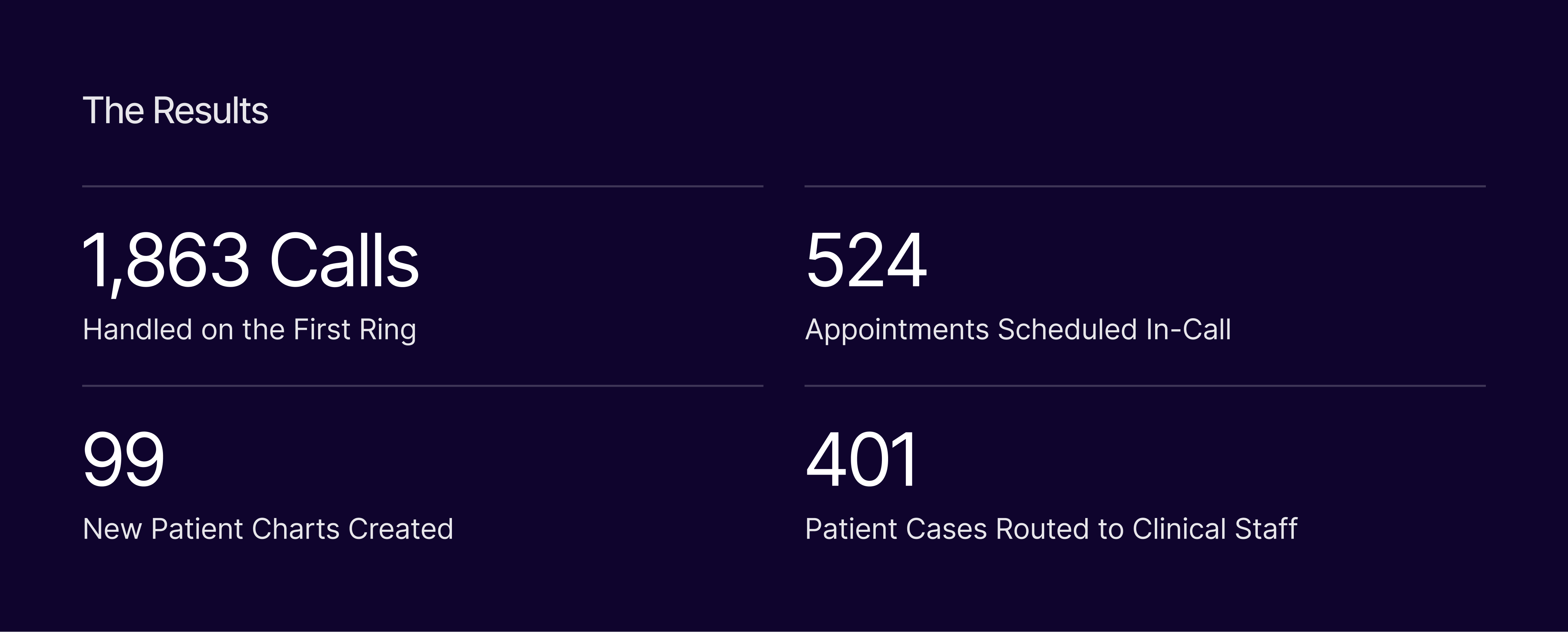
Of those, 524 turned into booked appointments. Patients who would have had to call back, leave a message, and wait for a callback got their visit scheduled during the conversation. Another 99 were new patients who got set up on the spot — a process that typically takes significant staff time and is one of the biggest bottlenecks in getting first-time patients through the door. And 401 patient cases were created and routed to the clinical team, meaning medical questions that used to land in a voicemail inbox or on a sticky note were documented and sent to the right person immediately.
The system also runs around the clock. "Previously, patients called when it was convenient for them, but we weren't here," said Kristi Ide, Business Manager. "Now they can actually get scheduled and have their issues taken care of 24/7." For a working parent trying to book an OB appointment after the kids go to bed, that's a meaningful difference.
And many patients don't even realize they're talking to AI. "This is so important to us because in the women's health field, we can be dealing with very sensitive or concerning issues and we want to make sure our patients feel supported," said Courtney Hawthorne, Scheduling Supervisor.
The staffing impact was one of the most significant outcomes. The three scheduling positions the practice lost before EliseAI have never been backfilled. They haven't needed to be. Elise absorbed that volume from day one. For a practice that was watching hold times climb and calls drop every time a team member left, that changed the picture entirely. Staff now spend more time with patients in the office and less time tied to the phone.
Why This Matters for Patients
The reason MetroPartners OBGYN made this change wasn't to reduce staff or cut costs. It was to increase access. A patient who calls at 8 PM can get booked. A patient who speaks Spanish can schedule in her native language. A patient who needs to reschedule doesn't have to sit on hold for 15 minutes to do it. And when patients do come into the office, the staff is focused on them instead of being pulled away by a ringing phone every 30 seconds.
Practices that adopt AI aren't trying to talk to patients less. They're trying to make sure the time their team spends with patients goes to the conversations that truly need a person — at the front desk, on a complex call, on a sensitive question — instead of being consumed by hold queues and voicemail backlogs.
Bring This Guide To Your Team
Download the patient communication guide and adapt the language for your own practice.