


Ready to Streamline Your Operations?
Book a demo to see how EliseAI automates communication, reduces workload, and delivers real results.

Of All Work Orders Closed Within SLA
Of Perennial Residents Interacted w/ MaintenanceAI
Of Emergency After-Hours Calls Deescalated by MaintenanceAI
Perennial Properties is an Atlanta based mixed-use commercial development firm that specializes in both high-end urban apartment projects and street level retail offerings. Their residential arm comprises 2,600 units of owned and operated multifamily housing, spanning a variety of asset types from single family homes to downtown high-rises to historic assets from the 1920s and 30s.
Perennial has built a reputation for high quality service at affordable price points driven by a consistent organizational culture that promotes low turnover rates, with many employees boasting tenures of over 10 years. That commitment to culture extends to the promotion of employee growth as well, as the Perennial Properties team both conducts on-going internal training as well as encourages their associates to attend continuing education programs at regional universities as well as courses run by the local apartment association.
So when Joel Spencer, CAPS CAMT, Director of Maintenance, returned to Perennial after seven years away, he was excited to find many of the same faces… and a little less excited to see some of the same maintenance technology in place.
As Joel looked to take stock of Perennial’s operational backend upon returning to the Perennial team, he found many of the same maintenance tools in place as when he had left the organization years before. Perennial was leveraging on legacy maintenance technology, which served their purposes adequately for basic work order management but fell short on annual/biannual inspections, preventive maintenance, and recurring tasks.
While they were able to create inspections in their original maintenance software, it was a time-consuming and frustrating process that required bouncing between corporate and property levels, building backward work orders, and building it from scratch for each different asset. Perennial’s diverse portfolio demanded customization that rigid, legacy maintenance systems just couldn't provide.
Perennial Properties leadership recognized that the systems that worked for a smaller portfolio wouldn't scale prompting "Perennial 2.0," a company-wide modernization initiative that Joel was responsible for managing on the maintenance side. Joel’s initial instinct was to try other, newer purpose-built maintenance tools, but he found that while other point-solution tools were helpful that they added yet another new platform to Perennial’s growing tech stack. This was directly against Joel’s mandate to consolidate Perennial Properties’ operations during his new technology rollout, with the proverbial juice of onboarding a completely new vendor not worth the squeeze of the accompanying tech stack bloat.
That was when Joel first heard of EliseAI’s Maintenance App.
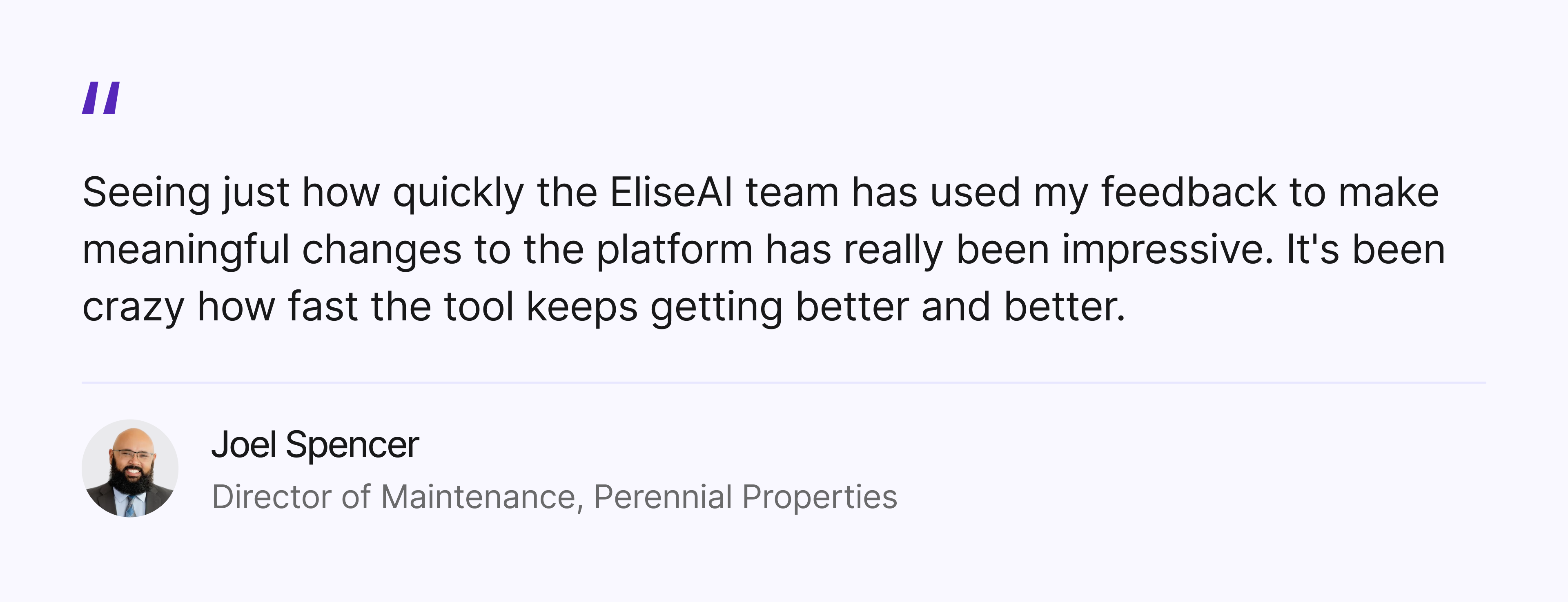
Perennial Properties was already using EliseAI on the leasing side, so when the Maintenance App pilot launched in the early summer of 2025, Joel raised his hand to see if it could help improve Perennial’s maintenance operations while not requiring the addition of a new vendor to their tech stack. While his earliest impressions of the tool were good, it was the speed at which his feedback translated into actual, usable product improvements was what won Joel and team over and convinced them to roll it out across the entire Perennial Properties portfolio.
Joel provided the EliseAI team insights into how Perennial’s technicians were using the product, any shortcomings or missing features they identified, and key workarounds that Perennial had put in place in order to inform further development of the tool. With that feedback in hand, EliseAI quickly launched new capabilities and functionality that specifically mapped to pain points Perennial (and many other maintenance teams) are all too familiar with. Now, Perennial’s maintenance teams don’t only use the Maintenance App for standard workflows like work order management, resident communication, and technician performance evaluation, but also have leveraged it for novel use cases like recurring preventive maintenance, fall winterization tasks, and more.
Beyond their direct role in shaping the capabilities of the tool, Joel and the Perennial team are advocates of the Maintenance App for several key reasons. For one, the app makes it easy to track progress at a portfolio level as well as on an individual site basis, which gives Joel both the macro-level perspective he needs to identify trends as well as the micro-level insights into specific technician or asset-level performance data that can be used to spot issues on the fly. The inspection capabilities of the tool are a crucial differentiating factor, as the Maintenance App makes it seamless to add new custom inspection questions on the fly, useful for tracking partially completed capital projects like light fixture replacements as they take place over a period of time. Finally, the consolidation of tools in the EliseAI product suite means Perennial’s maintenance teams no longer have to juggle multiple platforms, improving adoption rates and adhering closely to the vision for “Perennial 2.0.”
The outcomes? Improved work order closure rates and average completion times (58% work orders completed before SLA), higher technician productivity, strong adoption stats, and positive sentiment built with both the maintenance teams and Perennial residents.
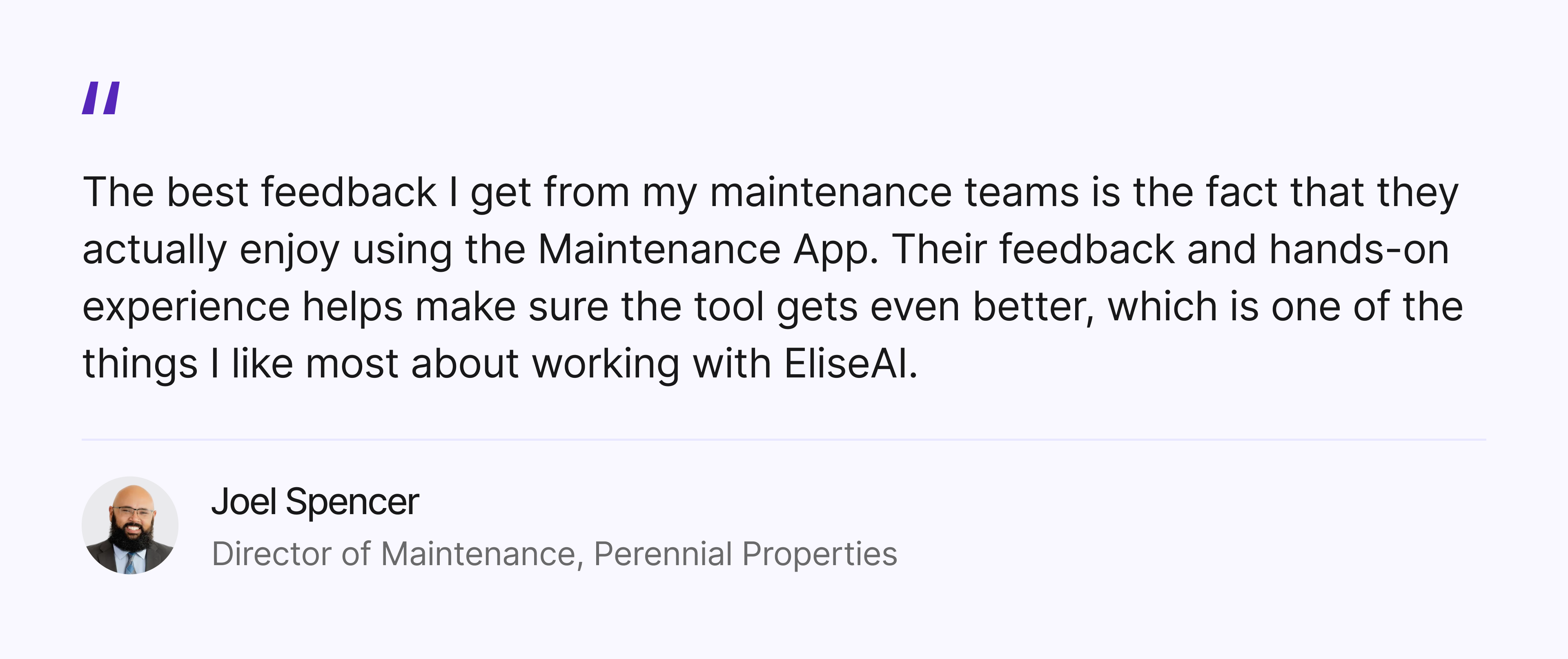
As Perennial continues to expand, they look forward to continuing to expand the usage of EliseAI products across their portfolio. The team is particularly excited for further development of capabilities within the Maintenance App product, including continued improvements to the facilities reporting functionality of the tool. As the facilities intelligence capabilities continue to be developed, Joel foresees the ability to access and analyze work order data at scale rather than reviewing individual PDFs as a key unlock to promote improved capital deployment, better inventory management, and better capacity planning for his teams. Perennial is currently in the process of rolling out more recurring inspections in the tool as well, with lighting inspections, pool inspections, annual compliance tasks, and elevator inspection tracking all on the docket as the product continues to expand in scope.
The Maintenance App rollout at Perennial Properties has been a success because of how well it has achieved different goals for different teams. It’s provided visibility for corporate leadership without adding friction for technicians who are already stretched thin. It’s about empowering technicians to get work done faster and giving residents real-time feedback and information along the way. And it’s about defining your edge against the market, with Joel citing EliseAI's rapid development pace as a competitive advantage when it comes to delighting residents and keeping margins healthy in a tight capital environment. Cheers to the Perennial Properties team for showing that good, old-fashioned hard work can be just a bit simpler with better technology.

Joel Spencer serves as Director of Maintenance at Perennial Properties, overseeing the service department as well as safety, regulatory, and training programs. Joel is an Atlanta native who graduated from Dekalb Technical College in 2007 with a focus in Air-Conditioning Technology. With over 16 years in the multifamily field, Joel brings a wealth of experience in all facets of apartment maintenance. Alongside his time at Perennial, Joel most recently served as a Regional Maintenance Manager for a portfolio of 7,000+ units at 70 assets across Georgia, Alabama, & Tennessee.

Book a demo to see how EliseAI automates communication, reduces workload, and delivers real results.