


Ready to Streamline Your Operations?
Book a demo to see how EliseAI automates communication, reduces workload, and delivers real results.
Collection Rate Improvement
Of All Leasing Messages Automated
Leases from After-Hours LeasingAI Chats
RYSE Management is a rapidly growing, boutique, tech-enabled property management company headquartered in Texas, managing nearly 3,600 units across 18 communities in Texas and Oklahoma. Founded by Amber Jacobs, a 30-year multifamily veteran who previously ran the Southwest Region for FPI and served as VP of Operations at RPM Living, RYSE was built on a straightforward thesis: the fee management industry had room for a company that could combine institutional-level operations with a boutique, people-first approach.

RYSE took over its first property in March 2025 and scaled to its current portfolio in under a year, achieving a pace of growth that would be aggressive even for firms with decades of infrastructure behind them. The company was able to move that quickly because of three deliberate decisions made early on.
First, RYSE built its operating model around technology and centralized support rather than trying to recreate the infrastructure of a 10,000-unit firm. Second, leadership was selective about who they brought in early; while the company is young, its leadership team has decades of experience scaling large portfolios across multiple states. Third, RYSE partnered with ownership groups who believed in their vision and were excited to grow alongside the “new kid on the block”, empowering the company to scale thoughtfully without sacrificing operational excellence.
That technology-first mindset extended to every part of the business. When RYSE was evaluating its tech stack, they took an inverse approach to the conventional “if it ain’t broke, don’t fix it” mentality. Instead, Amber and team focused on identifying where the biggest operational bottlenecks existed for onsite teams and residents, including after-hours leasing inquiries, coordinating prospect follow-up, and uncomfortable collections conversations, to reverse engineer what the perfect tech stack looked like for them.
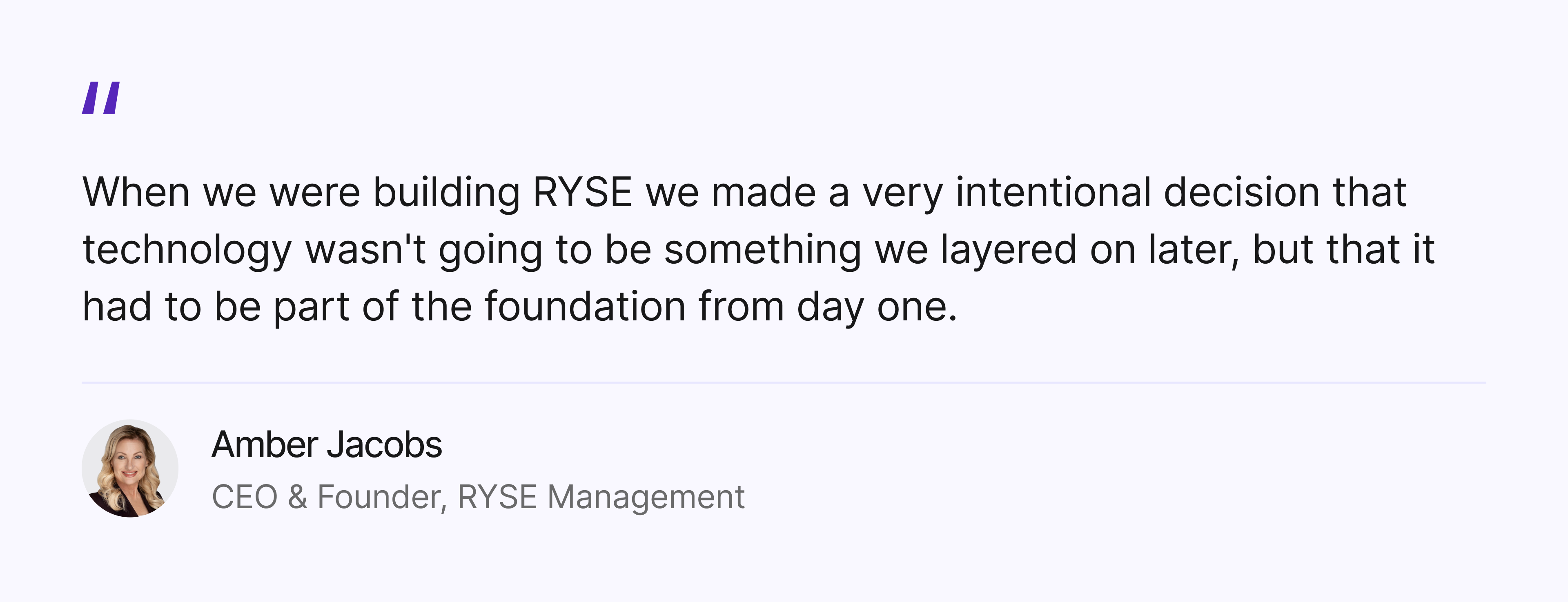
Going from zero to 3,600 units in under a year means onboarding communities at a pace that leaves almost no margin for inefficiency. RYSE had the talent onsite. The problem was that too much of the day was consumed by transactional work, like fielding calls, handling walk-ins, and coordinating with maintenance technicians, leaving too little room for the resident-facing, community-building interactions the company was founded to prioritize.
The biggest culprit was communication volume. Leasing inquiries, prospect follow-ups, resident questions, tour scheduling competed for the same limited team bandwidth. For Amber, who thinks about operations in terms of "people hours," it was clear that there just weren’t enough hours in the day to get everything that needed to get done done. Between fielding calls, responding to emails, managing reports, answering to asset managers, and keeping up with Google reviews, onsite associates were routinely forced to close their doors to residents just to get through the administrative backlog.
After-hours coverage only compounded the “too few hours in the day” problem. Without staff onsite during evenings and weekends across 18 communities, RYSE was dark during some of the highest-intent hours for prospective renters. Leads that came in at 9 PM on a Tuesday or 2 PM on a Sunday sat untouched until the next business day, with conversion rates dropping by the hour the inquiry was left untouched.
Collections, unsurprisingly, posed their own challenges. Amber had seen firsthand what happens when proactive collections outreach disappears. A client of RYSE's had previously deployed AI-powered delinquency tools at a prior management company and watched collection rates climb. When that tool was cut, delinquency went right back up. The lesson stuck: consistent, automated outreach works, and pulling it creates an immediate and measurable backslide. But asking onsite team members to make those calls themselves was a drain on morale, and represented an inefficient use of time that could otherwise be spent on resident relationships.
As a fee manager serving multiple ownership groups, RYSE also faced a constant pressure to demonstrate ROI on every dollar spent. Every tool in their tech stack had to earn its place in client budgets, and Amber knew that the first line item owners scrutinize is software. RYSE needed a platform that could deliver results measurable enough to survive that conversation, demonstrating unmistakable impact on the bottom line.

Most operators adopt AI after years of established operations, layering automation onto workflows that were already built for a pre-AI world. RYSE Management did the opposite, baking EliseAI directly into their operating model from the early days of the company to empower them to deliver boutique service with efficient staffing ratios.
Today, EliseAI's LeasingAI and VoiceAI manage the first layer of prospect communication across all 18 of RYSE's active communities. Reese, the company's EliseAI-powered assistant, handles tour scheduling, responds to inquiries, and nurtures leads around the clock, automating 86% of all leasing communications. Across the RYSE portfolio, Reese sends over 13,700 leasing messages per month, nurturing potential residents with an average of seven touchpoints per lead. That kind of consistent, high-frequency follow-up would require significant dedicated headcount to replicate manually, and for a company onboarding new communities every few weeks, the ability to scale that coverage instantly to each new property has been critical.
The after-hours impact has been especially meaningful for RYSE. Fifty percent of all leads across the portfolio interacted with Reese outside of standard business hours, and 42% of all leasing messages were sent after-hours, whether as first responses to new inquiries or follow-ups on active conversations. In total, 164 leases have been signed by leads who first engaged after hours since launching LeasingAI.
On the collections side, Delinquency has had a measurable impact on RYSE's bottom line. Collection rates improved from 86.1% pre-AI to 92.4% post-AI, a 630 basis point increase. Over $2.1 million in rent was AI-collected during the period of December 2025 and March 2026, with an additional $359,000 collected on accounts receivable aged 30 days or more. For RYSE's ownership groups, those are the kinds of numbers that make any questions about tech spend fade away.
For Amber and team, it has been essential to stress that none of this is about reducing headcount. RYSE's teams are the same size they were before EliseAI. The difference is in how those teams spend their time. Instead of sitting near the phone waiting for it to ring, or closing their office doors to grind through administrative backlogs, RYSE's onsite associates can walk the property, greet residents, lead tours, and build the kind of community atmosphere that drives renewals. As Amber put it at a recent industry event: the things that really define great communities, like building relationships with residents, solving problems, touring apartments, and maintaining the asset, still belong to the onsite teams. AI handles the volume so those teams actually have the bandwidth to do that work well.
RYSE has also begun testing a hybrid centralized leasing model at certain assets, where a remote leasing specialist works in tandem with EliseAI to cover multiple properties simultaneously, with strong early returns. That centralized approach, with AI qualifying and nurturing leads before a human closer steps in, is becoming a template RYSE expects to expand as the portfolio grows.
In under a year, RYSE has gone from onboarding its first community to its current footprint of 3,600 units across 18 communities. EliseAI has been a key part of that trajectory, automating 86% of leasing communications, improving collection rates by 630 basis points, and delivering 164 leases from after-hours leads alone. Those results have made it easy for RYSE to demonstrate their future-looking approach to clients, helping them win new business in a competitive fee management landscape.
The next phase for RYSE is maintenance. The RYSE team envisions a world where EliseAI's Maintenance tools handle work order intake, triage, and data while onsite technicians focus on execution, resident experience, and asset quality. For a company built on the belief that technology should free people to do higher-value work, maintenance is the natural next application of that approach.
Beyond maintenance, RYSE plans to continue expanding its centralized leasing model and deepening the integration of EliseAI across its growing portfolio. The vision is a company that scales to 15,000 or 20,000 units over the next three years without losing the high-touch, performance-driven identity that has defined RYSE from the beginning. EliseAI is proud to serve as a foundational partner in that effort, and to grow alongside one of multifamily's most ambitious new operators.

Amber Jacobs is a tenured multifamily operator with over 30 years in the multifamily industry, She’s built a career on optimizing performance, streamlining operations, and leading high-impact teams, with an approach is rooted in strategic execution, data-driven decision-making, and an unwavering commitment to results. After spending over 10 years in leadership roles at FPI Management and RPM Living, Amber set out to found RYSE Management in 2025 where she now serves as the Founder and CEO.

Book a demo to see how EliseAI automates communication, reduces workload, and delivers real results.