


Ready to Streamline Your Operations?
Book a demo to see how EliseAI automates communication, reduces workload, and delivers real results.

Decrease in Median Work Order Completion Time
Of All Emergency After-Hours Calls Deescalated
Weekly Per Community Time Savings
S2 Capital is a vertically integrated real estate investment platform founded in 2012 and headquartered in Dallas, Texas. The firm acquires, repositions, manages, and exits multifamily assets across high-growth Sun Belt markets, with over $12.5 billion in total transaction value and 50,000+ units repositioned to date. S2 Residential, the company's property management arm, currently oversees roughly 28,000 owned units across 78 communities, with no fee-managed component to the portfolio. That portfolio composition has made the company an aggressive adopter of technology across its operations.
Alongside their tech-focused approach, centralization serves as a central piece of S2's operating thesis. Shelby Bigbee, Vice President of Centralization Services at S2 Residential, leads the effort to unify workflows, reduce costs, and scale high-touch operations across the portfolio. It was that outcome-focused centralized approach, plus a fateful cold LinkedIn message from a member of the EliseAI team, that first put the Maintenance App on S2's radar.
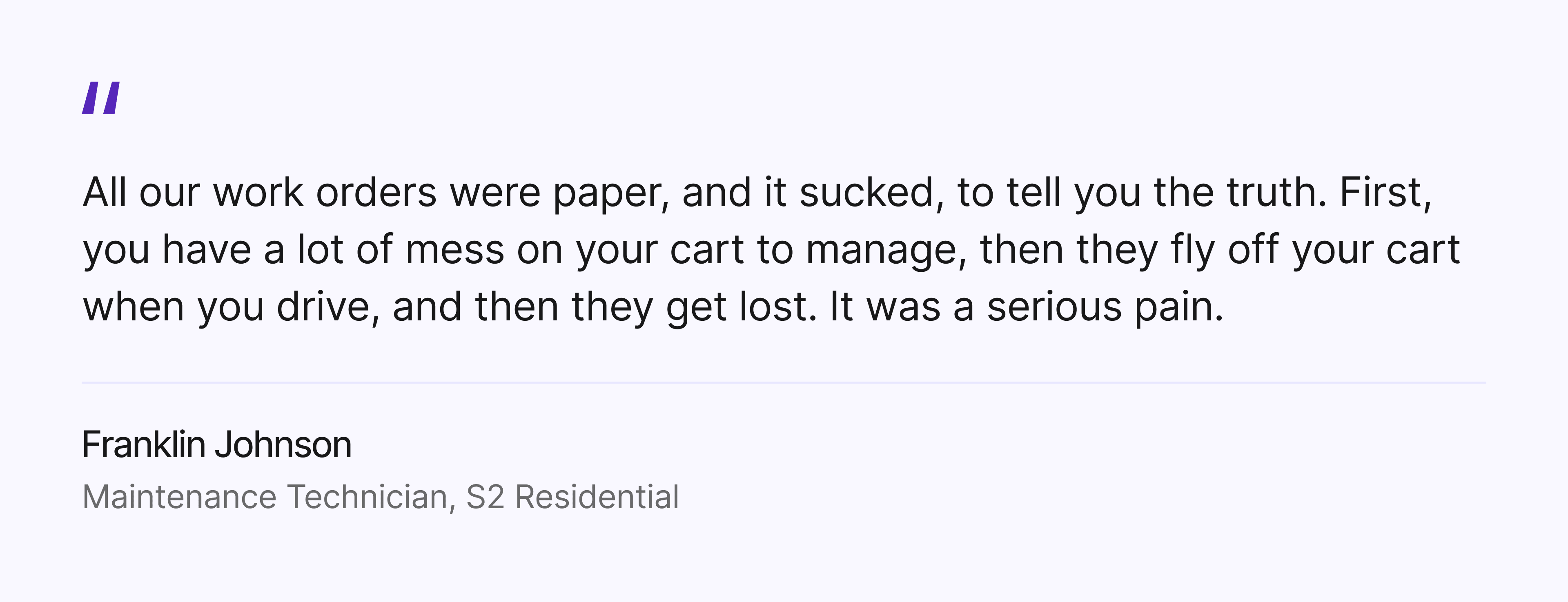
Before the Maintenance App, daily operations for S2's maintenance teams looked much the same as they had for years. Each morning, supervisors printed out the day's work orders, reviewed them manually for priority and skill match, and physically distributed tickets to their technicians. The process, on a good day, ate up 30 to 45 minutes of a supervisor's morning before a single wrench was turned.
For technicians, the paper-based system created its own set of problems. Closing out a completed work order meant returning to the office, logging into the PMS, and entering notes, which often became a bottle neck and required batched time at the end of the day or after lunch. That lag meant completed work sat in limbo, residents didn't get timely updates, and supervisors lacked real-time visibility into what was actually done versus what was still open.
That was just one component of the cumbersome resident communication process. Technicians who needed to coordinate entry or discuss a repair had no direct line to the resident. Instead, they'd call the leasing office, ask someone there to relay the message, and wait for a callback. For S2's Spanish-speaking technicians, the friction was even sharper.
These weren't problems unique to S2, as most multifamily maintenance teams were running some version of this same workflow. But for an operator with 28,000 units and a centralization strategy built on scalable, tech-enabled operations, the gap between how the rest of the business ran and how maintenance ran was hard to ignore. That’s where EliseAI’s Maintenance App comes in.
The EliseAI relationship started with a cold LinkedIn message. Shelby took a demo, and what stood out immediately was the platform's approach to the core issue his team was struggling with: technicians navigating a clunky, outdated PMS that nobody wanted to use. EliseAI's Maintenance App offered a purpose-built alternative, with a mobile-first tool designed specifically for how maintenance teams actually work.
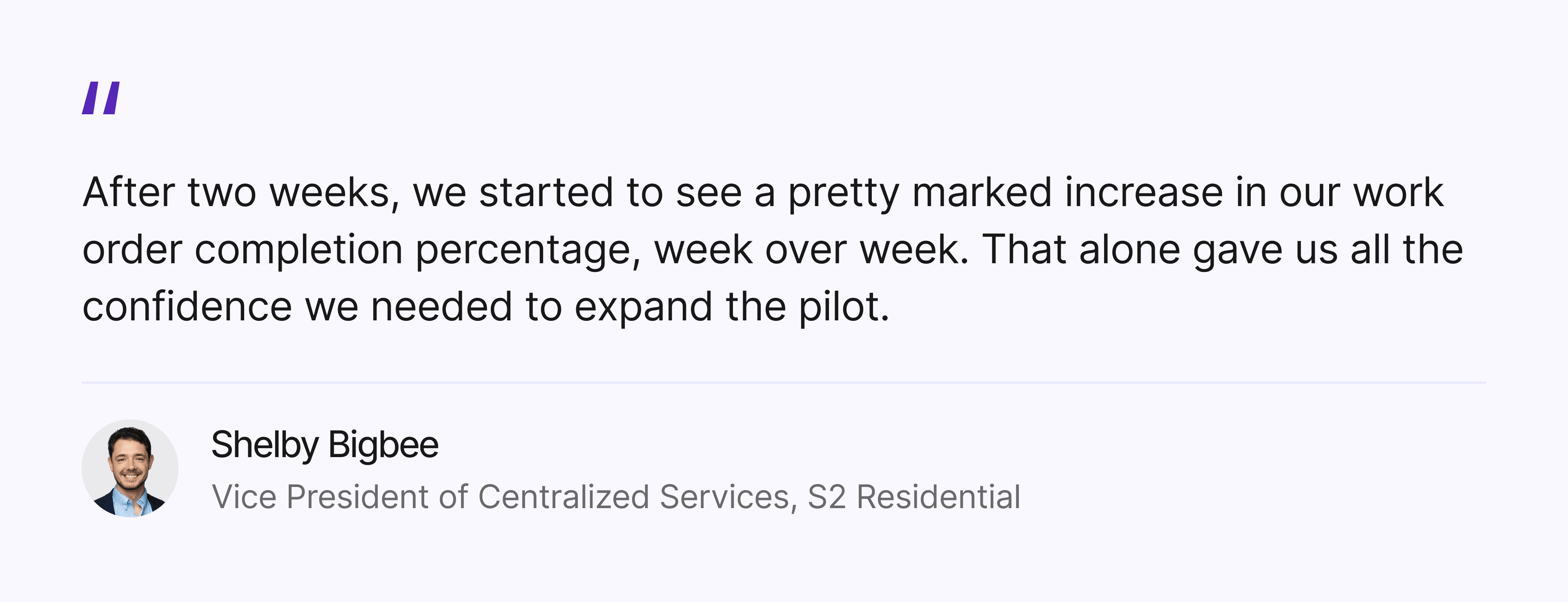
S2 started with a pilot across three to four communities. The approach was deliberately measured: pick a few sites, let the teams run with it, and see what the data said. Within two weeks, work order completion percentages showed a marked improvement week over week.
The next phase was the real test. S2 deliberately rolled the app out to communities with supervisors they knew would be skeptical and team members who were used to doing things the same way for years. Skeptics became advocates once they experienced the day-to-day improvements firsthand. At one Dallas community, the lead technician told Shelby something he'd never heard before: every single tech on the team had opened and was actively using the app, something that had never happened with the old platform.
The features that won over the onsite members of S2's maintenance teams centered on three things: auto-assignment, resident communication, and bilingual support. The app's AI distributes incoming work orders to technicians based on their individual skill profiles, like HVAC or plumbing, so supervisors no longer have to manually match tickets to techs each morning.
The communication improvements were just as significant. Technicians can now text residents directly through the app to coordinate entry, discuss repairs, and provide updates rather than having to route their communications through the leasing office. The app also automatically notifies residents when a work order is received, when a technician is scheduled, and when the job is complete.
The bilingual capabilities of the Maintenance App similarly addressed a real barrier that S2's Spanish-speaking technicians had been working around for years. The app operates fully in Spanish, and the AI auto-translates between technicians and residents so neither party has to work in a second language. Auto-translation also eliminated S2's reliance on third-party call services to bridge language gaps, reducing costs.
Emergency triage rounds out the operational picture. The Maintenance App's built-in AI differentiates genuine emergencies from routine after-hours requests, customizable to S2's specific priority settings. When a real emergency comes in overnight, the system routes it appropriately with detailed notes for troubleshooting. When it doesn't qualify, techs aren't getting woken up unnecessarily, cutting overtime costs.
The early returns from S2's Maintenance App deployment speak to improvements across the metrics that matter most to Shelby and his team. Average hours to completion have trended downward by 40%, while the number of tickets closed per week has increased. Overtime hours are also tracking down, with emergency after-hours triaging deescalating nearly 45% of all after-hours calls. Preventative maintenance completion rates hit 91%, an all time high. And S2’s maintenance teams are saving 17 hours per week through having almost 75% of all work orders delegated via auto-assignment, in addition to after-hours triaging and improved efficiency through the Maintenance App.
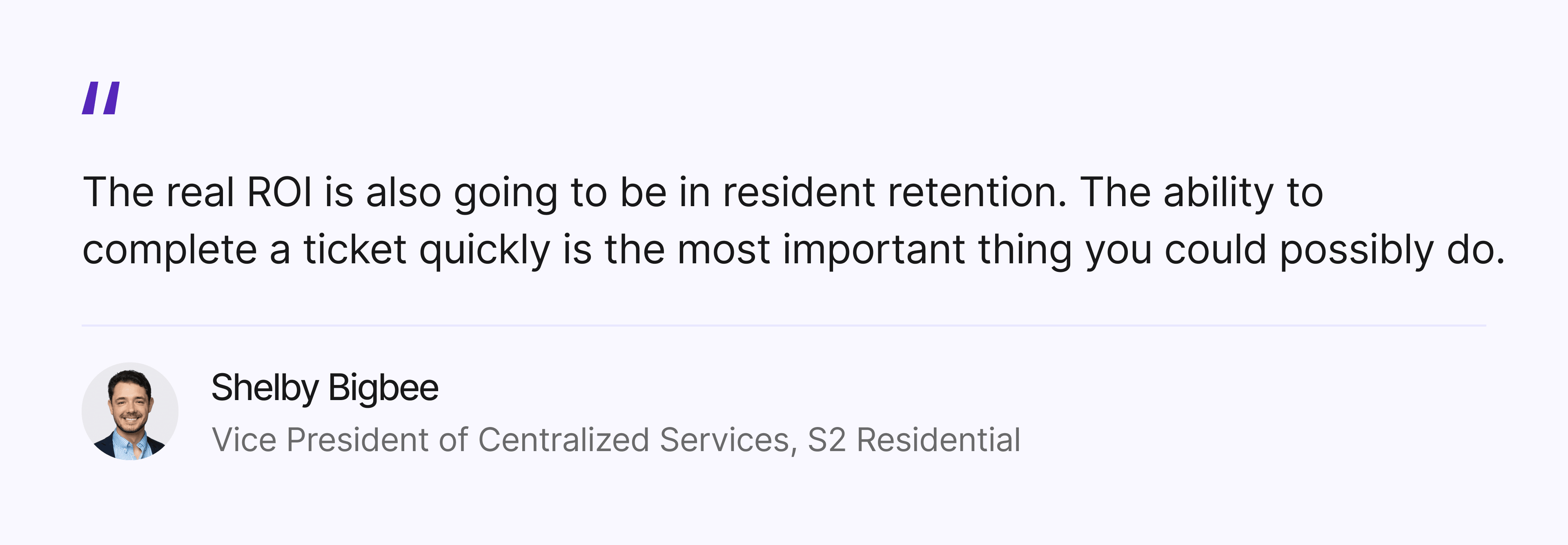
But for Shelby, the performance data only tells part of the story. Resident satisfaction scores at Maintenance App communities have been strong, and he attributes it to two things: communication and speed. When residents know their ticket has been received, know when a technician is scheduled, and know when the work is complete, the entire experience changes even before the work gets done.
Shelby credits the app's simplicity, including the mobile-first nature of the product and the consumer-like experience, for their strong adoption stats. For a workforce that spends its day moving between units and buildings, that accessibility is the difference between a tool that gets used and one that gets ignored.
S2 is exploring ways to build on the foundation the Maintenance App has created. Shelby's team is developing a gamification program tied to the app's built-in leaderboards and achievement badges, with plans to incentivize top performers based on completion volume and speed. On the intake side, S2 is pivoting toward routing more maintenance requests through EliseAI's VoiceAI rather than the resident portal, finding that the AI's ability to ask follow-up questions and gather detailed information from residents produces higher-quality work orders than portal submissions. And as S2's data set deepens over the coming months, Shelby anticipates using the app's reporting to identify training gaps at the individual technician level, providing signals for targeted coaching.
For S2 Residential, the Maintenance App has become something rare in multifamily technology: a tool that the people who actually have to use it every day genuinely want to use. That adoption, paired with measurable operational improvements and a clear path toward deeper integration, positions S2 to scale its maintenance operations with the same discipline and data-driven rigor it applies to every other part of its business, all the while boosting resident sentiment.

Shelby Bigbee is a tenured Vice President of Operations, with 10+ years of leadership in multifamily property management and real estate ops. A veteran of the United States Army, he has a proven track record of optimizing portfolio performance, reducing operating expenses, improving NOI, driving customer satisfaction, and leading cross-functional teams through acquisition, stabilization, and disposition phases. With a strong background in budgeting, asset management collaboration, capital planning, compliance, and technology-driven operational improvements, Shelby works consistently to strengthen both resident sentiment and S2 Residential’s bottom line.

Book a demo to see how EliseAI automates communication, reduces workload, and delivers real results.