


Ready to Streamline Your Operations?
Book a demo to see how EliseAI automates communication, reduces workload, and delivers real results.

Increase in Collection Rates
Additional Monthly Revenue Per Unit
Of Resident + Prospect Communications Automated
WinnCompanies is one of the most recognized names in American affordable housing. Founded in Boston in 1971 by Arthur Winn, the family-owned company has grown over five decades into a national owner, developer, and manager of high-impact apartment communities, with approximately 105,000 units under management across 27 states, the District of Columbia, and Puerto Rico. WinnResidential, the company's property management arm, operates the nation's largest portfolio of affordable housing and ranks as the ninth-largest apartment manager on the NMHC Top 50 Managers List.
While Winn's scale is impressive, what truly sets it apart is the depth of its commitment to the people who live in its communities. In 2017, Trevor Samios joined WinnCompanies and launched Connected Communities, an internal resident services department built on the premise that affordable housing could serve as a platform for measurable social impact. Today, Connected Communities is a 501(c)(3) nonprofit organization expanding its impact beyond Winn to partner with affordable housing owners and managers nationwide. It is one of the nation’s largest housing-based resident services providers, partnering with more than 3,000 local, regional, and national service providers to connect residents to programs across six outcome areas: housing stability, employment, education, community engagement, health, and economic mobility.
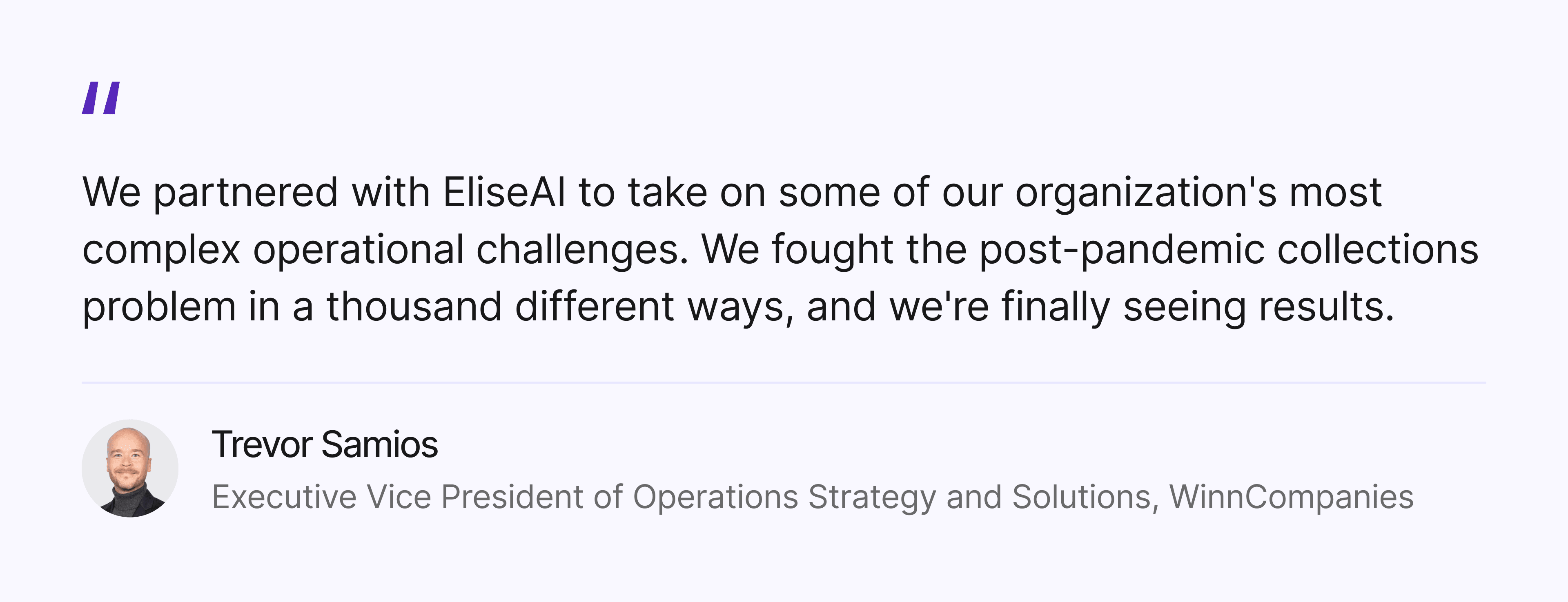
It was that perspective that led Winn to approach EliseAI differently than most operators. Rather than deploying AI to solve a single leasing or collections problem, Winn set out to use EliseAI's platform to systemically address the most difficult operational challenges facing affordable housing today, including a persistent post-pandemic collections challenge, an overwhelmed and rapidly turning over workforce, and a growing gap between the needs of residents and the capacity of onsite teams to meet them.
For an organization managing the nation's largest affordable housing portfolio, the years following the pandemic surfaced operational challenges that converged into sustained pressure: rising delinquency, an affordable housing workforce stretched beyond capacity, and a widening gap between what residents needed and what onsite teams could realistically provide.
The collections problem came first. Like many operators across the multifamily industry, Winn saw a sharp increase in delinquent balances during and after the pandemic. But unlike market rate operators, affordable housing providers work with residents who often have limited income and complex financial circumstances, making collections an especially sensitive undertaking. Onsite teams struggled to balance empathetic resident engagement with the financial realities of maintaining healthy asset performance.
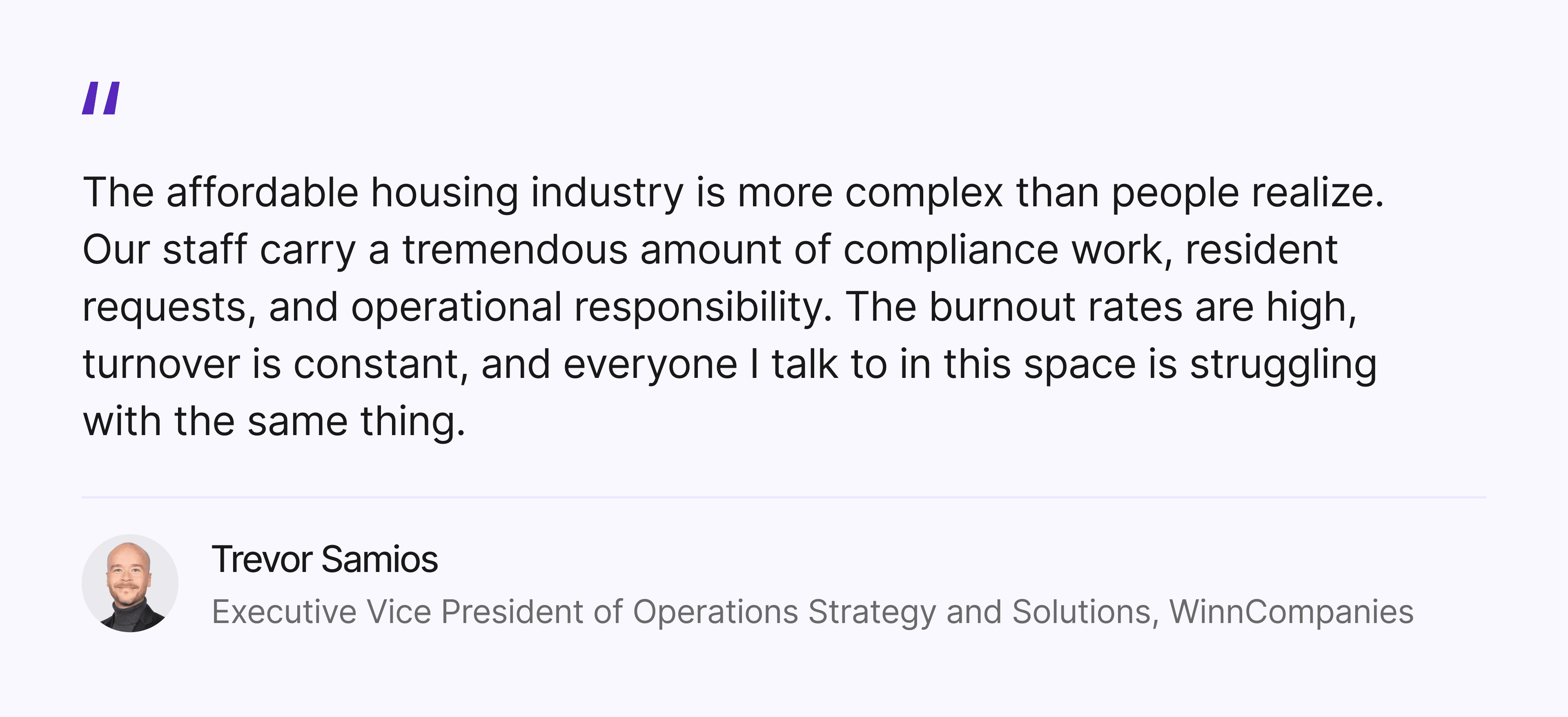
Maintaining a high-impact workforce compounded the problem. Onsite staff at affordable communities handle responsibilities, and compliance burdens, well beyond what their market rate counterparts typically handle, often with leaner staffing ratios. The administrative burden leaves little room for the high-touch, relationship-driven work that defines quality affordable housing management. Turnover across the affordable housing sector is a persistent issue, and Winn was no exception.
The third challenge was less visible but equally consequential. Through its Connected Communities program, Winn had surveyed hundreds of thousands of residents and identified clear, consistent gaps in healthcare access, childcare, job training, financial coaching, and other services essential to their stability and upward mobility. The problem was scale. With approximately 150 social workers and community organizers funded primarily through Section 8 deals, Connected Communities could only serve about a third of Winn's portfolio. Winn had the data, the programs, and the partnerships, but what it lacked was a cost-effective, scalable mechanism to connect residents to those resources on their terms.
So, Trevor and Winn set out to look for a technology partner that could address all of these persistent issues within a single platform. They found EliseAI.
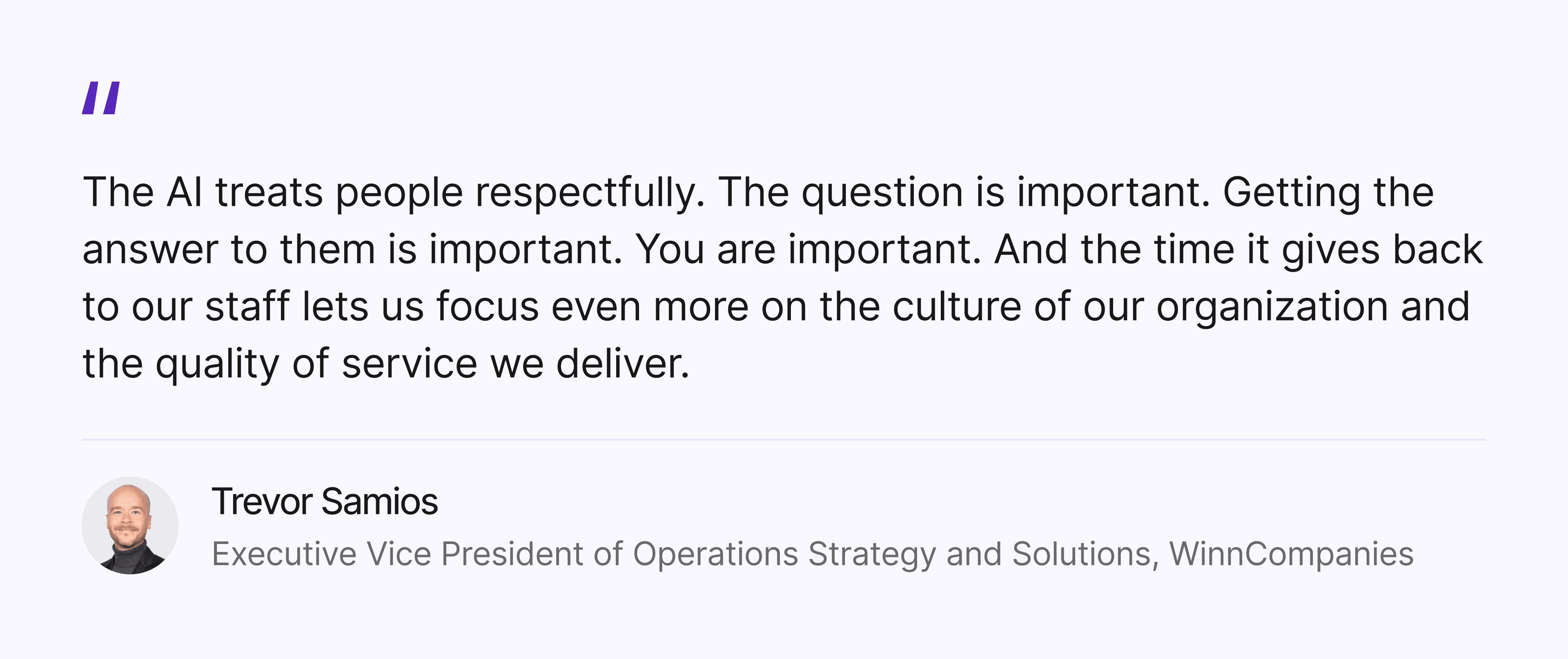
WinnResidential's deployment of EliseAI has been broad from the start, with LeasingAI, VoiceAI, and ResidentAI across large sections of the WinnResidential portfolio. Maya, Winn’s EliseAI-powered assistant, handles communications across text, email, chat, and voice, automating 90% of all interactions and leaving only a fraction of volume for onsite teams to manage.
The impact on collections has been substantial. Across 294 communities, DelinquencyAI has driven a 1,130 basis point increase in collection rates, moving WinnResidential from a pre-AI collection rate of 74.1% to 85.4% post-AI. The delinquency rate has dropped nearly in half, from 25.9% to 14.6%. Maya has collected $47.1 million in rent autonomously since initial deployment in mid-2025, including $16.8 million in balances that were 30 or more days delinquent. On a per-unit basis, WinnResidential is collecting an additional $103.52 per unit per month, translating to a monthly revenue increase of approximately $3.9 million across the portfolio. The key factor here is the AI-powered volume and consistency of outreach that no onsite team could sustain manually, with the kind of empathetic, persistent follow-through that Trevor and his team were looking for.
The time savings have been felt immediately by onsite staff, with EliseAI saving WinnResidential communities a significant amount of time per week across leasing operations, maintenance, delinquency management, and renewals. Team members have positively responded to AI taking repetitive work off their plates, giving them room to focus on the in-person, resident-facing interactions that brought them to the industry.
The resident experience has shifted as well. Residents who once called multiple times without receiving a callback now get answers in real time. If they have a follow-up question about that answer, Maya follows up again. Every inquiry, every concern, every maintenance request is tracked and resolved rather than lost in the shuffle of an overwhelmed leasing office. And the AI delivers those answers in whatever language the resident speaks. At one Winn community, a resident initiated a conversation with Maya in Haitian Creole and Maya responded fluently, at one point even providing a recipe when the resident asked, half-jokingly, if the AI knew how to make Haitian food. For a portfolio that serves tens of thousands of residents across dozens of languages, that kind of real-time translation capability ensures that every resident receives the same quality of communication regardless of what language they speak.
Perhaps the most distinctive element of the partnership is what comes next. Winn's survey data had identified hundreds of thousands of residents with specific, unmet needs, and while Connected Communities had the partnerships and the programming to address them, it didn’t have enough team members to handle it at scale. So, the EliseAI team worked with Winn to map Connected Communities' resource library across every community Winn manages nationally, so that when a resident identifies a need through Maya the AI can connect them to relevant programs, services, and benefits in real time and in their language.
If affordable housing AI can do more than simply collect rent and schedule tours, it opens a pathway to addressing the affordable housing challenge from a fundamentally different angle: not just building new units, but helping the families who live in affordable communities access the resources they need to build stability and upward mobility.
The results of the partnership speak clearly through the data: a 1,130 basis point increase in collection rates, $47.1 million in AI-collected rent, 11.3 hours per community per week returned to onsite teams, and a 90% automation rate across all interactions. But for Trevor, the numbers that matter most are the ones that are harder to put in a QBR slide. Residents at communities like Mission Main, a 540-unit public housing redevelopment in Boston where a resident task force holds a 51% ownership stake through a joint venture with WinnCompanies, are telling leadership that, for the first time, they trust the process. They ask a question and get an answer. They follow up and get a follow-up. The loop closes.
That resident-level trust is translating into broader interest across Winn's diverse client base. Ownership groups representing everything from resident-controlled public housing to large-scale nonprofit affordable development are seeing the impact of the EliseAI deployment at communities they own. For Winn, an operator that serves a wide variety of ownership structures and client types, the ability to demonstrate measurable AI-driven results across that range strengthens its value proposition as a management partner.
Looking ahead, the Connected Communities Foundation's resource library integration with EliseAI remains the most ambitious frontier for the partnership. If the early work of mapping social services resources across Winn's portfolio scales as intended, the model could eventually allow affordable housing operators nationwide to deliver resident services at a fraction of the current cost, reaching people at times convenient to them, in their own language, and connecting them to the specific programs and supports that their circumstances require.
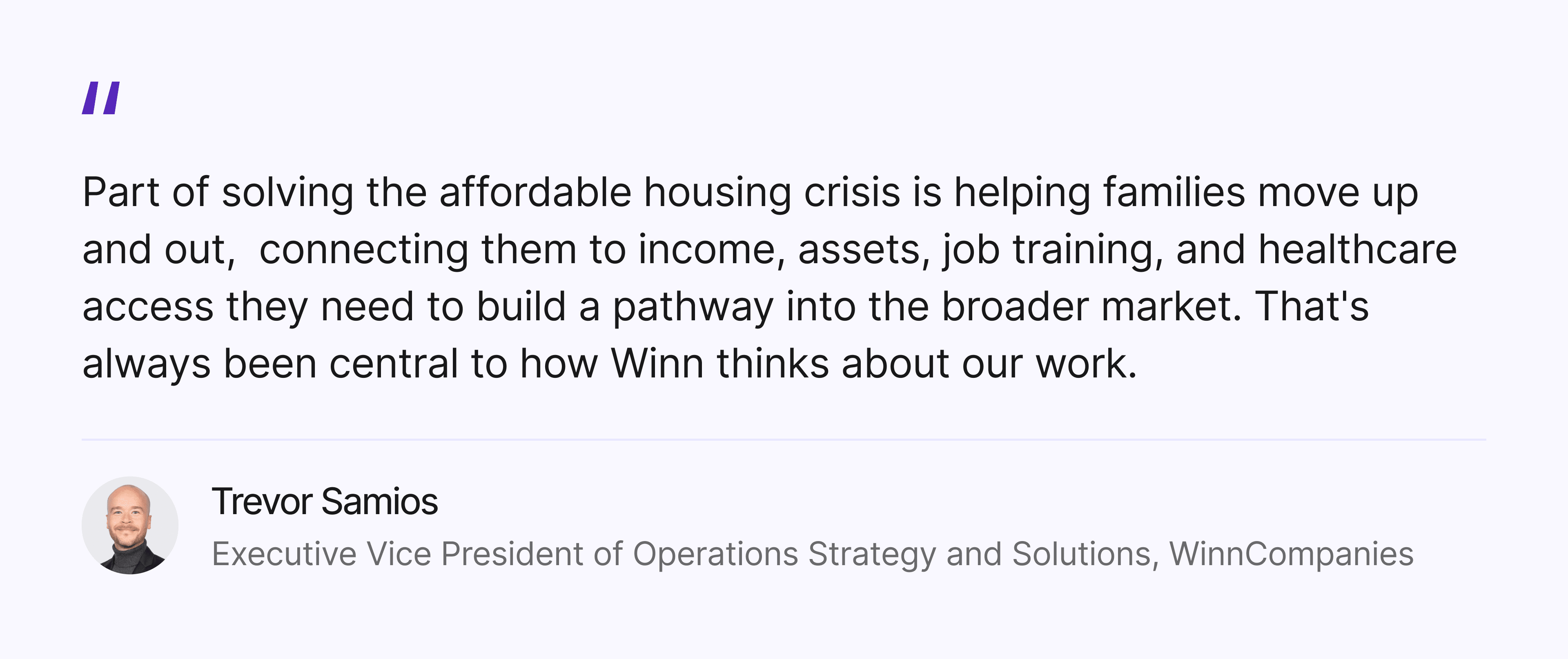
For Trevor, that's the long game: using AI to help families build the income, assets, and stability they need to move up and out of affordable housing, solving the nation's housing affordability challenge from the demand side as well as the supply side. EliseAI is proud to partner with WinnCompanies as it continues to push the boundaries of what technology can do for the communities that need in most.

Trevor Samios serves as Executive Vice President, Operations Strategy & Solutions at WinnCompanies, supporting operations, community partnerships and the advancement of mission-driven public policy on behalf of the organization’s real estate development and property management divisions. Samios began his career at WinnCompanies in 2017, launching Connected Communities as the resident services division of the organization before establishing the Connected Communities Foundation in 2024 to expand the scale and impact of its mission. He now serves as Chair of the Board of Directors, supporting Connected Communities’ staff and board leadership to grow its capacity, strategic partnerships, and collective-impact approach to community development nationally. Prior to joining WinnCompanies in 2017, Samios led the Community Impact team at Preservation of Affordable Housing (POAH) and operations for the Community Life team at The Community Builders (TCB), both national affordable housing non-profit organizations.

Book a demo to see how EliseAI automates communication, reduces workload, and delivers real results.