
Built to Automate & Scale Your Operations
Answer a couple of questions and we'll connect you with the right team member.
Answer a couple of questions and we'll connect you with the right team member.


Of Gen Z Renters Will Abandon Their Issue If They Can't Self-Serve
Of Gen Z Already Pays for AI Tools in Their Personal Life
Of Gen Z Expects Digital Experiences to Be AI-Powered
At face value, student housing as an industry looks like it's thriving. Dig deeper and you'll see there's trouble lurking: a shrinking pipeline of Gen Z renters, every one of whom expects instant, 24/7 self-service. In response, student housing providers are pioneering state-of-the-art approaches to leasing and resident experience, and are shaping a new generation of renters that will soon graduate into the conventional multifamily ecosystem. This whitepaper examines student housing operators at the cutting edge like Landmark Properties, Cardinal Group Management, PeakMade Properties, Student Quarters, and The Scion Group, to project where multifamily is going next.
We’ll cover:

Student housing has quietly become one of the most competitive corners of the rental housing industry. On paper, the fundamentals look strong: national occupancy hit 95.1% for the 2025-2026 academic year, average asking rent reached $1,017 per bed (up 3.4% year-over-year), and institutional capital continues to flow into the sector. By most measures, student housing is healthy, if not booming.
However, there’s trouble lurking beneath seemingly calm waters.
The bad news: the number of U.S. high school graduates is projected to decline steadily, with some estimates pointing to a drop of up to 13% by 2041. Student housing operators are staring down the barrel of a slow-moving compression of the entire addressable market in response to demographic pressures and changing workforce realities that reduce the amount of students who need housing.
At the same time, today’s student residents (and the student residents of the future) that operators are competing for have never been harder to impress. Today's student renter demographic is largely composed of members of Gen Z, whose steady exposure to consumer-grade experiences on platforms like TikTok, Uber, and Netflix have conditioned them to expect instant access to everything and AI-powered personalization as a default. For most of them, their time in student housing is their first independent living experience. The expectations they form here will follow them into the conventional multifamily market for decades.
This creates a dual pressure that's unique to student housing:
For the conventional multifamily operators out there, let this serve as a wakeup call: these students are going to graduate, and will walk into your leasing offices (or, more likely, onto your TikTok pages at 12:13am) carrying every expectation that these innovative student housing operators have conditioned them to expect. They won't accept a step backwards because they moved out of student housing and into conventional multifamily communities.
This whitepaper examines how leading student housing operators are responding to these twin pressures, what their results look like in practice, and what their experiences can teach the broader multifamily industry. The next generation of renters is being shaped right now, on college campuses across the country. The question is whether most operators will be ready for them when they arrive.
Before we get into how student housing operators are responding to external pressures, it's worth spending a moment on what exactly they're responding to. The phrase "digital natives" gets thrown around constantly in multifamily marketing, but the actual behavioral data behind Gen Z's consumer expectations paints a sharper and more demanding picture than most operators realize.
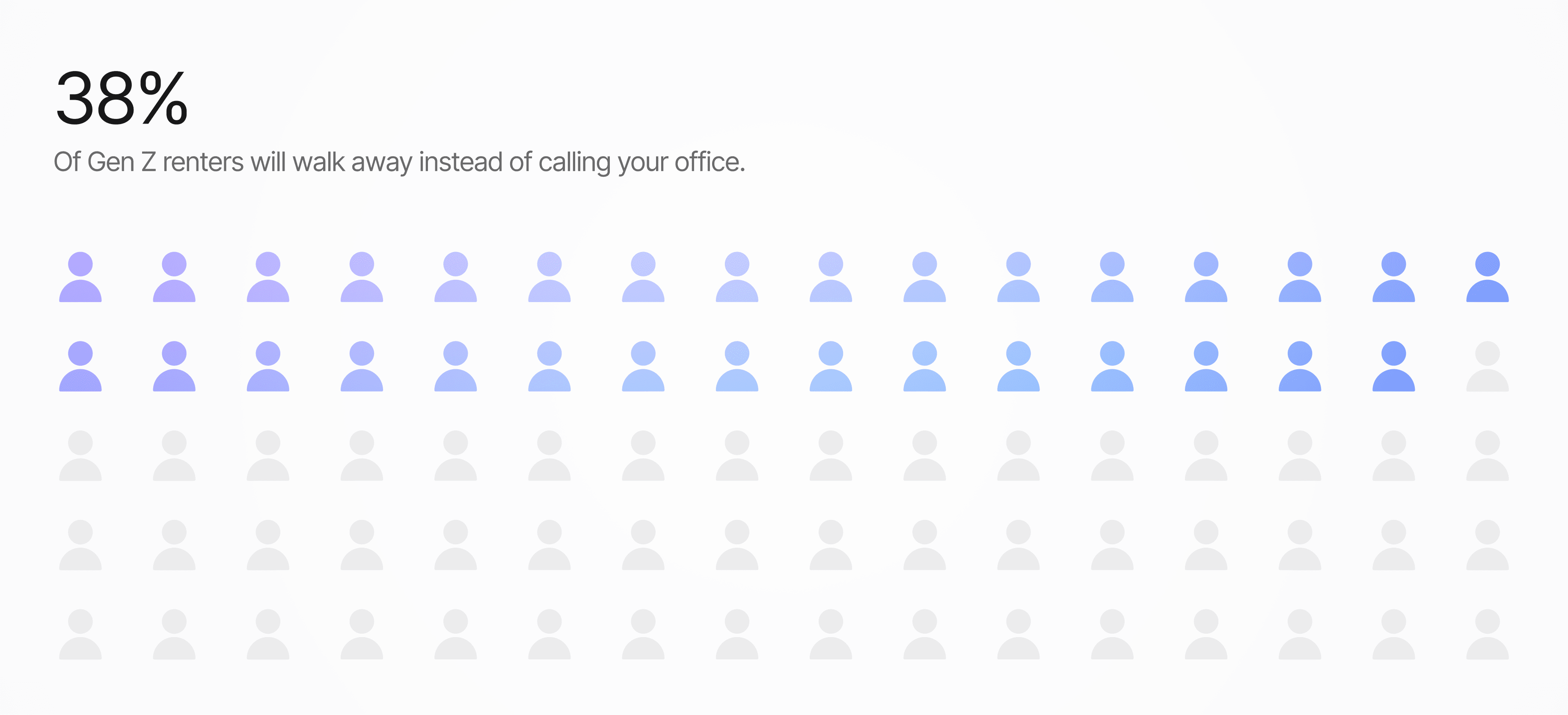
Let’s start with how Gen Z approaches problem-solving. According to Five9's 2025 Customer Experience Report, 94% of Gen Z consumers attempt to solve issues through self-service channels before ever reaching out to a support team. Even more telling: a Gartner study found that 38% of Gen Z customers will abandon their issue entirely if they can't resolve it through a self-service option like a chatbot or knowledge base. We’ve all heard the “Gen Z hates phone calls narrative,” but these data points crystalize just how far they will go to avoid having to interact with support. Picture how this might play out if they can’t schedule a tour on your site without calling a phone number. They’ll probably opt to schedule a tour at a community that allows them to do it directly on their phone.
The self-service expectation is part of a broader pattern. Nearly 80% of Gen Z expects their digital experiences to be AI-powered, and 73% personally pay for AI tools in their daily lives. This is a generation that uses AI the way previous generations used Google. When they interact with a leasing office that can't answer a question at 9pm on a Tuesday, they're comparing that experience to the AI-powered customer service they get from their bank, their streaming platform, and their favorite retailer, setting up an unflattering head-to-head for rental housing operators.
The benchmark keeps moving. Gen Z consumers spend an average of 6.9 hours per day engaging with media and entertainment content, with 89% regularly using multiple screens simultaneously. Their attention is fragmented across platforms that have spent billions of dollars engineering frictionless, personalized experiences. TikTok's algorithm learns what you want before you know you want it. Uber gets you a car in three taps. Netflix serves up recommendations calibrated to your viewing history down to the sub-genre level. These are the experiences that have calibrated Gen Z's expectations for speed, personalization, and access, and bring those expectations with them when they start apartment hunting.
The point for student housing operators is this: their residents are evaluating the leasing, touring, communication, and maintenance experience against the same standards they apply to every other digital interaction in their lives. An operator's real competition for a student resident's attention and loyalty includes every consumer brand that resident interacts with daily, and they’ve got a head start.
Student housing operators feel this pressure more acutely than conventional multifamily operators because they're serving the youngest, most digitally immersed segment of Gen Z during that resident's very first independent living experience. The habits and expectations formed during those first one to four years of renting become the baseline that follows them into conventional multifamily communities after graduation.
So how are the best operators responding? With a multi-pronged approach that addresses the full resident lifecycle, starting at the very top of the funnel.
The leasing experience is where expectation gaps show up first, and where their costs are felt most acutely. With compressed lease-up timelines revolving around narrow seasonal windows and fierce competition for the same shrinking pool of incoming students, slow responses or clunky touring processes are a surefire contributor to negative NOI impact.
The operators gaining ground over their peers in this environment share a common approach: they've restructured their top-of-funnel operations to match the speed, availability, and self-serve access that students already get from every other consumer platform in their lives. We’ll focus on three specific operators: Landmark Properties, Cardinal Group Management, and PeakMade Real Estate, who have demonstrated what the impact of meeting their prospective residents where they want to be met can look like in practice.
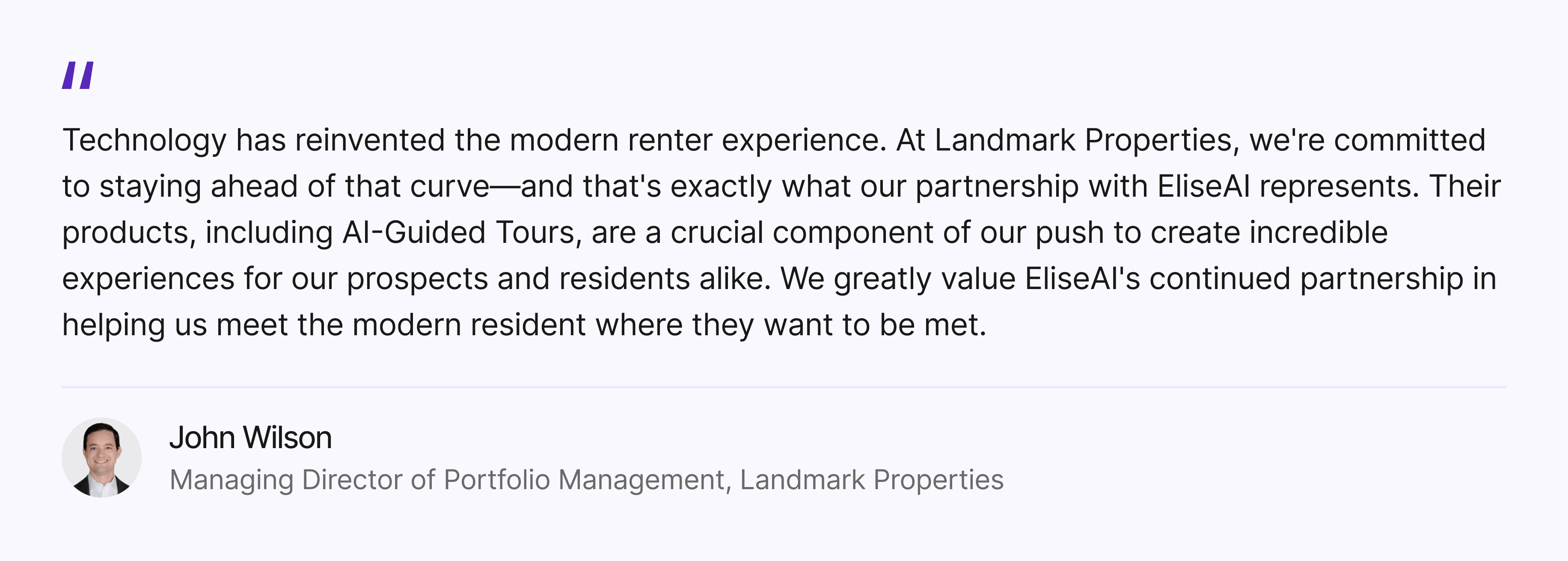
With $15 billion of assets under management, including over 115 student and multifamily communities across the country with more than 72,000 student beds under management, Landmark Properties has proven their ability to operate at scale. In 2025, they recognized that their touring experience had a fundamental mismatch with how their prospects actually behave. Rather than hunting apartments on a traditional 9-to-5 schedule, the Gen Z student resident population takes the time to research communities between classes, late at night, on weekends, with the expectation that they will be able to act on that interest immediately just like they'd browse and buy on any other platform.
Landmark made the decision to deploy the AI-Guided Tour platform across their entire portfolio of 100+ assets based on the results they saw from a strong 3-property pilot, giving prospects access to self-guided touring experiences 24 hours a day, 7 days a week. The model mirrors the kind of low-friction, personalized discovery that students are already conditioned to expect. Landmark found that when they let students browse on their own terms, at their own pace, with relevant information surfaced contextually rather than delivered through a scheduled sales pitch, that it made a concrete impact on conversion rates.
Deploying AI-Guided Tours increased their after-hours touring volume by 42% versus their prior self-guided touring tool, which scored high marks for convenience but failed to deliver the personalized experience that modern eCommerce brands have conditioned us to expect. They realized a nearly 20% delta in lead-to-lease conversion rates with AI-powered lead nurturing baked directly into the platform. Prospective Landmark residents no longer had to choose between convenience and quality when looking to tour on their own time, and it shows in their bottom line.
For Landmark, the strategic logic connects directly back to the demographic pressures outlined in the introduction to this piece. When the total number of prospective student renters is declining, removing friction from the touring experience captures demand that would otherwise leak to competitors with more accessible processes.
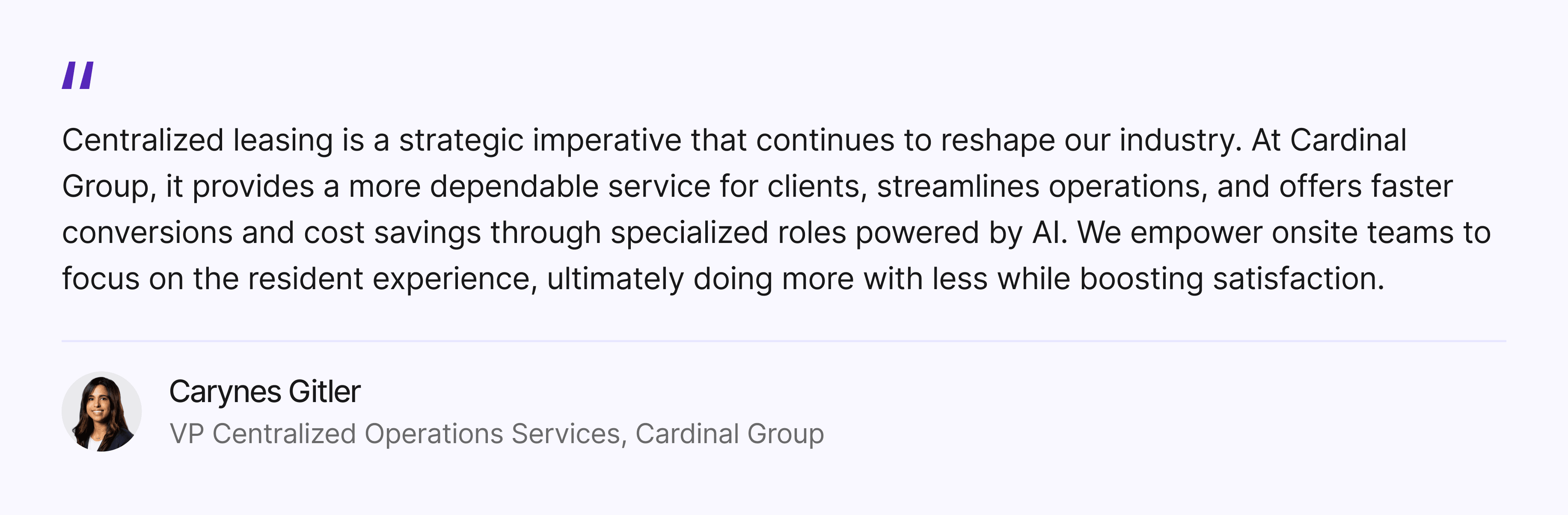
Cardinal Group Companies took a different structural approach to the same underlying problem. Rather than distributing leasing conversations across individual onsite teams, each with varying response times, capacity constraints, and staffing gaps, Cardinal moved their top-of-funnel leasing communications to a centralized team, called CX3.
The centralized model lets Cardinal respond to inquiries faster, route conversations based on prospect intent, and maintain consistent service quality regardless of what's happening at any individual property on a given day. For student housing specifically, where inquiry volume can spike dramatically during peak leasing season, centralization absorbs those surges without the lag that comes from understaffed onsite offices trying to keep up.
AI is a crucial part of that effort, automating 89% of all prospect conversations including 55% of all inbound leasing calls for CX3. The almost standardized nature of initial leasing inquiries—when can I move in, how much does the unit cost, how many roommates will I have—are a perfect candidate for AI-powered automation. Cardinal’s dedicated Customer Sales Specialists only have to enter the loop for edge cases, saving their bandwidth and reducing friction as inquiries become tours around the clock.
The parallels to eCommerce are deliberate. When a student can schedule a tour, get their questions answered, and move through the leasing funnel without waiting for a callback or visiting an office during business hours, the experience starts to feel like the kind of streamlined checkout process they navigate daily on consumer platforms. Cardinal uses AI and centralization to compress the distance between "I'm interested" and "I've scheduled a tour," and in a tight leasing season, that speed advantage compounds quickly.
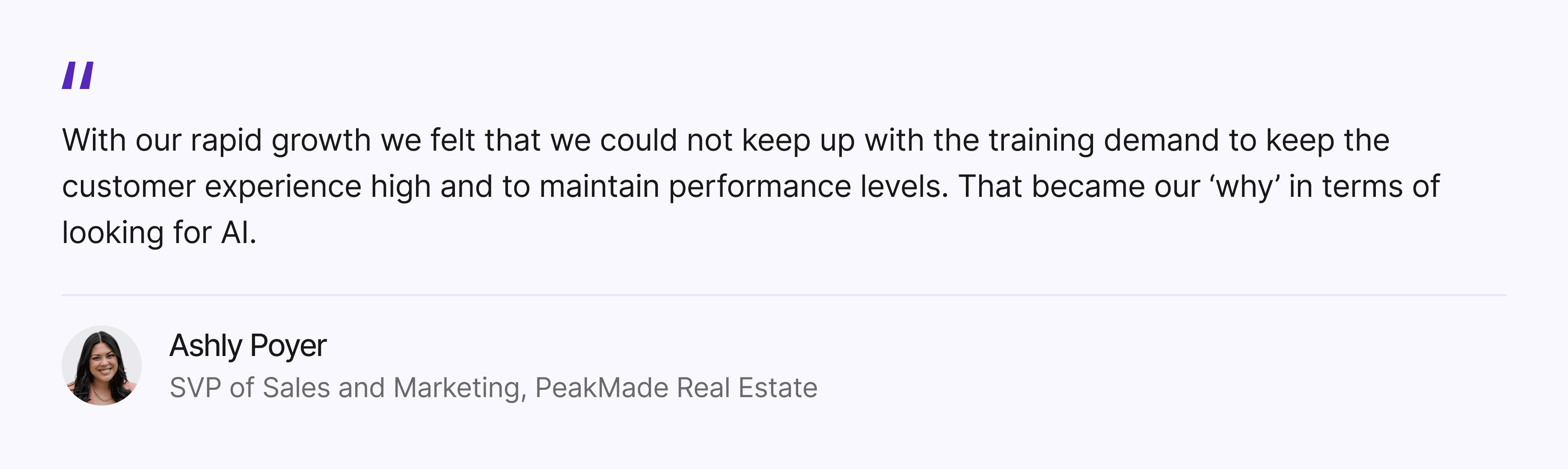
PeakMade Real Estate faces a challenge that amplifies the pressures already baked into student housing: rapid portfolio growth layered on top of chronic staffing turnover in student-staffed leasing positions. Their brand is built on a high-touch, personalized approach to resident service, but maintaining that standard across an expanding footprint with a revolving door of temporary student leasing staff is an operational puzzle that human capital alone can't solve.
PeakMade created a layer of consistent, always-available service that holds regardless of who's sitting at the leasing desk on any given week. New hires ramp up with AI handling the baseline of prospect communication, and the personalized touch that defines PeakMade's brand stays intact even during periods of turnover.
Having AI deeply integrated into the leasing journey has been crucial given the pace of PeakMade’s rapid unit growth, as attempting to hire and train new staff at the pace they’re acquiring new assets would’ve proved near impossible. PeakMade saw a 24% uptick in leads booked via VoiceAI versus their existing call center subscription, leading to a 20% year over year increase in in-person tours.
Beyond the obvious occupancy impact of this AI-infused leasing model, it is also acutely relevant for student housing where leasing roles tend to turn over more frequently than in conventional multifamily. Coupled with the stakes of vacancy loss being heightened by a gradually narrowing prospect pipeline, operators (like PeakMade) that can decouple service quality from individual staff tenure realize structural advantages that grow more valuable as competition for residents intensifies.
Each of these operators arrived at AI-powered leasing from a different starting point—Landmark through touring access and “always-on” service, Cardinal through operational centralization for efficiency and scalability, and PeakMade for staffing resilience in the face of portfolio growth— but they converged on the same outcome: removing the friction between a student's intent to rent and their ability to act on that intent. In a market defined by compressed timelines and a shrinking prospect pool, the operators who capture demand fastest are the ones who will maintain occupancy as the demographic headwinds pick up.
But AI-powered student housing journeys don’t stop at leasing—that’s simply where they begin.
The expectation gap that drives leasing behavior doesn't reset once a student signs a lease. If anything, the bar goes higher. During the leasing process, a student is one of many prospects evaluating a community. Once they move in they expect the experience to feel personalized, responsive to their specific needs, available on their schedule, and delivered through the channels they actually use.
For student housing operators, this phase of the resident lifecycle carries a unique emotional dimension. Most student residents are navigating independent living for the first time. The garbage disposal jams, circuit breaker trips, and HVAC units that make a noise they've never heard before are moments that used to end with a call to mom or dad. Operators that can step into that gap with genuinely helpful, context-aware support are shaping how an entire generation of renters learns to interact with their housing provider.
Two operators in particular have demonstrated what AI-powered resident services look like in practice: Student Quarters on the maintenance side, and The Scion Group on the feedback and insights side.
Student Quarters recognized that a significant portion of their emergency maintenance call volume stemmed from issues that residents could realistically handle themselves if they had the right guidance at the right moment. The challenge was delivering that guidance how students wanted to receive it. A static FAQ page buried on a resident portal wasn't going to cut it for a generation that expects conversational, context-aware assistance on demand, and mom and dad aren’t around to solve those little nagging fixes for their kids.
Student Quarters built out detailed maintenance self-help workflows accessible via phone and text, walking residents through common troubleshooting steps in real time. A student dealing with a tripped breaker at 11pm on a Wednesday doesn't need to wait for a maintenance tech or sit on hold with an answering service, but can instead text in, describe the issue, and receive step-by-step guidance tailored to their specific community's systems and equipment.
The results were significant: Student Quarters saw a 26% reduction in emergency maintenance call volume after implementing these AI-powered self-help workflows. That's a meaningful operational win that resulted in fewer after-hours dispatch calls, lower emergency maintenance costs ($27,624 in annualized overtime maintenance cost savings to be exact), and reduced burden on maintenance teams, resulting in 533 maintenance hours saved in Q1 2025.
But the resident experience dimension matters just as much as the operational efficiency. For a 19-year-old who has never lived on their own, getting immediate, helpful guidance on a maintenance issue through a familiar channel like text builds confidence and trust in their housing provider. That positive association sticks with them, builds loyalty, and increases renewal rates. It also shapes what they'll expect from their next apartment, and the one after that, so take note multifamily operators.
The Scion Group, one of the largest student housing owner-operators in North America, had a different challenge on the resident experience side. They weren't lacking resident feedback by any means—in fact, it was quite the opposite. With tens of thousands of student residents across their portfolio, they had an enormous volume of resident communication flowing through their systems daily. The true challenge was parsing through this mass of unstructured data and extracting actionable insight from that volume at a pace that could actually influence operational decisions, given manual review processes couldn't keep up. By the time a pattern surfaced through traditional channels, like traditional survey tools and Google reviews, the semester was often already underway and the window to address the issue had narrowed or closed entirely.
Scion deployed SentimentAI tool to analyze resident conversations in real time, scraping insights from the actual language students use when they communicate with their communities. Rather than relying on periodic surveys that capture a filtered snapshot, SentimentAI surfaces trends, pain points, and sentiment shifts as they emerge, giving Scion's operations teams the ability to intervene proactively rather than reactively.
Switching their feedback gathering approach from conventional tools to real time sentiment analysis based on unstructured conversational data significantly increased Scion’s ability to act on Gen Z resident feedback. They doubled their response rate and saved 40 hours per week across two employees for data analysis, allowing them to boost resident NPS by 22 points.
For student housing specifically, this kind of real-time feedback intelligence is a competitive weapon. With operators fighting over a gradually contracting resident base, understanding what your current residents actually think, and subsequently acting on it, creates a retention advantage with direct occupancy implications. Scion has cracked that code, and the results show.
It’s in the compounding effect of full-lifecycle integration where real operational leverage is created. When AI handles leasing communication, touring, maintenance triage, collections, renewals, and resident feedback within a single connected platform, each stage generates data and context that makes the next stage more effective. Leasing communication patterns inform how touring experiences get optimized. Maintenance interaction data reveals which communities need capital investment. Sentiment trends during the middle of a lease term can predict renewal likelihood months before the renewal conversation happens. Siloed point solutions, by contrast, operate with incomplete information, leaving value on the table at every handoff.
The operators in this paper have recognized this and built accordingly.
Student housing, with its compressed timelines, seasonal intensity, and demanding resident demographics, forced these operators to think in terms of full-lifecycle integration earlier than conventional multifamily has had to.
Conventional multifamily faces an inflection point. The renter classes that tolerated voicemail, paper applications, and Monday-through-Friday office hours are shrinking. The generations replacing them have been trained by the operators in this paper to expect something entirely different. They're entering your communities right now, and they're bringing those expectations with them. The conventional multifamily operators who will thrive in this environment are the ones building the infrastructure to meet these residents now, before the demographic math becomes unavoidable.
The playbook for winning and retaining Generation Z renters already exists. The question is who will adopt it first, and how large the gap between them and their competitors will grow.
Student housing has quietly become one of the most competitive corners of the rental housing industry. On paper, the fundamentals look strong: national occupancy hit 95.1% for the 2025-2026 academic year, average asking rent reached $1,017 per bed (up 3.4% year-over-year), and institutional capital continues to flow into the sector. By most measures, student housing is healthy, if not booming.
However, there’s trouble lurking beneath seemingly calm waters.
The bad news: the number of U.S. high school graduates is projected to decline steadily, with some estimates pointing to a drop of up to 13% by 2041. Student housing operators are staring down the barrel of a slow-moving compression of the entire addressable market in response to demographic pressures and changing workforce realities that reduce the amount of students who need housing.
At the same time, today’s student residents (and the student residents of the future) that operators are competing for have never been harder to impress. Today's student renter demographic is largely composed of members of Gen Z, whose steady exposure to consumer-grade experiences on platforms like TikTok, Uber, and Netflix have conditioned them to expect instant access to everything and AI-powered personalization as a default. For most of them, their time in student housing is their first independent living experience. The expectations they form here will follow them into the conventional multifamily market for decades.
This creates a dual pressure that's unique to student housing:
For the conventional multifamily operators out there, let this serve as a wakeup call: these students are going to graduate, and will walk into your leasing offices (or, more likely, onto your TikTok pages at 12:13am) carrying every expectation that these innovative student housing operators have conditioned them to expect. They won't accept a step backwards because they moved out of student housing and into conventional multifamily communities.
This whitepaper examines how leading student housing operators are responding to these twin pressures, what their results look like in practice, and what their experiences can teach the broader multifamily industry. The next generation of renters is being shaped right now, on college campuses across the country. The question is whether most operators will be ready for them when they arrive.
Before we get into how student housing operators are responding to external pressures, it's worth spending a moment on what exactly they're responding to. The phrase "digital natives" gets thrown around constantly in multifamily marketing, but the actual behavioral data behind Gen Z's consumer expectations paints a sharper and more demanding picture than most operators realize.
Let’s start with how Gen Z approaches problem-solving. According to Five9's 2025 Customer Experience Report, 94% of Gen Z consumers attempt to solve issues through self-service channels before ever reaching out to a support team. Even more telling: a Gartner study found that 38% of Gen Z customers will abandon their issue entirely if they can't resolve it through a self-service option like a chatbot or knowledge base. We’ve all heard the “Gen Z hates phone calls narrative,” but these data points crystalize just how far they will go to avoid having to interact with support. Picture how this might play out if they can’t schedule a tour on your site without calling a phone number. They’ll probably opt to schedule a tour at a community that allows them to do it directly on their phone.
The self-service expectation is part of a broader pattern. Nearly 80% of Gen Z expects their digital experiences to be AI-powered, and 73% personally pay for AI tools in their daily lives. This is a generation that uses AI the way previous generations used Google. When they interact with a leasing office that can't answer a question at 9pm on a Tuesday, they're comparing that experience to the AI-powered customer service they get from their bank, their streaming platform, and their favorite retailer, setting up an unflattering head-to-head for rental housing operators.
The benchmark keeps moving. Gen Z consumers spend an average of 6.9 hours per day engaging with media and entertainment content, with 89% regularly using multiple screens simultaneously. Their attention is fragmented across platforms that have spent billions of dollars engineering frictionless, personalized experiences. TikTok's algorithm learns what you want before you know you want it. Uber gets you a car in three taps. Netflix serves up recommendations calibrated to your viewing history down to the sub-genre level. These are the experiences that have calibrated Gen Z's expectations for speed, personalization, and access, and bring those expectations with them when they start apartment hunting.
The point for student housing operators is this: their residents are evaluating the leasing, touring, communication, and maintenance experience against the same standards they apply to every other digital interaction in their lives. An operator's real competition for a student resident's attention and loyalty includes every consumer brand that resident interacts with daily, and they’ve got a head start.
Student housing operators feel this pressure more acutely than conventional multifamily operators because they're serving the youngest, most digitally immersed segment of Gen Z during that resident's very first independent living experience. The habits and expectations formed during those first one to four years of renting become the baseline that follows them into conventional multifamily communities after graduation.
So how are the best operators responding? With a multi-pronged approach that addresses the full resident lifecycle, starting at the very top of the funnel.
The leasing experience is where expectation gaps show up first, and where their costs are felt most acutely. With compressed lease-up timelines revolving around narrow seasonal windows and fierce competition for the same shrinking pool of incoming students, slow responses or clunky touring processes are a surefire contributor to negative NOI impact.
The operators gaining ground over their peers in this environment share a common approach: they've restructured their top-of-funnel operations to match the speed, availability, and self-serve access that students already get from every other consumer platform in their lives. We’ll focus on three specific operators: Landmark Properties, Cardinal Group Management, and PeakMade Real Estate, who have demonstrated what the impact of meeting their prospective residents where they want to be met can look like in practice.
With $15 billion of assets under management, including over 115 student and multifamily communities across the country with more than 72,000 student beds under management, Landmark Properties has proven their ability to operate at scale. In 2025, they recognized that their touring experience had a fundamental mismatch with how their prospects actually behave. Rather than hunting apartments on a traditional 9-to-5 schedule, the Gen Z student resident population takes the time to research communities between classes, late at night, on weekends, with the expectation that they will be able to act on that interest immediately just like they'd browse and buy on any other platform.
Landmark made the decision to deploy the AI-Guided Tour platform across their entire portfolio of 100+ assets based on the results they saw from a strong 3-property pilot, giving prospects access to self-guided touring experiences 24 hours a day, 7 days a week. The model mirrors the kind of low-friction, personalized discovery that students are already conditioned to expect. Landmark found that when they let students browse on their own terms, at their own pace, with relevant information surfaced contextually rather than delivered through a scheduled sales pitch, that it made a concrete impact on conversion rates.
Deploying AI-Guided Tours increased their after-hours touring volume by 42% versus their prior self-guided touring tool, which scored high marks for convenience but failed to deliver the personalized experience that modern eCommerce brands have conditioned us to expect. They realized a nearly 20% delta in lead-to-lease conversion rates with AI-powered lead nurturing baked directly into the platform. Prospective Landmark residents no longer had to choose between convenience and quality when looking to tour on their own time, and it shows in their bottom line.
For Landmark, the strategic logic connects directly back to the demographic pressures outlined in the introduction to this piece. When the total number of prospective student renters is declining, removing friction from the touring experience captures demand that would otherwise leak to competitors with more accessible processes.
Cardinal Group Companies took a different structural approach to the same underlying problem. Rather than distributing leasing conversations across individual onsite teams, each with varying response times, capacity constraints, and staffing gaps, Cardinal moved their top-of-funnel leasing communications to a centralized team, called CX3.
The centralized model lets Cardinal respond to inquiries faster, route conversations based on prospect intent, and maintain consistent service quality regardless of what's happening at any individual property on a given day. For student housing specifically, where inquiry volume can spike dramatically during peak leasing season, centralization absorbs those surges without the lag that comes from understaffed onsite offices trying to keep up.
AI is a crucial part of that effort, automating 89% of all prospect conversations including 55% of all inbound leasing calls for CX3. The almost standardized nature of initial leasing inquiries—when can I move in, how much does the unit cost, how many roommates will I have—are a perfect candidate for AI-powered automation. Cardinal’s dedicated Customer Sales Specialists only have to enter the loop for edge cases, saving their bandwidth and reducing friction as inquiries become tours around the clock.
The parallels to eCommerce are deliberate. When a student can schedule a tour, get their questions answered, and move through the leasing funnel without waiting for a callback or visiting an office during business hours, the experience starts to feel like the kind of streamlined checkout process they navigate daily on consumer platforms. Cardinal uses AI and centralization to compress the distance between "I'm interested" and "I've scheduled a tour," and in a tight leasing season, that speed advantage compounds quickly.
PeakMade Real Estate faces a challenge that amplifies the pressures already baked into student housing: rapid portfolio growth layered on top of chronic staffing turnover in student-staffed leasing positions. Their brand is built on a high-touch, personalized approach to resident service, but maintaining that standard across an expanding footprint with a revolving door of temporary student leasing staff is an operational puzzle that human capital alone can't solve.
PeakMade created a layer of consistent, always-available service that holds regardless of who's sitting at the leasing desk on any given week. New hires ramp up with AI handling the baseline of prospect communication, and the personalized touch that defines PeakMade's brand stays intact even during periods of turnover.
Having AI deeply integrated into the leasing journey has been crucial given the pace of PeakMade’s rapid unit growth, as attempting to hire and train new staff at the pace they’re acquiring new assets would’ve proved near impossible. PeakMade saw a 24% uptick in leads booked via VoiceAI versus their existing call center subscription, leading to a 20% year over year increase in in-person tours.
Beyond the obvious occupancy impact of this AI-infused leasing model, it is also acutely relevant for student housing where leasing roles tend to turn over more frequently than in conventional multifamily. Coupled with the stakes of vacancy loss being heightened by a gradually narrowing prospect pipeline, operators (like PeakMade) that can decouple service quality from individual staff tenure realize structural advantages that grow more valuable as competition for residents intensifies.
Each of these operators arrived at AI-powered leasing from a different starting point—Landmark through touring access and “always-on” service, Cardinal through operational centralization for efficiency and scalability, and PeakMade for staffing resilience in the face of portfolio growth— but they converged on the same outcome: removing the friction between a student's intent to rent and their ability to act on that intent. In a market defined by compressed timelines and a shrinking prospect pool, the operators who capture demand fastest are the ones who will maintain occupancy as the demographic headwinds pick up.
But AI-powered student housing journeys don’t stop at leasing—that’s simply where they begin.
The expectation gap that drives leasing behavior doesn't reset once a student signs a lease. If anything, the bar goes higher. During the leasing process, a student is one of many prospects evaluating a community. Once they move in they expect the experience to feel personalized, responsive to their specific needs, available on their schedule, and delivered through the channels they actually use.
For student housing operators, this phase of the resident lifecycle carries a unique emotional dimension. Most student residents are navigating independent living for the first time. The garbage disposal jams, circuit breaker trips, and HVAC units that make a noise they've never heard before are moments that used to end with a call to mom or dad. Operators that can step into that gap with genuinely helpful, context-aware support are shaping how an entire generation of renters learns to interact with their housing provider.
Two operators in particular have demonstrated what AI-powered resident services look like in practice: Student Quarters on the maintenance side, and The Scion Group on the feedback and insights side.
Student Quarters recognized that a significant portion of their emergency maintenance call volume stemmed from issues that residents could realistically handle themselves if they had the right guidance at the right moment. The challenge was delivering that guidance how students wanted to receive it. A static FAQ page buried on a resident portal wasn't going to cut it for a generation that expects conversational, context-aware assistance on demand, and mom and dad aren’t around to solve those little nagging fixes for their kids.
Student Quarters built out detailed maintenance self-help workflows accessible via phone and text, walking residents through common troubleshooting steps in real time. A student dealing with a tripped breaker at 11pm on a Wednesday doesn't need to wait for a maintenance tech or sit on hold with an answering service, but can instead text in, describe the issue, and receive step-by-step guidance tailored to their specific community's systems and equipment.
The results were significant: Student Quarters saw a 26% reduction in emergency maintenance call volume after implementing these AI-powered self-help workflows. That's a meaningful operational win that resulted in fewer after-hours dispatch calls, lower emergency maintenance costs ($27,624 in annualized overtime maintenance cost savings to be exact), and reduced burden on maintenance teams, resulting in 533 maintenance hours saved in Q1 2025.
But the resident experience dimension matters just as much as the operational efficiency. For a 19-year-old who has never lived on their own, getting immediate, helpful guidance on a maintenance issue through a familiar channel like text builds confidence and trust in their housing provider. That positive association sticks with them, builds loyalty, and increases renewal rates. It also shapes what they'll expect from their next apartment, and the one after that, so take note multifamily operators.
The Scion Group, one of the largest student housing owner-operators in North America, had a different challenge on the resident experience side. They weren't lacking resident feedback by any means—in fact, it was quite the opposite. With tens of thousands of student residents across their portfolio, they had an enormous volume of resident communication flowing through their systems daily. The true challenge was parsing through this mass of unstructured data and extracting actionable insight from that volume at a pace that could actually influence operational decisions, given manual review processes couldn't keep up. By the time a pattern surfaced through traditional channels, like traditional survey tools and Google reviews, the semester was often already underway and the window to address the issue had narrowed or closed entirely.
Scion deployed SentimentAI tool to analyze resident conversations in real time, scraping insights from the actual language students use when they communicate with their communities. Rather than relying on periodic surveys that capture a filtered snapshot, SentimentAI surfaces trends, pain points, and sentiment shifts as they emerge, giving Scion's operations teams the ability to intervene proactively rather than reactively.
Switching their feedback gathering approach from conventional tools to real time sentiment analysis based on unstructured conversational data significantly increased Scion’s ability to act on Gen Z resident feedback. They doubled their response rate and saved 40 hours per week across two employees for data analysis, allowing them to boost resident NPS by 22 points.
For student housing specifically, this kind of real-time feedback intelligence is a competitive weapon. With operators fighting over a gradually contracting resident base, understanding what your current residents actually think, and subsequently acting on it, creates a retention advantage with direct occupancy implications. Scion has cracked that code, and the results show.
It’s in the compounding effect of full-lifecycle integration where real operational leverage is created. When AI handles leasing communication, touring, maintenance triage, collections, renewals, and resident feedback within a single connected platform, each stage generates data and context that makes the next stage more effective. Leasing communication patterns inform how touring experiences get optimized. Maintenance interaction data reveals which communities need capital investment. Sentiment trends during the middle of a lease term can predict renewal likelihood months before the renewal conversation happens. Siloed point solutions, by contrast, operate with incomplete information, leaving value on the table at every handoff.
The operators in this paper have recognized this and built accordingly.
Student housing, with its compressed timelines, seasonal intensity, and demanding resident demographics, forced these operators to think in terms of full-lifecycle integration earlier than conventional multifamily has had to.


