



For decades, career growth in property management has followed a predictable sequence: leasing agent, assistant manager, community manager, regional manager, and so on. Each rung of the ladder meant more units, more responsibility, and more of the same (or similar) work on a larger scale.
That model worked when the industry operated one way. But as centralized operations and AI reshape how multifamily companies run, a different kind of career trajectory is starting to take shape, one that rewards specialization over generalism, portfolio-level thinking over single-asset management, and adaptability over tenure.
We spoke with three real multifamily professionals at different points in their career and in different phases of this shift. While their backgrounds are different, with some rising up the ranks of the onsite operations and others entering the industry from the outside, the bottom line is clear: centralization opened doors for their growth that the traditional multifamily career track never could.
What can we learn from their stories?
.svg)

Navigating The Onsite “Ceiling” Problem
Ask enough onsite operators about their expected career trajectory and you'll hear a similar frustration surface. Leveling up means becoming a generalist, and generalism means doing a lot of things you potentially don't enjoy.
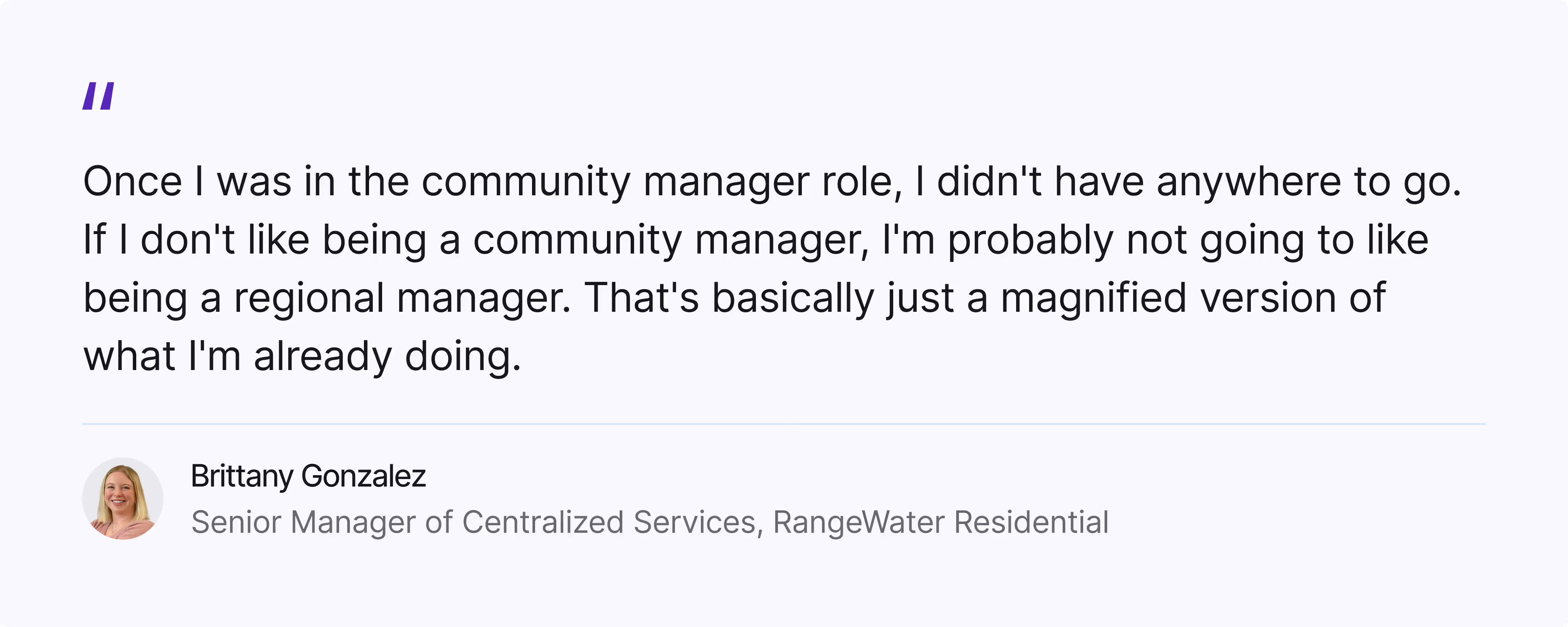
Brittany Gonzalez experienced that friction firsthand. She started in resident services working for Cardinal Group Management at a student housing community near Penn State, climbed the ladder to assistant manager, and eventually became a community manager. On paper, it was a clear upward trajectory. In practice, it didn’t feel like it.
As an assistant manager, Brittany gravitated toward the work she found engaging: delinquency management, ownership reporting, invoicing, and financials. She was good at it. But the community manager role required her to sacrifice depth on her focus areas and spread herself thin across aspects of the role including leasing and resident interaction, the parts of the job she liked least.
Isaiah Aguilar tells a version of the same story from a different angle. He entered multifamily as a leasing agent in 2022 and immediately noticed that the career progression felt disjointed. You go from a sales-focused leasing role to an assistant manager position that demands financial acumen and legal knowledge, with little training bridging the gap. Then, the community manager role shifts again toward budgeting and high-level performance.
The traditional ladder assumes that people want to climb vertically through a stack of increasingly broad roles. For many operators, what they actually want is to go deeper, not wider, and centralization enables that.


Prepping for A Different Kind of Move
When centralized operations teams started forming at companies like Cardinal Group, Brittany saw an opportunity. Jacob Kosior, then VP of Centralized Services at Cardinal (now VP of Client Strategy at EliseAI), was running lunch-and-learns explaining how the model worked, what it meant for communities and ownership groups, and what it entailed for the people who would staff these teams.
Brittany attended one of those sessions and knew immediately that this was the job she wanted. She knew that making a lateral shift into a role that better aligned with her strengths would open future doors she couldn't see yet. Some of her peers were skeptical, and a few felt she was taking a step back (or stepping off the ladder entirely). But Brittany's calculus was straightforward: she had no drive to continue climbing the ranks on the traditional growth path. Centralization created a new opportunity.
That bet paid off. She went from centralized specialist to team lead to, eventually, Senior Manager of Centralized Services at RangeWater Residential, one of the largest operators in the country.
.avif)
Seeing Centralization as Career Acceleration
For those already in the industry, centralization can compress career timelines in ways that onsite roles rarely do.
Isaiah went from leasing agent to assistant manager to a corporate role to centralized team lead within roughly three years, skipping the community manager rung entirely. At his current operator, S2 Residential, he oversees centralized delinquency operations across the company's entire portfolio.
The results he's driving are tangible. At one property, his team increased collected income by 11% after standardizing the collections process. At a 400-unit asset that had been writing off over $100,000 in delinquency every month, his team brought that number below $80,000 before the month was even halfway through. The lever was straightforward: consistent follow-up schedules and standardized filing timelines applied uniformly, rather than case-by-case judgment calls that varied from site to site.
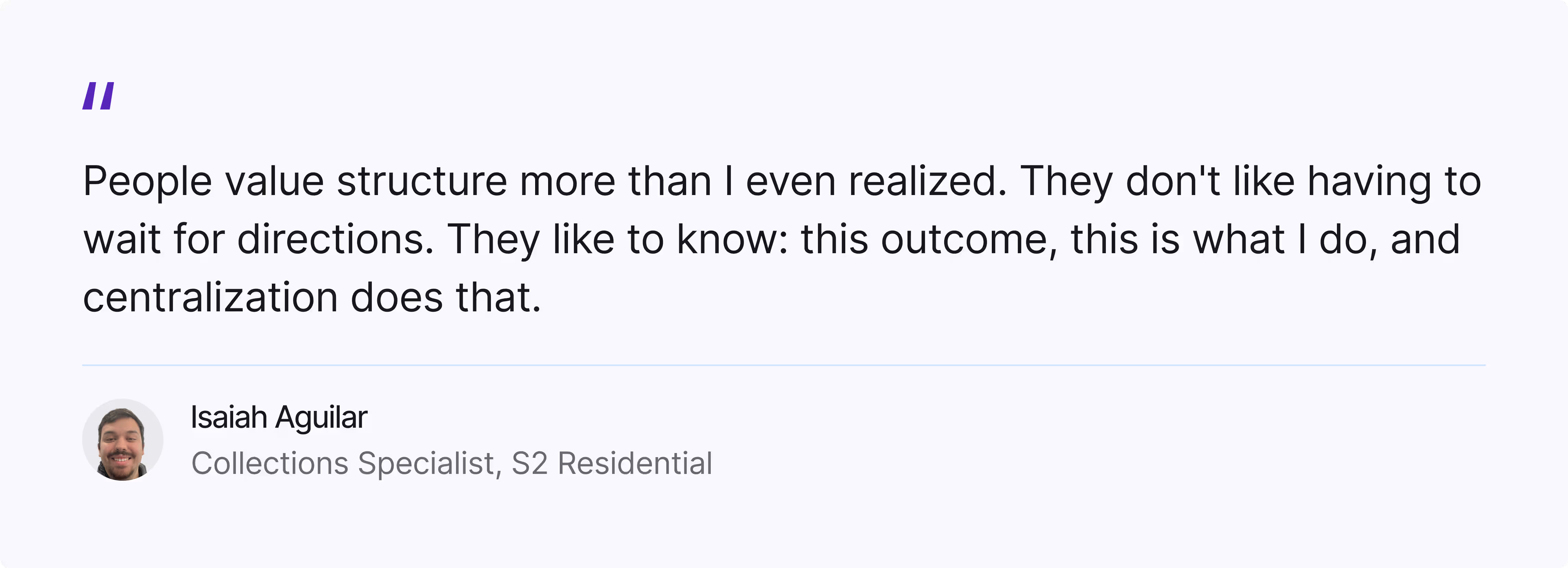
What centralization gave Isaiah, beyond the career jump, was exposure to problems at scale. Managing delinquency at one property taught him how to collect rent. Managing it across an entire portfolio taught him how to build systems that scale. The distinction between doing the work and designing how the work gets done is where the skill development accelerates, and where Isaiah has seen his career accelerate the fastest.
Unlocking Outside Perspectives with Centralization
Not every path into centralized leadership runs through an onsite career. Chris Fields came to multifamily from e-commerce marketing, an industry noted for better data attribution, faster iteration cycles, and a fundamentally different relationship between marketing and revenue creation.
When he joined Kittle Property Group, the gap was immediately apparent. Marketing was decentralized and difficult to measure. His first move was to centralize all marketing operations, recognizing that decentralized marketing across 150 properties, with varying levels of compliance awareness and no standardized workflows, was a liability.
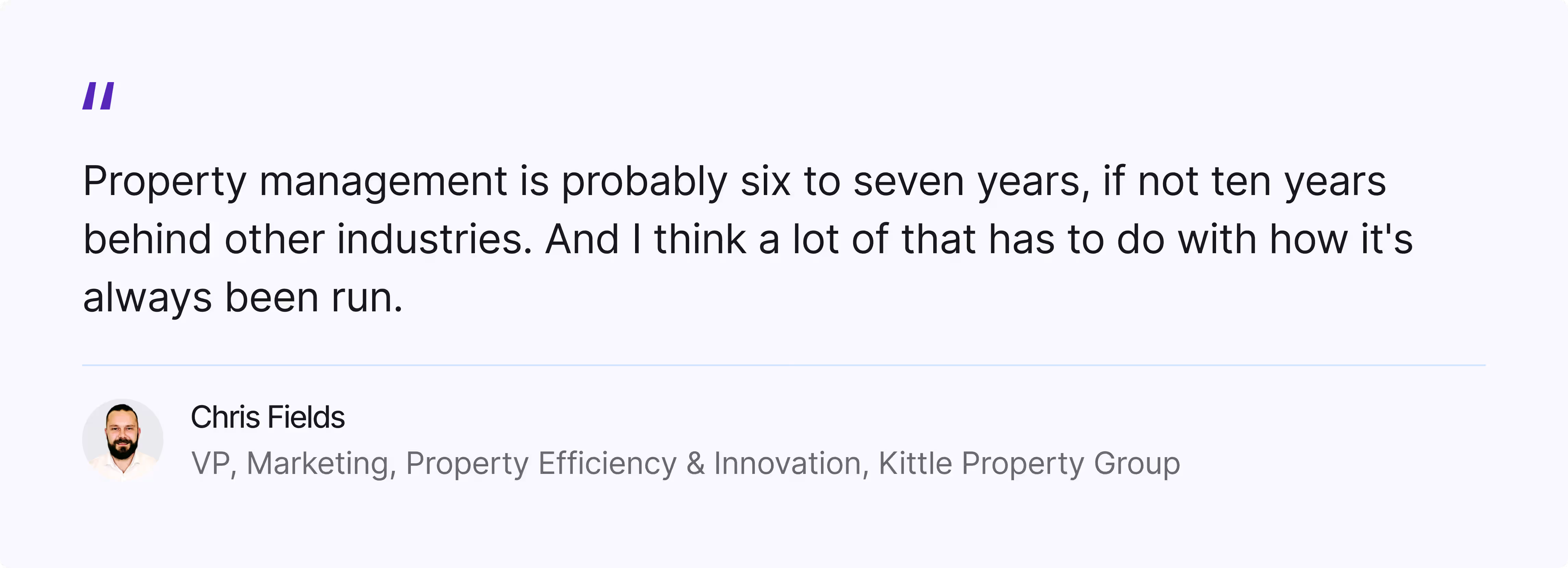
Today, Chris manages marketing for Kittle's entire portfolio with a team of five. The team uses AI heavily and operates off a centralized production calendar with 60-day lead times. He's had almost zero turnover in four years, prioritizing coachability and adaptability over industry experience to keep turnover down.
His story matters for the career progression argument because it demonstrates something the industry needs to internalize: centralization makes multifamily accessible to skilled professionals from adjacent fields. And those professionals bring operational rigor that the industry has historically lacked. Chris sees the people who adapt to technology as the ones who are set up for success. For him, coachability, adaptability, and the ability to critically think are far more important than a college degree or multifamily background.
Seeing What Centralization Actually Changes
Across all three stories, the same structural shift keeps surfacing. The traditional model rewards breadth: manage one property, take on more units, repeat. Centralization rewards depth: specialize in what you're best at, apply it across a portfolio, and build skills that translate upward.
That shift has downstream effects on what leadership looks like in multifamily. Brittany gained exposure to multiple markets and asset types by working centrally, aggregating experience that a single-property community manager would take years to accumulate. Isaiah developed project rollout and data analysis skills that didn't exist in his onsite toolkit. Chris brought a systems-thinking approach from outside the industry entirely.
These are the competencies that executive roles increasingly require. And centralization is producing them faster than the traditional path ever did.
Addressing The Headcount Myth That Won't Die
Every person we spoke with raised the same concern unprompted: the fear that centralization eliminates jobs.
The perception is persistent and understandable. When onsite teams hear that an offsite team is taking over tasks they’ve traditionally owned, the instinct is to feel threatened. But the reality, as all three interviewees described it, looks different. Centralized roles typically fill gaps created by attrition, not layoffs. They reduce workload onsite rather than reducing headcount. And they create entirely new positions, including centralized specialists, team leads, operations managers, that didn't previously exist in most org charts.
For Isaiah, centralization represents a support channel, providing extra hands for often short-staffed onsite teams. With centralization, S2’s property teams are freed up for different, higher-value work, like resident retention, rather than chasing outstanding balances.
What Comes Next and How EliseAI Can Help
The traditional career path in multifamily was designed for an operating model that's changing underneath it. Leasing agents who excel at relationship-building shouldn't be forced into back-office financial work as their only path upward. Assistant managers who love data and process shouldn't have to become generalist community managers to advance. And skilled professionals from outside the industry shouldn't be locked out because they didn't start onsite.
Centralization is starting to solve for all of this. The operators we spoke with are already seeing new leadership pipelines form: centralized operations managers, portfolio-level performance leads, revenue operations roles, and AI-enabled operational leadership positions that didn't exist five years ago.
For professionals willing to step into these roles now, while the model is still being built and the talent pool is still thin, the opportunity is significant. As Brittany told us, there's not a ton of people right now who have a foundational background in centralized services. Even though centralization has been the buzzword for the past four or five years, it's still relatively new at most operators. That window won't stay open forever. But for now, centralization is proving to be one of the most promising career accelerants the industry has seen in a long time.
If you're thinking about centralization, or are already on the journey, EliseAI's Strategy and Planning team can help you move faster and avoid the missteps. Built of former management consultants, this team has worked to support hundreds of operators, large and small, across strategy, role design, change management, and AI rollouts. Whether affordable or market rate, fee managed or owned and operated, this team has experience partnering with every type of real estate company. Our work is grounded in data from real implementation, available at no extra cost to all EliseAI partners. To find out more, get in touch with us at centralization@eliseai.com, watch our webinar series on centralization, or grab your copy of the 2026 edition of our 250 page Centralization Playbook.