
Built to Automate & Scale Your Operations
Answer a couple of questions and we'll connect you with the right team member.
Answer a couple of questions and we'll connect you with the right team member.


Of operators have included AI as part of their operating model.
Of operators use multiple AI vendors and 27% are prioritizing consolidation to become more efficient.
Of operators with AI have reduced operating expenses as a result of using the technology.
The 2025 edition of our “State of AI in Multifamily” report drew a straightforward conclusion: AI adoption in multifamily was rapidly becoming table stakes, with 92% of operators expanding their use of AI-powered solutions. One year later, the conversation has evolved. New data from this year reveals two increasingly divided groups of operators: those that simply “have” AI, layering it on top of their existing operations, versus those who are rethinking their operating models and getting more out of AI through organizational re-design around the tools. This report draws on a third-party survey of 350 U.S. multifamily decision-makers and 500 residents to identify where the multifamily industry stands with AI usage today, and where opportunities exist in current deployment strategies.
This transformation comes at an important time for operators. External pressures are mounting, with 89% of teams expecting insurance costs to rise at least moderately this year, 57% worrying about new supply pressuring rents, and industry-wide consolidation becoming more commonplace. Meanwhile, owners continue to push for cost savings, renters continue to expect 24/7 coverage, and onsite teams continue to face capacity challenges. The onus to move from simply layering AI tools into existing workflows to truly restructuring operations around them has never been higher.
The data from this survey points to three key areas where operators are working towards “AI mastery,” becoming AI-native organizations:
1. Scaling rollouts from pilot to full deployment
2. Expanding AI usage across the renter journey to enable compounding returns
3. Consolidating AI vendors to cut the hidden costs of complexity

A year ago, the 2025 edition of this report highlighted a widening gap among operators. It argued that there was no longer a question around whether AI would see mass adoption in multifamily, and that the operators who were on board early would get ahead. A year later, almost everyone has moved on the technology. Nearly nine in ten operators have deployed AI into their operating models, and the old dividing line between the companies that use it and those that do not has mostly disappeared.
However, the AI divide between operators did not vanish. It simply moved. Now that almost every operator has some level of access to AI, the disparity no longer runs between the companies that have it and those that do not. It exists between operators who have simply layered AI on top of current workflows, and the teams rebuilding their operations and day-to-day areas of focus around the technology. Last year, two thirds of operators believed the early movers would gain a permanent advantage. They were right that an advantage opened, but it is now the operators reinventing how they run that are pulling ahead in 2026.
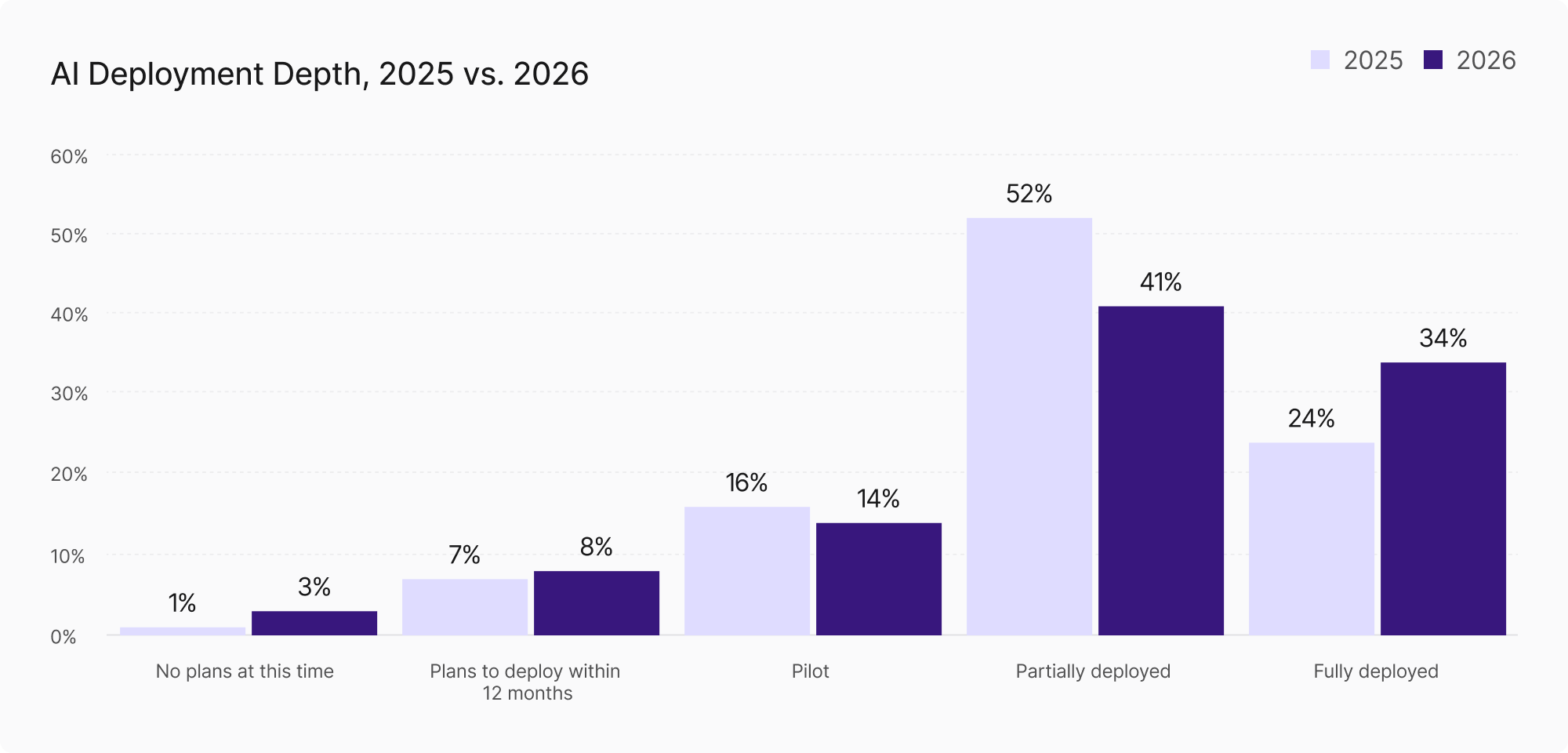
In 2026, 89% of operators have introduced AI to some degree, but only 34% feel they have fully deployed it. The rest are still piloting or partially using it. The encouraging signal is the trajectory: 34% is up from 24% a year ago, which is an increase of almost half in twelve months. The market is steadily moving toward product depth, not just surface-level adoption.
The other aspect that has changed is conviction. In 2025, only about half of operators (51%) felt the industry was still underestimating AI, a sign the market was split on the extent to which it really mattered. That hesitation has largely evaporated, as 89% are now increasing their AI investment year over year, and a quarter of all operators are raising the dedicated budget by over 25%. The conversation has clearly moved past whether AI belongs in multifamily and onto a harder question from operators: Do we simply “have AI”, or are redesigning our operating models around the strengths of the tools? If not, how do we get comfortable enough to take the plunge? Therefore, the rest of this report explores where opportunities are showing up and the importance of further embracing AI in 2026.
If the multifamily AI story in 2025 was about not falling behind, the story in 2026 is about using AI to protect and improve margins against real economic headwinds. There are four key pressures: rising costs, new supply, a stretched workforce, and steeper expectations from owners and renters alike.
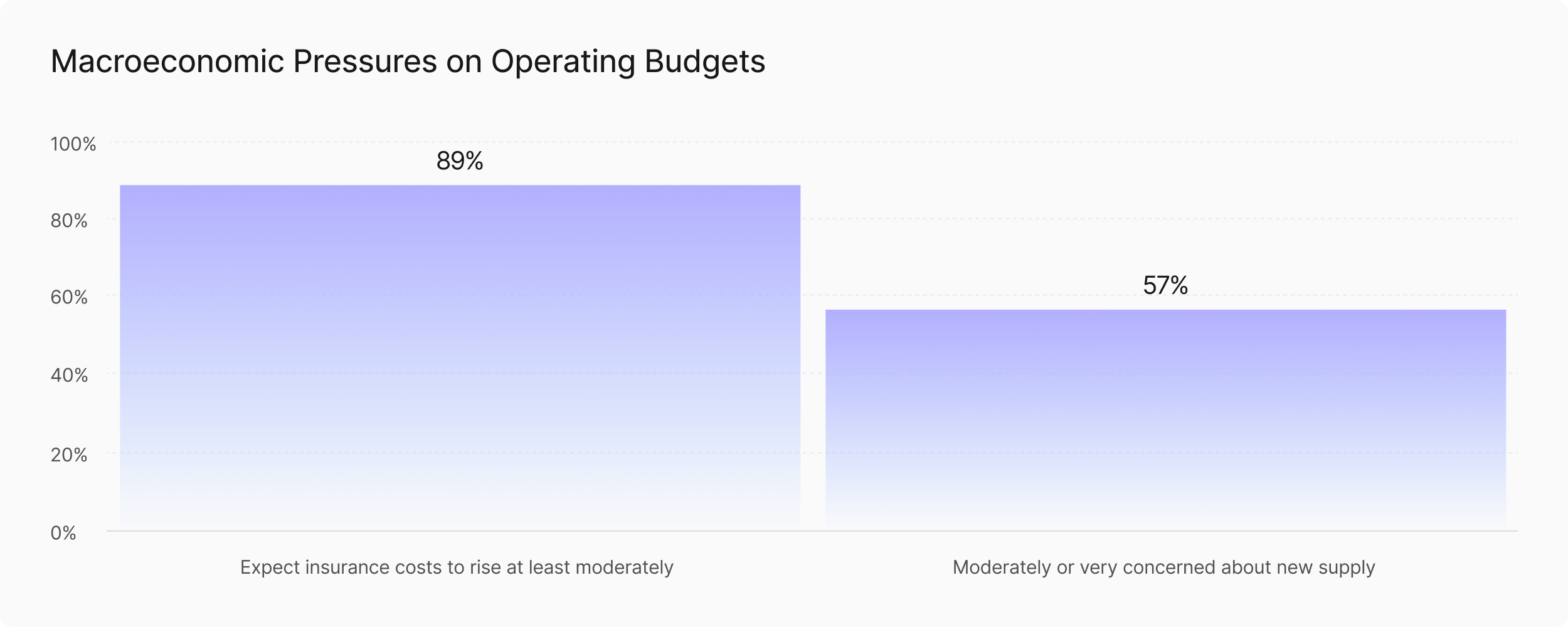
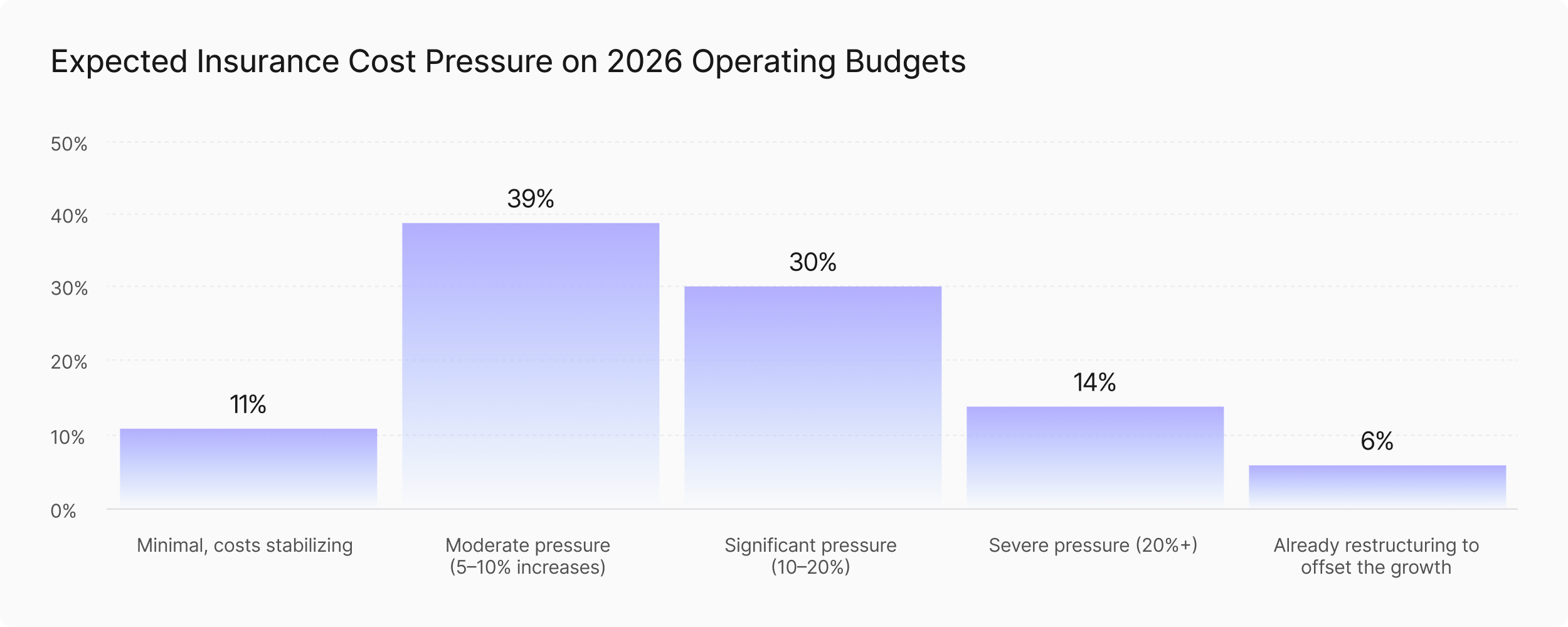
Starting with rising costs, 89% of operators expect insurance to rise at least moderately this year, and 50% are bracing for significant or severe increases. At the same time, 57% are concerned that new supply will weigh on rents.
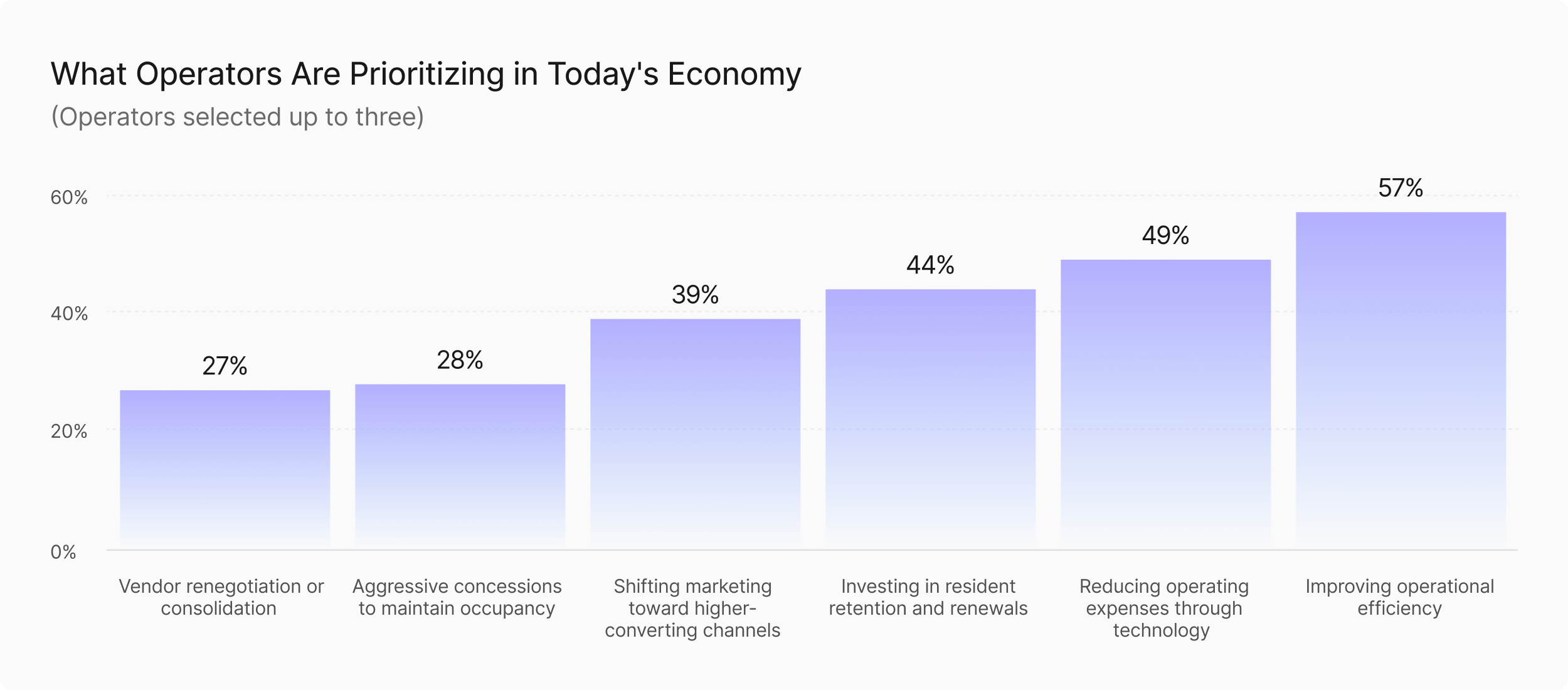
The second pressure, new supply, turns those rising costs into a competition problem. With more units coming online and renters weighing their options, operators cannot always simply raise rents to cover higher expenses; they have to work harder to keep their current properties full. In response to the squeeze, operators are not chasing a single fix. As the most recent chart shows, improving operational efficiency tops the list at 57%. However, it sits right alongside reducing operating expenses through technology (49%), investing in resident retention (44%), and sharpening marketing spend (39%). The common thread is doing more with the same resources, which is exactly where AI is most valuable.
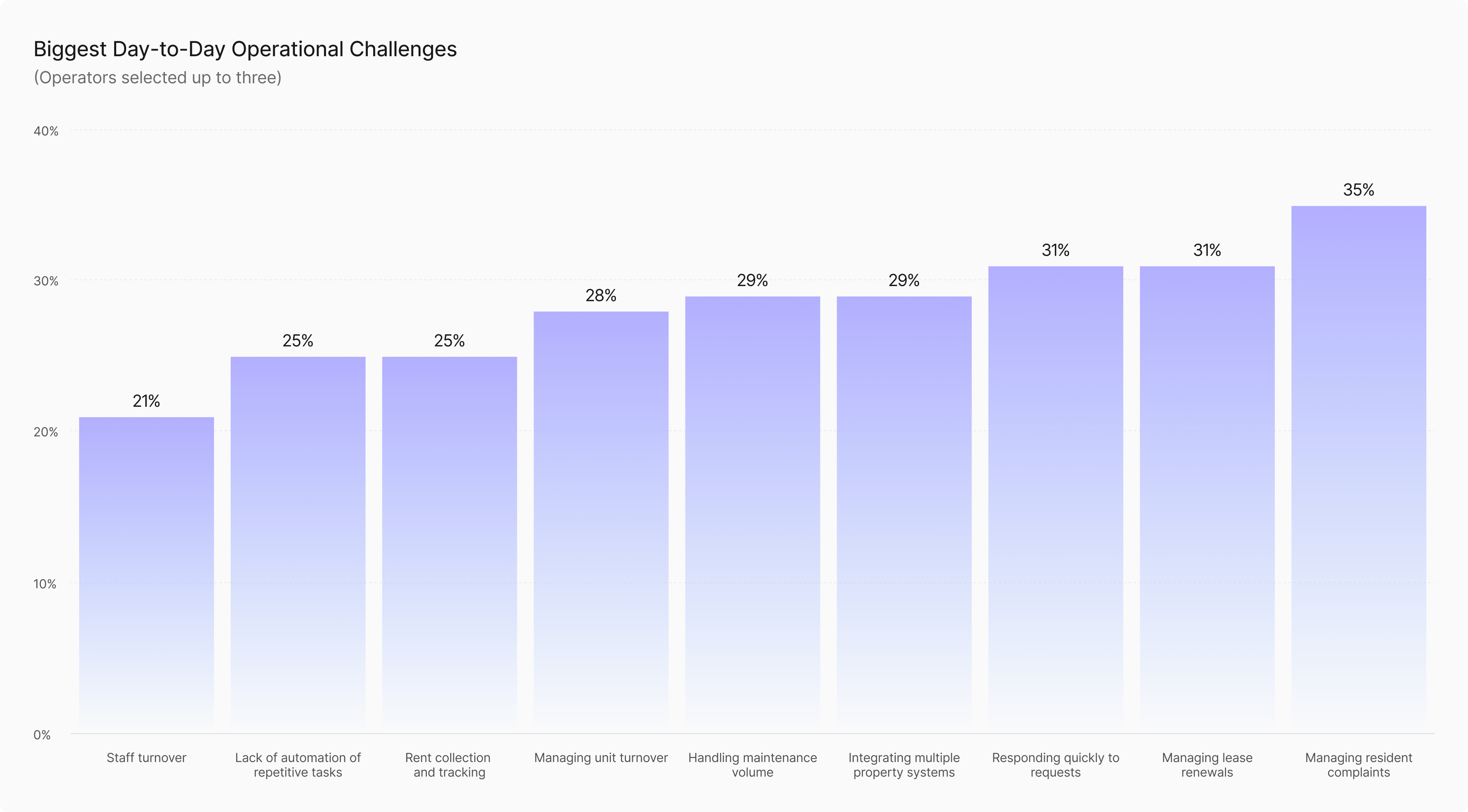
The third pressure is a workforce stretched too thin. To make the efficiency gains they are prioritizing, operators first have to clear a stack of familiar day-to-day challenges. As the chart above shows, no single day-to-day problem dominates, which means there's no easy fix. Teams are stretched thin everywhere, impacting their ability to follow up with residents and find moments to deliver exceptional experiences. Fixing one thing in one place rarely adds up to much.
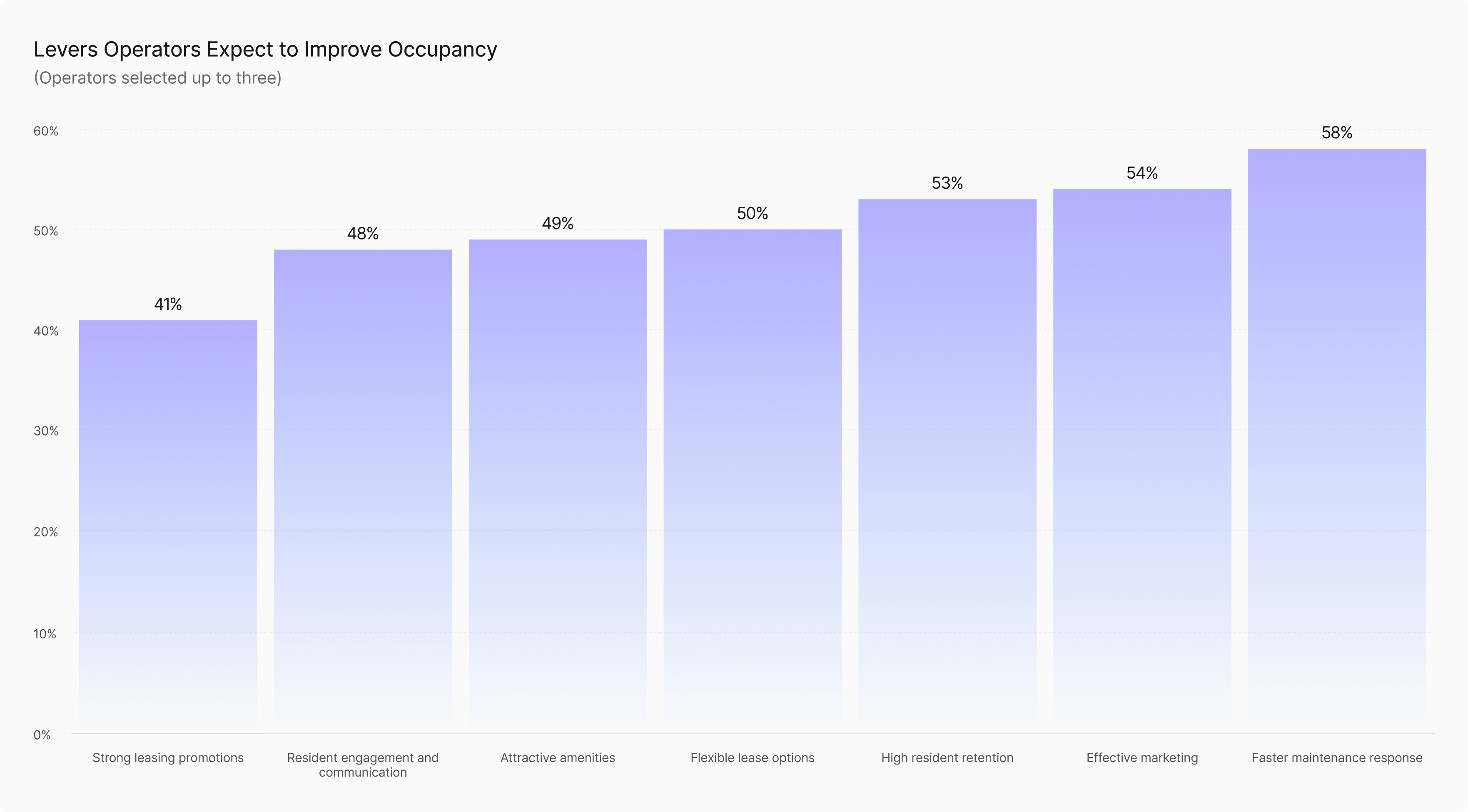
That same capacity problem shapes how operators plan to protect occupancy. The levers they expect to drive improved occupancy rates include faster replies to maintenance-related issues, better marketing strategies, higher resident retention rates, and improved resident communication. These have traditionally been highly manual, communication-heavy workflows, which is fueling conversations around handling them more effectively with AI.
The fourth pressure is steeper expectations from owners and renters alike. Owners expect asset performance, while renters demand around the clock service and reply times akin to what they receive in other modern digital consumer experiences. More specifically, 73% of renters now expect a response by the end of the same business day, and over 60% are now expecting at least some degree of 24/7 responsiveness. They are also shopping around in response to oversupply, with 61% contacting more than one community before they sign.

Considering internal challenges and external tension, the industry is being squeezed from multiple sides at once. With insurance and inflation driving costs up, new supply pressing down on rents, and mounting consumer expectations, onsite teams cannot stretch far enough to cover all of it, and operators continue to reach for AI as the most practical way to withstand the pressure.
Almost every operator now has AI, yet far fewer implement it deeply. The first move leading operators are making is to capitalize on that opportunity by turning AI into a system their operating model can rely on, rather than a siloed pilot in one corner of the business.
Last year's report captured operators' strong appetite for AI, but it may have under-indexed on how deeply teams had actually rebuilt their operations around the technology. The evidence is in the data: adoption looked near universal, yet full automation of any single workflow was rare. Only 14% had fully automated leasing end to end, even though it was the most common AI use case in the business. Resident and maintenance communications, two other leading use cases, followed the same pattern: widely used in some form, but rarely automated from end to end.

One year later, the market has shifted further along. 34% of operators have now fully embedded an AI solution into their daily operations, up from 24% a year ago. The progress is real but it still leaves most of the market running AI in a pilot or in partial usage. Having “some” AI has become the norm. Fully automating workflows end to end is not.
When we dig into what is holding operators back, teams are becoming more confident in AI but the challenge now lies in execution. After data privacy and compliance (39%), the following four blockers are: integrating AI with the existing tech stack (35%), budget constraints (32%), a shortage of in-house expertise (28%), and legacy technology limitations (28%). Only data privacy is doubt-driven, and even that is now a governance question rather than a fear of the unknown. The rest are the mechanics of scaling: making the tools work inside a live operation, paying to expand them across it, and finding the people to run them.
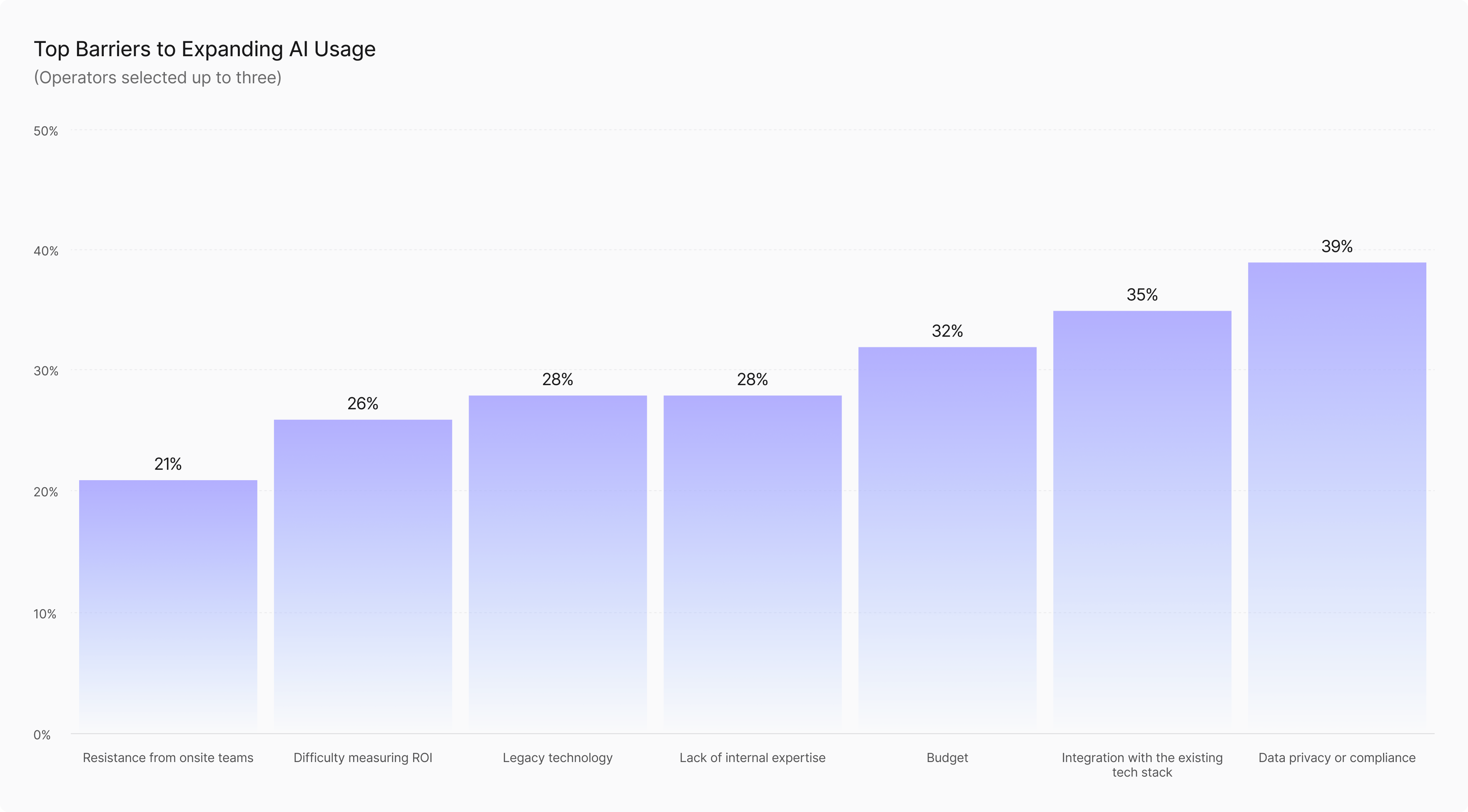
Integration challenges (35%) and legacy technology limitations (28%) both come down to the same problem, that AI has to run inside systems never built for it. Together, they make tech-stack friction the single most-cited theme, which will be covered in more depth later in this report. Similarly, budget constraints (32%) sit right beside them. Thus, even where operators are sold on AI, expanding it across a portfolio still competes for limited dollars, especially when working with tight margins. This exposes that the barrier to going deeper is rarely due to a lack of belief in AI. It is the cost and complexity of making it fit.
The other key blocker is internal capability. A shortage of in-house expertise was named by 28% of operators, yet a year ago nearly every operator surveyed was planning to train their teams to work alongside AI. The difficulty now is that the people doing the training are often just as new to the tools. With no established playbook to depend on, operators have had to learn as they go or lean on vendor partners to fill the gaps.
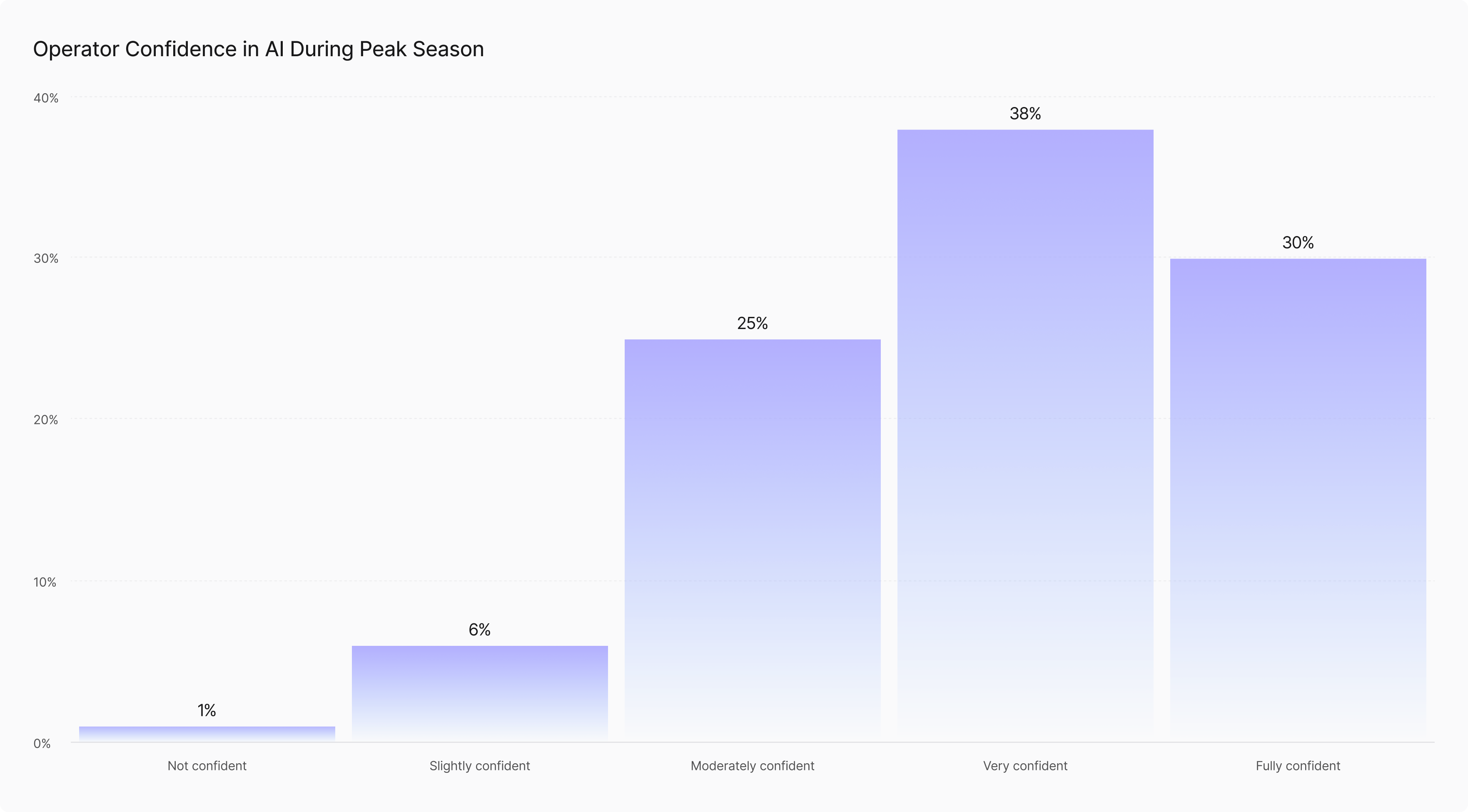
Even so, there is underlying conviction. 93% of operators using AI are confident it will perform during peak leasing season. The blockers to going deeper are now about execution, cost, integration, and training, rather than doubt about whether AI works. What is less clear is operators' willingness to go “all-in”, and it is those friction points that slow down large shifts in organizational design.
The second key divide between operators today is in how many parts of their operating models they’re reshaping with AI. The pattern is consistent: deploy AI in a few stages of the renter journey, leasing for example, measure the efficiency gains, then attempt to expand that impact across the lifecycle. There is no single agreed-upon playbook here. Some operators expand one stage at a time, others take on several at once. However, the direction among the most advanced operators is consistent. They have moved away from fragmented point-solutions and toward a more connected AI operating model, where the impact compounds.
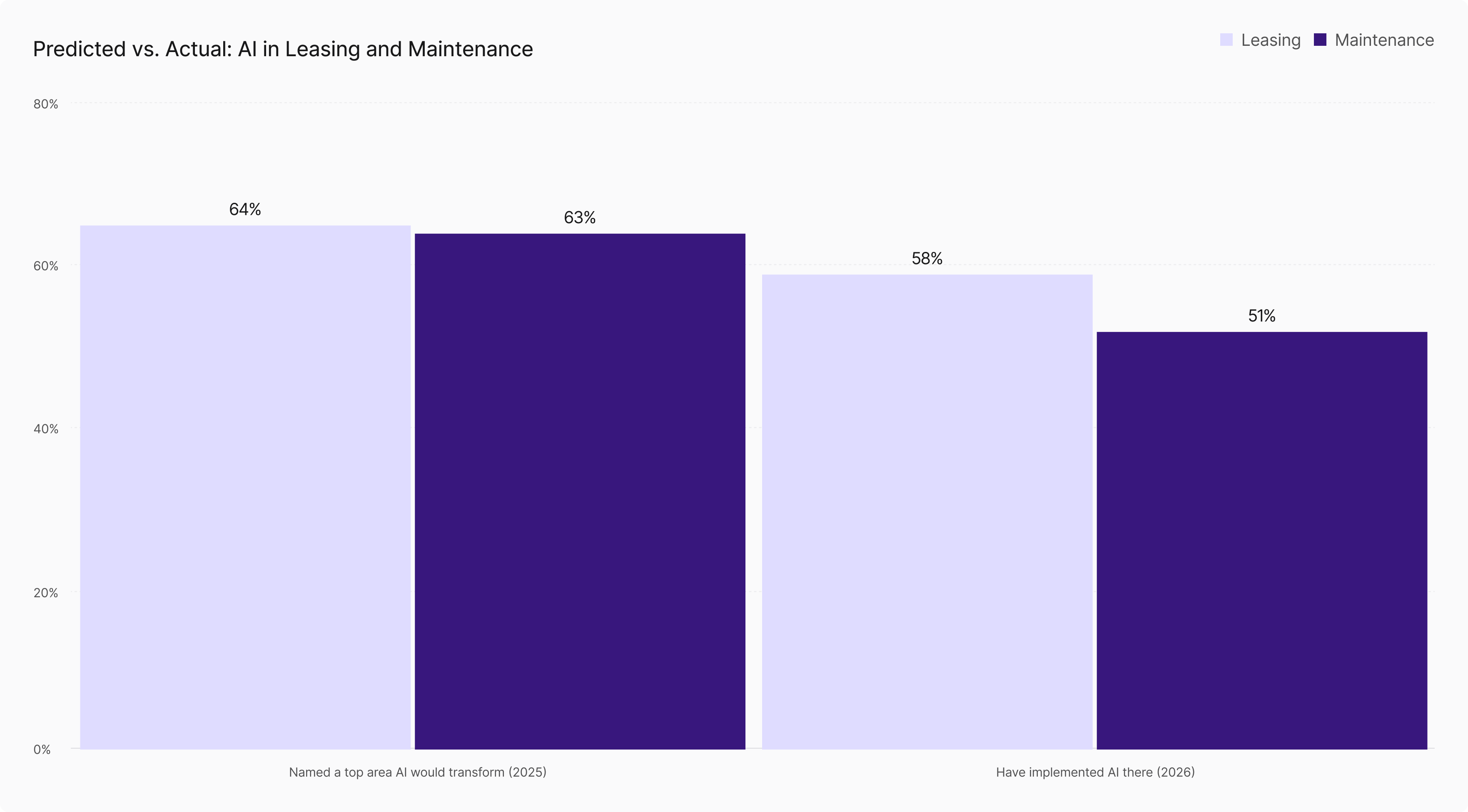
The 2025 report named leasing and maintenance as the two functions AI would change the most. AI delivered for leasing. As a natural place to begin due to the relative simplicity of leasing workflows, it is the most common area operators are using AI today. Maintenance was the prediction that operators got only partially correct. Operators believed it was a natural fit for AI, with rule-based triage logic, after-hours communication needs, and room for service improvement. However, the rollout has moved more slowly on the ground than expected, largely held up by the real friction of getting facilities teams and technicians to adopt new digital tools.
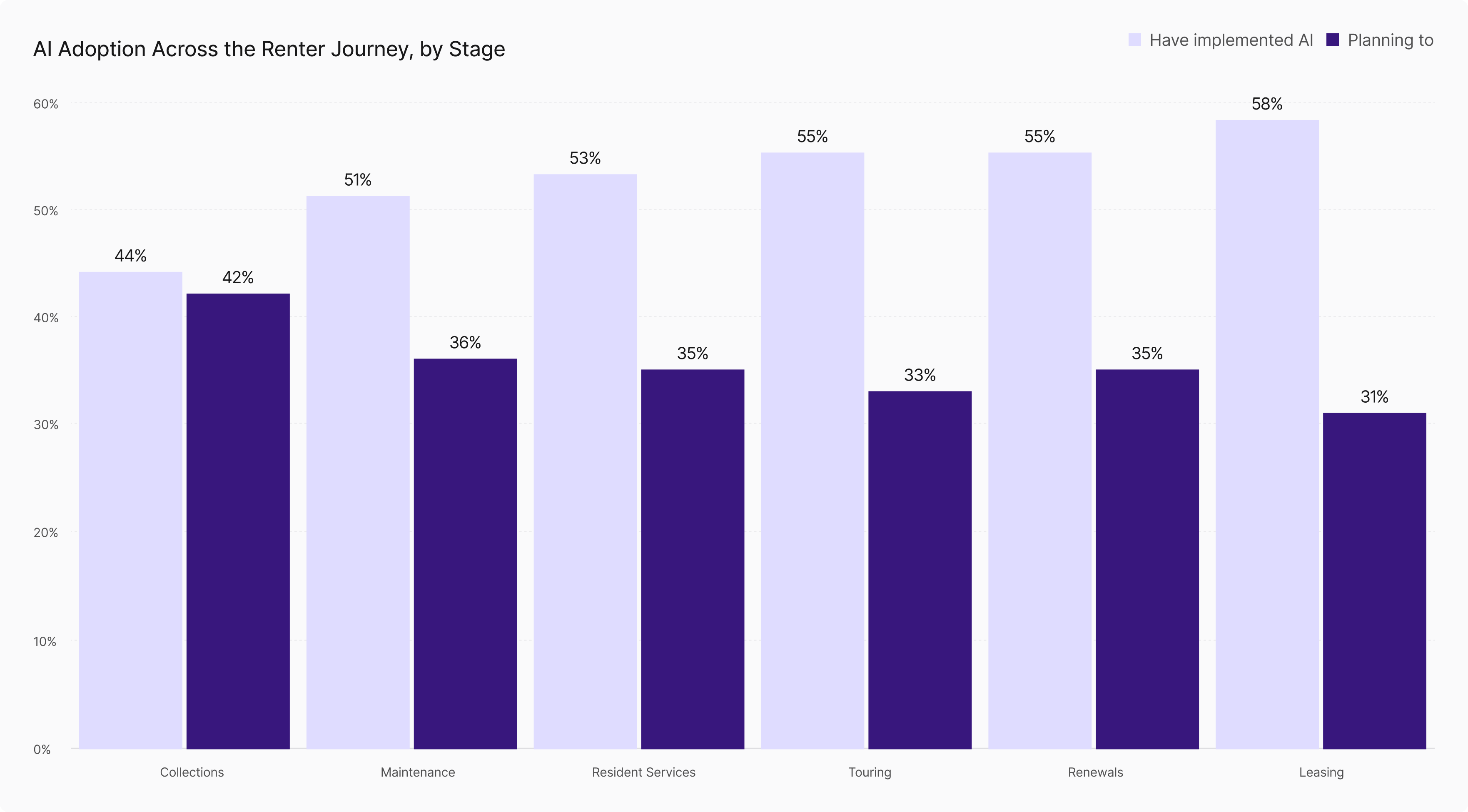
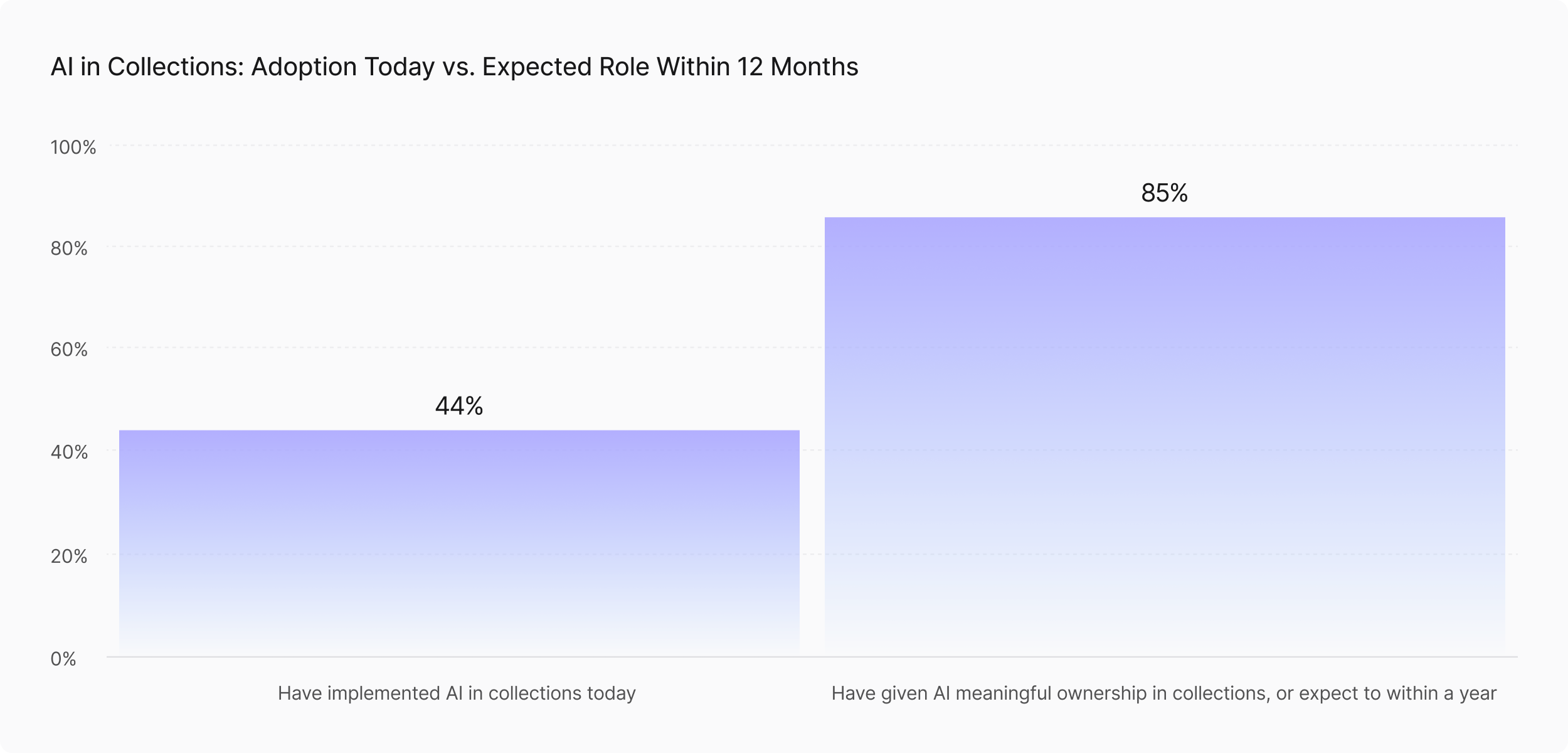
Across the full renter journey, AI usage thins out as you move from the front door to the back office, with the highest adoption rates in leasing and lowest in collections management. In many ways, collections is the clearest opportunity to drive ROI with AI. While it has the lowest adoption today, it also has the highest planned uptake of any stage. Additionally, 85% of operators using or planning to use AI reportedly expect to have given it meaningful ownership of collection processes within a year. They recognize that even marginal improvements in timely, fair, and consistent follow-up can have an outsized impact on NOI. Given the proximity of delinquency management to free cash flow, it’s expected that operators will move quickly given the tight economic climate.
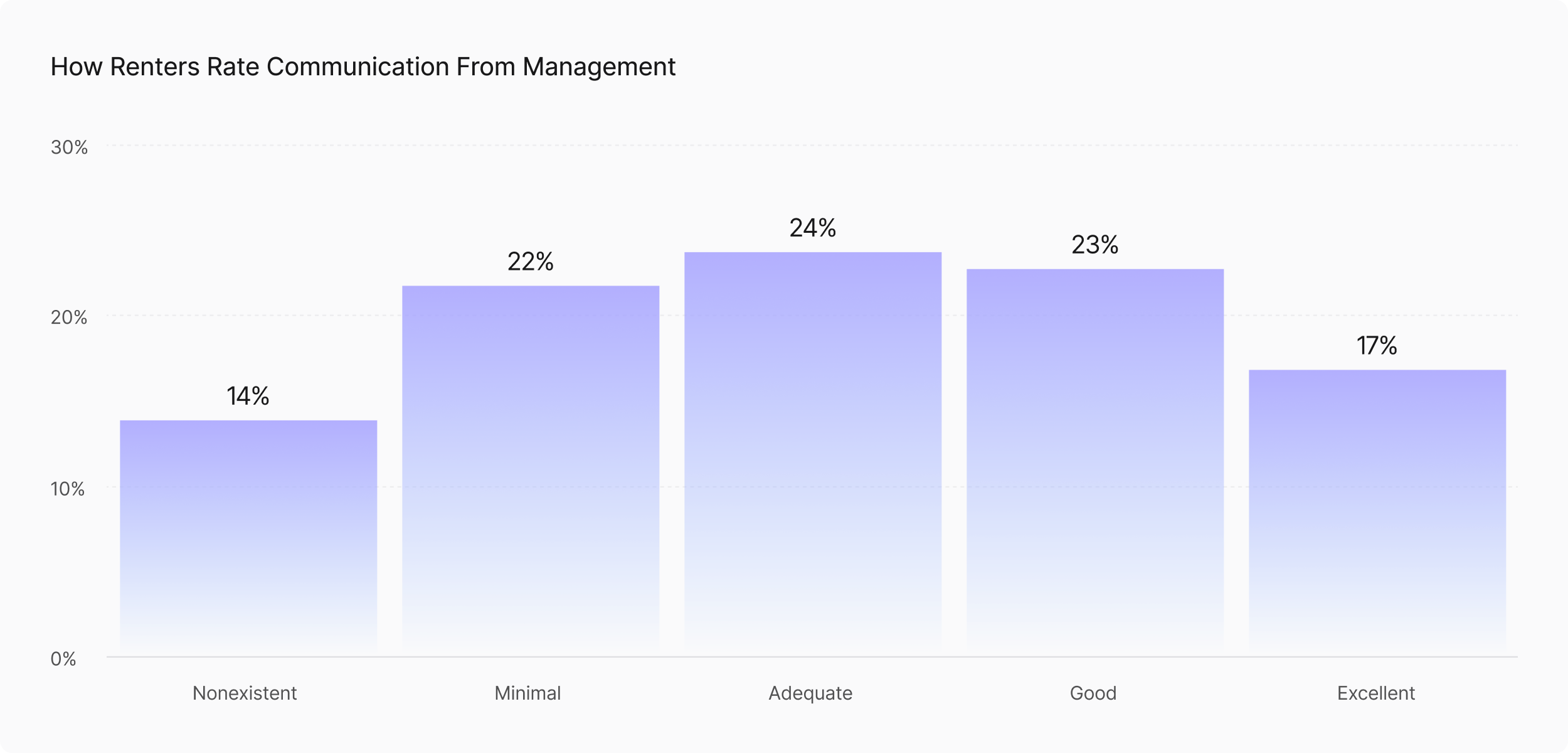
The cost of failing to deploy AI across the renter lifecycle shows up in real resident feedback. More specifically, 36% of residents surveyed describe the communication they get from management after moving in as minimal or nonexistent, 33% name maintenance quality and responsiveness as a critical factor in choosing their property, and 56% rate the digital experience at their community as average at best. These are not negligible concerns. They are the everyday moments where a stretched team goes quiet and a resident starts looking elsewhere. They are the exact moments where AI is best suited to support human teams.
Deeply integrating AI into internal workflows and also widely across the renter journey only creates value if those tools actually work together, and for many operators, they don't. As uncovered during the study, weak integrations, tools that are incompatible, and information that does not flow between systems all make true end-to-end automation impossible to reach. When a renter has to repeat themselves to a leasing assistant, a maintenance portal, and a payment app that know nothing about each other, the technology meant to make life easier suddenly becomes frustrating to navigate.
Over the past year, operators approached AI the way anyone solves problems under pressure: trying to fix one thing at a time. For many, that involved choosing an AI solution for leasing, then another for maintenance, then another for collections. Initially, that pattern presented as a momentum and a sign of how committed the industry had become in folding AI into their existing systems. However, with hindsight on our side, the disadvantages of building stacks of fragmented tools has become clear.
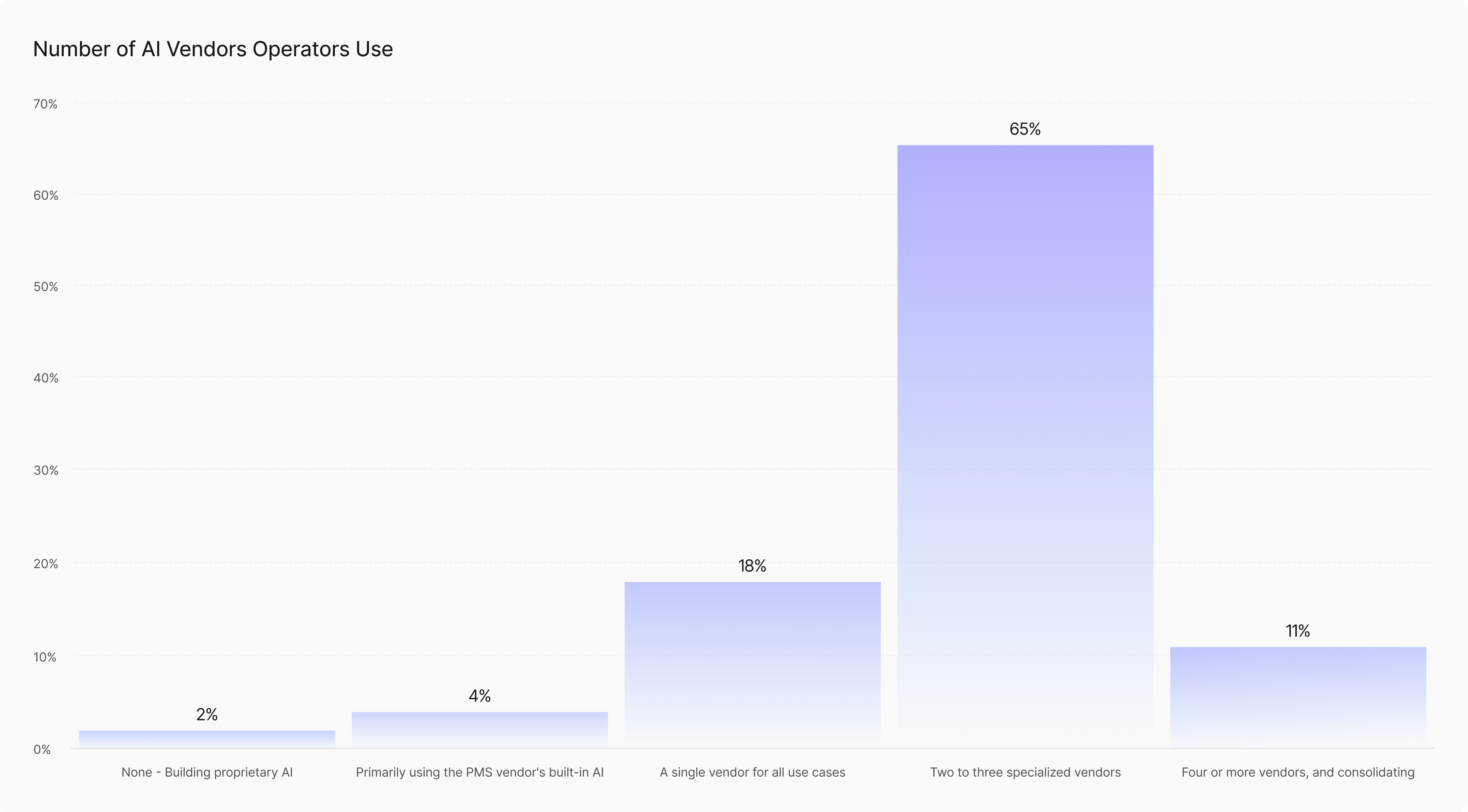
Today, only 22% of operators using AI rely on a single specialized vendor, with 4% of those leaning on the AI built into their PMS. The remaining 76% run two or more. For the latter, that patchwork carries a real daily cost that appears not on any single invoice, but in the hours staff must spend switching between systems, reconciling data by hand, and working around tools that do not share information. This was referenced earlier in the report, where behind data privacy and compliance, integrating these tools is the second most-cited barrier to expanding AI usage, flagged by 35% of operators. Similarly, 29% of operators surveyed name integrating their various property systems as one of their top three day-to-day frustrations, and 27% are now actively prioritizing consolidation to increase efficiency. In other words, the rapid exploration in 2025 has led to operational friction in 2026.

The consequences of fragmented systems are not only felt by the teams who use them, but ultimately result in a disjoined experience for residents. Thus, unsurprisingly, the most requested technology from renters is one app that handles everything. This is evidenced by the 29% of renters that cited “a single app” as the feature which would most improve their day-to-day experience. The modern renter craves a cohesive digital experience, rather than an amalgamation of tools that don’t talk to each other.

All of this raises the one question owners really care about: Does AI move the needle on NOI?
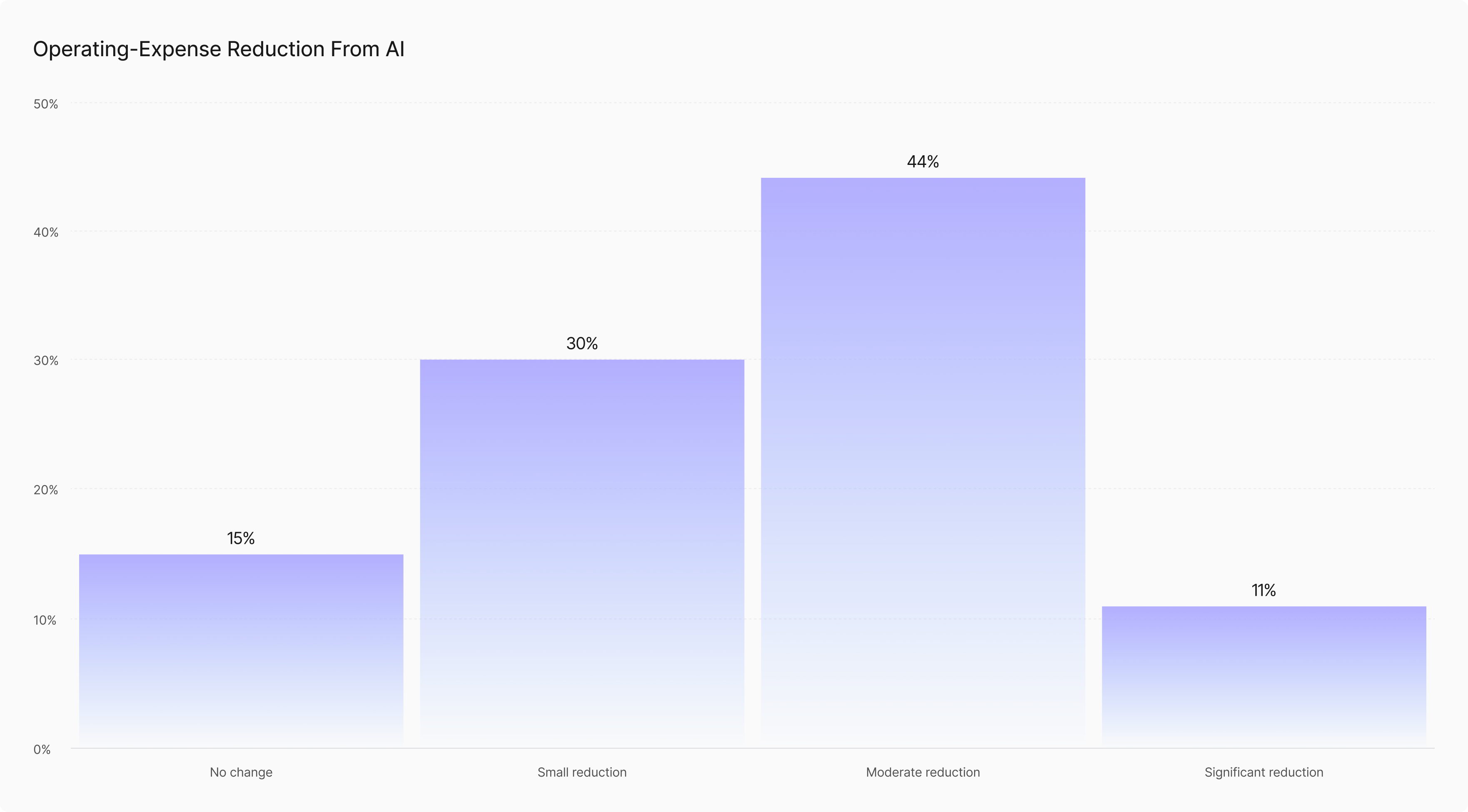
It does, but to what extent NOI is increased is where the two types of operators, as laid out at the beginning of this report, differ. The operators who simply “have” AI, and those who have rebuilt their systems around it. More specifically, 85% of operators with AI have reduced their operating expenses through their use of the technology. That is the headline, and it’s an encouraging one. However, the extent of that reduction is determined by their commitment to the implementation and scale of the technology, as shown throughout this report. Moderate to significant decreases in operating expenses as a result of AI were reported by 55% of operators, a reassuring sign, yet 30% are still only harnessing the technology well enough to capture slight reductions. The bottom-line is clear: most operators benefit from AI but only half are deploying the tools effectively enough to reap the full benefits of automation.
It’s worth noting that when we last ran this report, 77% of operators reported moderate or significant savings from AI. The lower proportion this year is not indicative of AI suddenly not working as well. It is the result of a wider, more representative market and a flood of new tools of varying efficacy. As more operators adopt the technology to different degrees, the gap between simply “having” AI and maximizing the impact of AI is clearly growing. The operators realizing greater savings are redesigning the way their teams work to squeeze the most they can from the tools, and their investments in them.
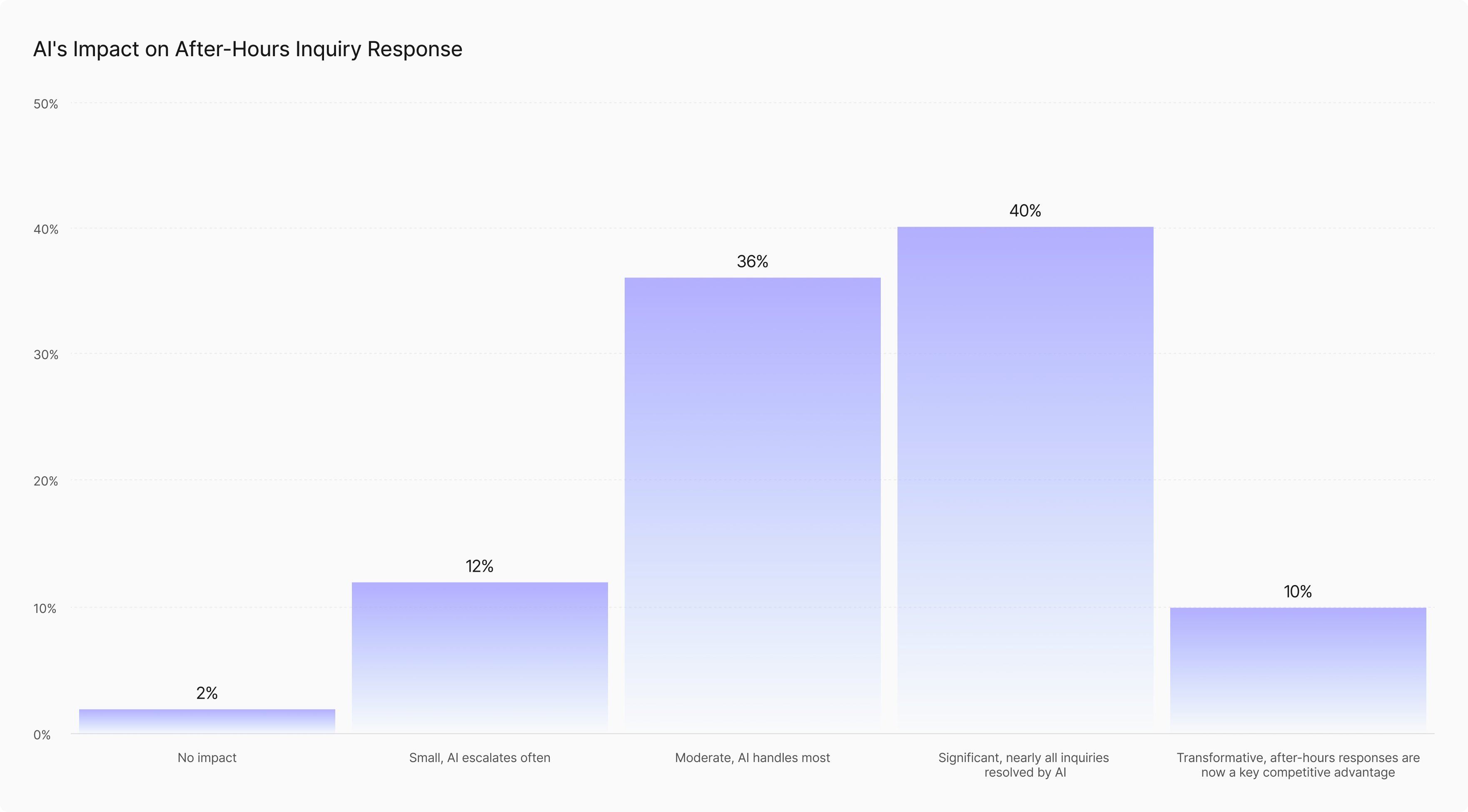
Our survey indicates the impact of AI shows up beyond P&L line items. It shows up in after hours coverage, when the leasing office is closed but the prospect/residents are reaching out expecting quick responses. This is made clear by the 86% of operators using AI who praise the improvement they’ve seen in how those inquiries are managed. The 2025 report noted that roughly half of prospect inquiries arrive after hours. Those leads used to sit unanswered until morning. With AI coverage, teams can open walk into the office with scheduled tours, not missed calls.
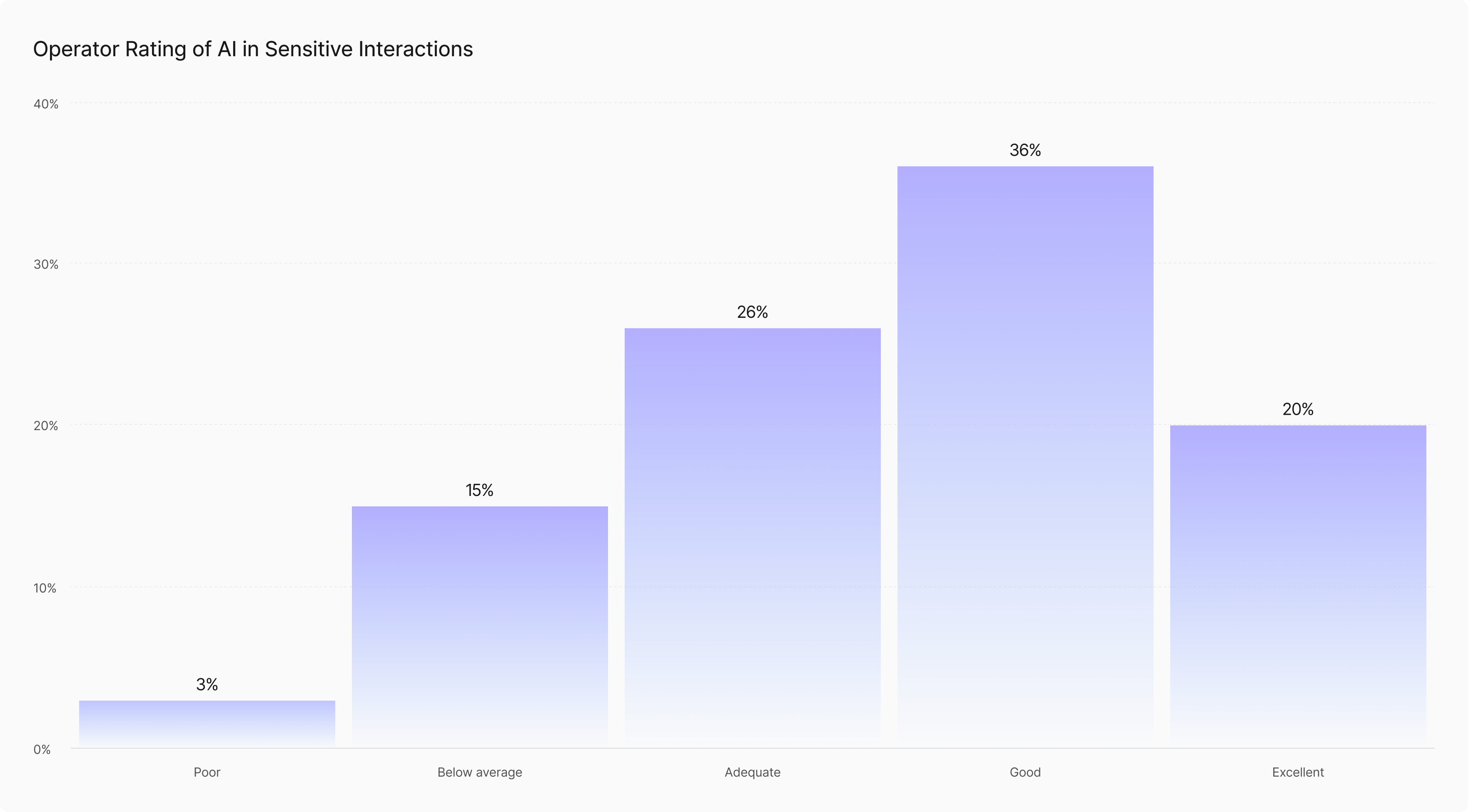
With scalable AI coverage across multiple resident and prospect channels, operators were initially concerned about the quality of the conversations being handled by their new AI agents. However, perhaps to the surprise of organizations a year ago, the 2026 data shows 82% of operators praising AI’s ability to manage highly nuanced and emotionally sensitive resident conversations—the kinds of interactions many operators assumed would always need a person. The positive sentiment around the conversation quality is the exact feedback teams need to expand across more of the renter lifecycle. With mounting evidence that AI agents can respectfully handle renter interactions, industry leaders are now looking to apply the same technology to their more sensitive resident communications, especially in collections and across affordable housing portfolios, as this report showed.
The operators pulling ahead are not just using better AI tools. They are rethinking their workflows and then restructuring their operating models around the new technology.
Last year, 82% of operators expected AI to take over several or many roles. The reality in year over year data collected tells a slightly different story. While 35% of operators have reorganized their onsite teams around AI, only a further 12% have moved to a fully centralized model. The pattern is redeployment, not replacement. With AI and centralization automating busywork, onsite staff can be freed from their administrative backlog and redouble their focus on creating outstanding experiences for their residents and prospects. With more time for high value work, operators have the ability to focus on standing out and protecting occupancy in competitive leasing environments.
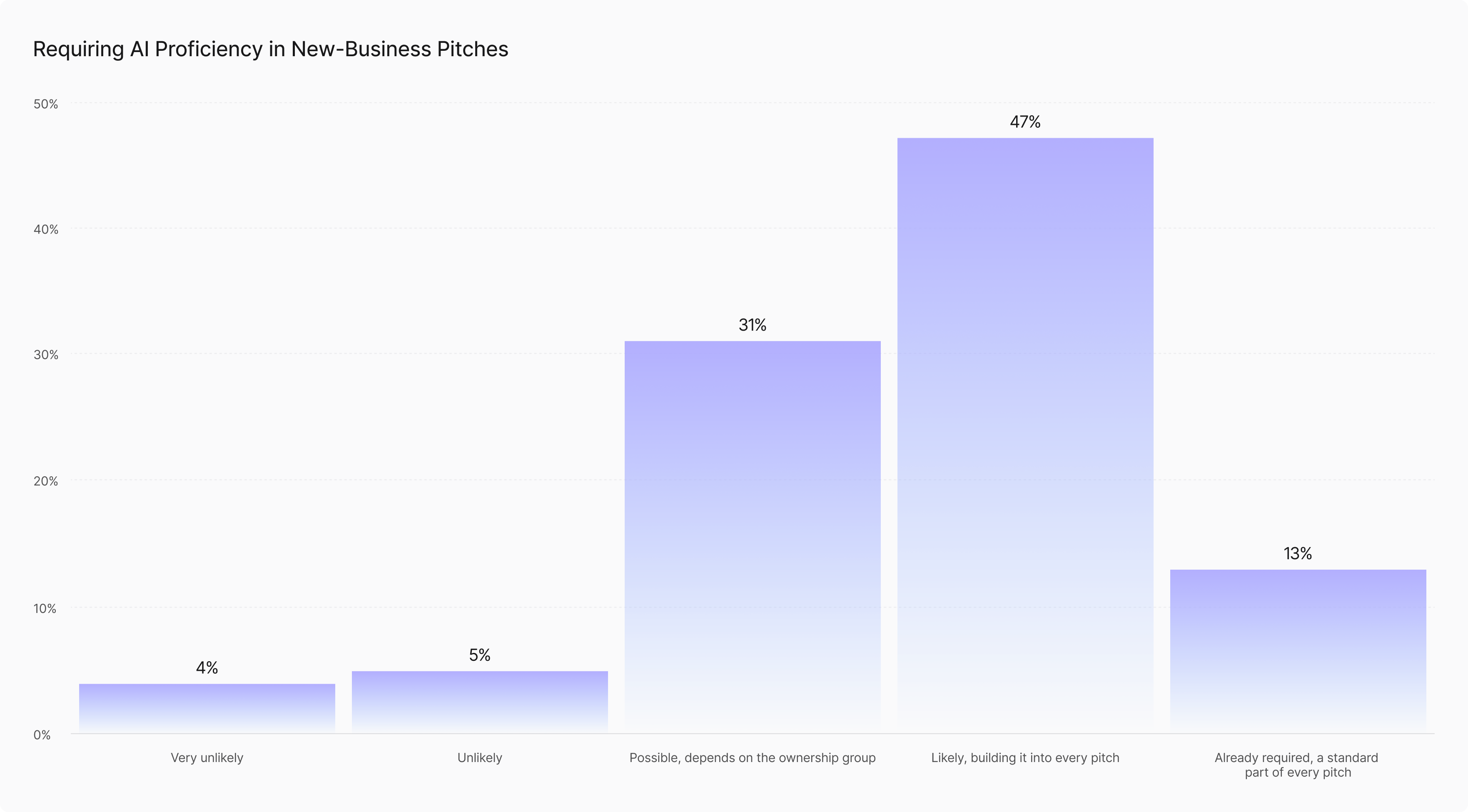
That same pressure to compete shows up at the highest level, when operators go after new business. Growing a portfolio means convincing ownership groups to give stewardship over their properties, and that decision is increasingly reliant on presenting compelling strategies around AI. Owners want to see exactly how the technology is going to reduce operating expenses, ideally alongside existing proof of it doing so already. The numbers confirm how far this has gone: only 9% of operators think AI is unlikely to be required in pitches to ownership groups, and 60% of operators already build it into every one they give. A year ago, AI was how you stood out. Now you cannot win the business without it.
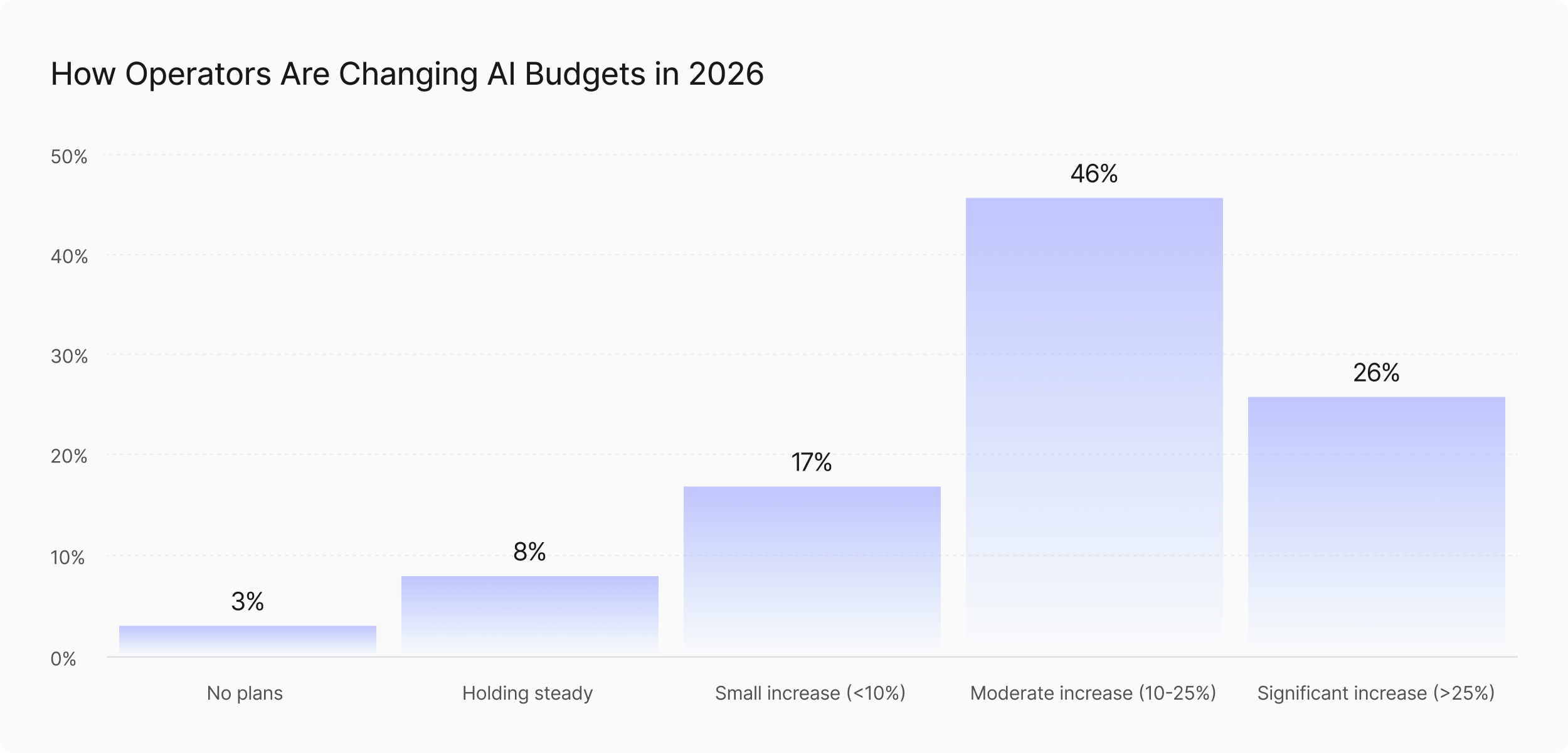
Winning that business is only the start. The cost savings an operator promises in a pitch have to be delivered every year they hold the contract, and shown again as proof in the next one. Consequently, the investment behind AI is not slowing. A year ago, a quarter of operators had committed to a multi-year AI budget. This dedication has continued in 2026, with 89% of operators allocating more budget to the technology year-over-year, and 72% doing so by a minimum of 10%.
This brings the story back to where it began, and the opportunity is clear: the operators who will win are the ones rebuilding their operating model around AI. That work takes many forms. For some, it means standing up specialized, central teams to manage AI handoffs at scale. For others, it means rethinking daily workflows to better reflect what onsite teams do now that more of their routine work is automated. A year ago, simply getting started with AI was enough to remain competitive in a tightening market. But, as shown throughout this report, just “having” AI is no longer sufficient. The operators pulling ahead in 2026 treat AI as a multi-year investment in NOI, not a line on this year's budget. They are building the depth, the breadth, and the connected foundation on which the technology’s benefits compound. They are transforming how workflows look end to end, and growing the divide between themselves and those with legacy operating models every quarter. They are reshaping their organizations to better capture the performance gains made possible with AI.
As budgets are set for the year ahead, the opportunities identified in this report can serve as a guide for operators who want to become AI-native organizations. Whether operators decide to keep up with the trajectory of the multifamily industry will be up to them. One thing is clear: change is not slowing down.
This report is based on a third-party survey of 350 U.S. multifamily decision-makers and 500 renters, conducted by an independent research firm in 2026. Questions about outcomes were asked of operators currently using AI (n=313), and questions about collections and delinquency were asked of operators using or planning to use AI (n=340). Year-over-year comparisons reference the 2025 State of AI in Multifamily report, a survey of 280 U.S. operators conducted with the same methodology. Survey data is the source of every figure in this report. Where operator and renter conversations are referenced, they are treated as supporting color rather than primary evidence.
A year ago, the 2025 edition of this report highlighted a widening gap among operators. It argued that there was no longer a question around whether AI would see mass adoption in multifamily, and that the operators who were on board early would get ahead. A year later, almost everyone has moved on the technology. Nearly nine in ten operators have deployed AI into their operating models, and the old dividing line between the companies that use it and those that do not has mostly disappeared.
However, the AI divide between operators did not vanish. It simply moved. Now that almost every operator has some level of access to AI, the disparity no longer runs between the companies that have it and those that do not. It exists between operators who have simply layered AI on top of current workflows, and the teams rebuilding their operations and day-to-day areas of focus around the technology. Last year, two thirds of operators believed the early movers would gain a permanent advantage. They were right that an advantage opened, but it is now the operators reinventing how they run that are pulling ahead in 2026.
In 2026, 89% of operators have introduced AI to some degree, but only 34% feel they have fully deployed it. The rest are still piloting or partially using it. The encouraging signal is the trajectory: 34% is up from 24% a year ago, which is an increase of almost half in twelve months. The market is steadily moving toward product depth, not just surface-level adoption.
The other aspect that has changed is conviction. In 2025, only about half of operators (51%) felt the industry was still underestimating AI, a sign the market was split on the extent to which it really mattered. That hesitation has largely evaporated, as 89% are now increasing their AI investment year over year, and a quarter of all operators are raising the dedicated budget by over 25%. The conversation has clearly moved past whether AI belongs in multifamily and onto a harder question from operators: Do we simply “have AI”, or are redesigning our operating models around the strengths of the tools? If not, how do we get comfortable enough to take the plunge? Therefore, the rest of this report explores where opportunities are showing up and the importance of further embracing AI in 2026.
If the multifamily AI story in 2025 was about not falling behind, the story in 2026 is about using AI to protect and improve margins against real economic headwinds. There are four key pressures: rising costs, new supply, a stretched workforce, and steeper expectations from owners and renters alike.
Starting with rising costs, 89% of operators expect insurance to rise at least moderately this year, and 50% are bracing for significant or severe increases. At the same time, 57% are concerned that new supply will weigh on rents.
The second pressure, new supply, turns those rising costs into a competition problem. With more units coming online and renters weighing their options, operators cannot always simply raise rents to cover higher expenses; they have to work harder to keep their current properties full. In response to the squeeze, operators are not chasing a single fix. As the most recent chart shows, improving operational efficiency tops the list at 57%. However, it sits right alongside reducing operating expenses through technology (49%), investing in resident retention (44%), and sharpening marketing spend (39%). The common thread is doing more with the same resources, which is exactly where AI is most valuable.
The third pressure is a workforce stretched too thin. To make the efficiency gains they are prioritizing, operators first have to clear a stack of familiar day-to-day challenges. As the chart above shows, no single day-to-day problem dominates, which means there's no easy fix. Teams are stretched thin everywhere, impacting their ability to follow up with residents and find moments to deliver exceptional experiences. Fixing one thing in one place rarely adds up to much.
That same capacity problem shapes how operators plan to protect occupancy. The levers they expect to drive improved occupancy rates include faster replies to maintenance-related issues, better marketing strategies, higher resident retention rates, and improved resident communication. These have traditionally been highly manual, communication-heavy workflows, which is fueling conversations around handling them more effectively with AI.
The fourth pressure is steeper expectations from owners and renters alike. Owners expect asset performance, while renters demand around the clock service and reply times akin to what they receive in other modern digital consumer experiences. More specifically, 73% of renters now expect a response by the end of the same business day, and over 60% are now expecting at least some degree of 24/7 responsiveness. They are also shopping around in response to oversupply, with 61% contacting more than one community before they sign.
Considering internal challenges and external tension, the industry is being squeezed from multiple sides at once. With insurance and inflation driving costs up, new supply pressing down on rents, and mounting consumer expectations, onsite teams cannot stretch far enough to cover all of it, and operators continue to reach for AI as the most practical way to withstand the pressure.
Almost every operator now has AI, yet far fewer implement it deeply. The first move leading operators are making is to capitalize on that opportunity by turning AI into a system their operating model can rely on, rather than a siloed pilot in one corner of the business.
Last year's report captured operators' strong appetite for AI, but it may have under-indexed on how deeply teams had actually rebuilt their operations around the technology. The evidence is in the data: adoption looked near universal, yet full automation of any single workflow was rare. Only 14% had fully automated leasing end to end, even though it was the most common AI use case in the business. Resident and maintenance communications, two other leading use cases, followed the same pattern: widely used in some form, but rarely automated from end to end.
One year later, the market has shifted further along. 34% of operators have now fully embedded an AI solution into their daily operations, up from 24% a year ago. The progress is real but it still leaves most of the market running AI in a pilot or in partial usage. Having “some” AI has become the norm. Fully automating workflows end to end is not.
When we dig into what is holding operators back, teams are becoming more confident in AI but the challenge now lies in execution. After data privacy and compliance (39%), the following four blockers are: integrating AI with the existing tech stack (35%), budget constraints (32%), a shortage of in-house expertise (28%), and legacy technology limitations (28%). Only data privacy is doubt-driven, and even that is now a governance question rather than a fear of the unknown. The rest are the mechanics of scaling: making the tools work inside a live operation, paying to expand them across it, and finding the people to run them.
Integration challenges (35%) and legacy technology limitations (28%) both come down to the same problem, that AI has to run inside systems never built for it. Together, they make tech-stack friction the single most-cited theme, which will be covered in more depth later in this report. Similarly, budget constraints (32%) sit right beside them. Thus, even where operators are sold on AI, expanding it across a portfolio still competes for limited dollars, especially when working with tight margins. This exposes that the barrier to going deeper is rarely due to a lack of belief in AI. It is the cost and complexity of making it fit.
The other key blocker is internal capability. A shortage of in-house expertise was named by 28% of operators, yet a year ago nearly every operator surveyed was planning to train their teams to work alongside AI. The difficulty now is that the people doing the training are often just as new to the tools. With no established playbook to depend on, operators have had to learn as they go or lean on vendor partners to fill the gaps.
Even so, there is underlying conviction. 93% of operators using AI are confident it will perform during peak leasing season. The blockers to going deeper are now about execution, cost, integration, and training, rather than doubt about whether AI works. What is less clear is operators' willingness to go “all-in”, and it is those friction points that slow down large shifts in organizational design.
The second key divide between operators today is in how many parts of their operating models they’re reshaping with AI. The pattern is consistent: deploy AI in a few stages of the renter journey, leasing for example, measure the efficiency gains, then attempt to expand that impact across the lifecycle. There is no single agreed-upon playbook here. Some operators expand one stage at a time, others take on several at once. However, the direction among the most advanced operators is consistent. They have moved away from fragmented point-solutions and toward a more connected AI operating model, where the impact compounds.
The 2025 report named leasing and maintenance as the two functions AI would change the most. AI delivered for leasing. As a natural place to begin due to the relative simplicity of leasing workflows, it is the most common area operators are using AI today. Maintenance was the prediction that operators got only partially correct. Operators believed it was a natural fit for AI, with rule-based triage logic, after-hours communication needs, and room for service improvement. However, the rollout has moved more slowly on the ground than expected, largely held up by the real friction of getting facilities teams and technicians to adopt new digital tools.
Across the full renter journey, AI usage thins out as you move from the front door to the back office, with the highest adoption rates in leasing and lowest in collections management. In many ways, collections is the clearest opportunity to drive ROI with AI. While it has the lowest adoption today, it also has the highest planned uptake of any stage. Additionally, 85% of operators using or planning to use AI reportedly expect to have given it meaningful ownership of collection processes within a year. They recognize that even marginal improvements in timely, fair, and consistent follow-up can have an outsized impact on NOI. Given the proximity of delinquency management to free cash flow, it’s expected that operators will move quickly given the tight economic climate.
The cost of failing to deploy AI across the renter lifecycle shows up in real resident feedback. More specifically, 36% of residents surveyed describe the communication they get from management after moving in as minimal or nonexistent, 33% name maintenance quality and responsiveness as a critical factor in choosing their property, and 56% rate the digital experience at their community as average at best. These are not negligible concerns. They are the everyday moments where a stretched team goes quiet and a resident starts looking elsewhere. They are the exact moments where AI is best suited to support human teams.
Deeply integrating AI into internal workflows and also widely across the renter journey only creates value if those tools actually work together, and for many operators, they don't. As uncovered during the study, weak integrations, tools that are incompatible, and information that does not flow between systems all make true end-to-end automation impossible to reach. When a renter has to repeat themselves to a leasing assistant, a maintenance portal, and a payment app that know nothing about each other, the technology meant to make life easier suddenly becomes frustrating to navigate.
Over the past year, operators approached AI the way anyone solves problems under pressure: trying to fix one thing at a time. For many, that involved choosing an AI solution for leasing, then another for maintenance, then another for collections. Initially, that pattern presented as a momentum and a sign of how committed the industry had become in folding AI into their existing systems. However, with hindsight on our side, the disadvantages of building stacks of fragmented tools has become clear.
Today, only 22% of operators using AI rely on a single specialized vendor, with 4% of those leaning on the AI built into their PMS. The remaining 76% run two or more. For the latter, that patchwork carries a real daily cost that appears not on any single invoice, but in the hours staff must spend switching between systems, reconciling data by hand, and working around tools that do not share information. This was referenced earlier in the report, where behind data privacy and compliance, integrating these tools is the second most-cited barrier to expanding AI usage, flagged by 35% of operators. Similarly, 29% of operators surveyed name integrating their various property systems as one of their top three day-to-day frustrations, and 27% are now actively prioritizing consolidation to increase efficiency. In other words, the rapid exploration in 2025 has led to operational friction in 2026.
The consequences of fragmented systems are not only felt by the teams who use them, but ultimately result in a disjoined experience for residents. Thus, unsurprisingly, the most requested technology from renters is one app that handles everything. This is evidenced by the 29% of renters that cited “a single app” as the feature which would most improve their day-to-day experience. The modern renter craves a cohesive digital experience, rather than an amalgamation of tools that don’t talk to each other.


